


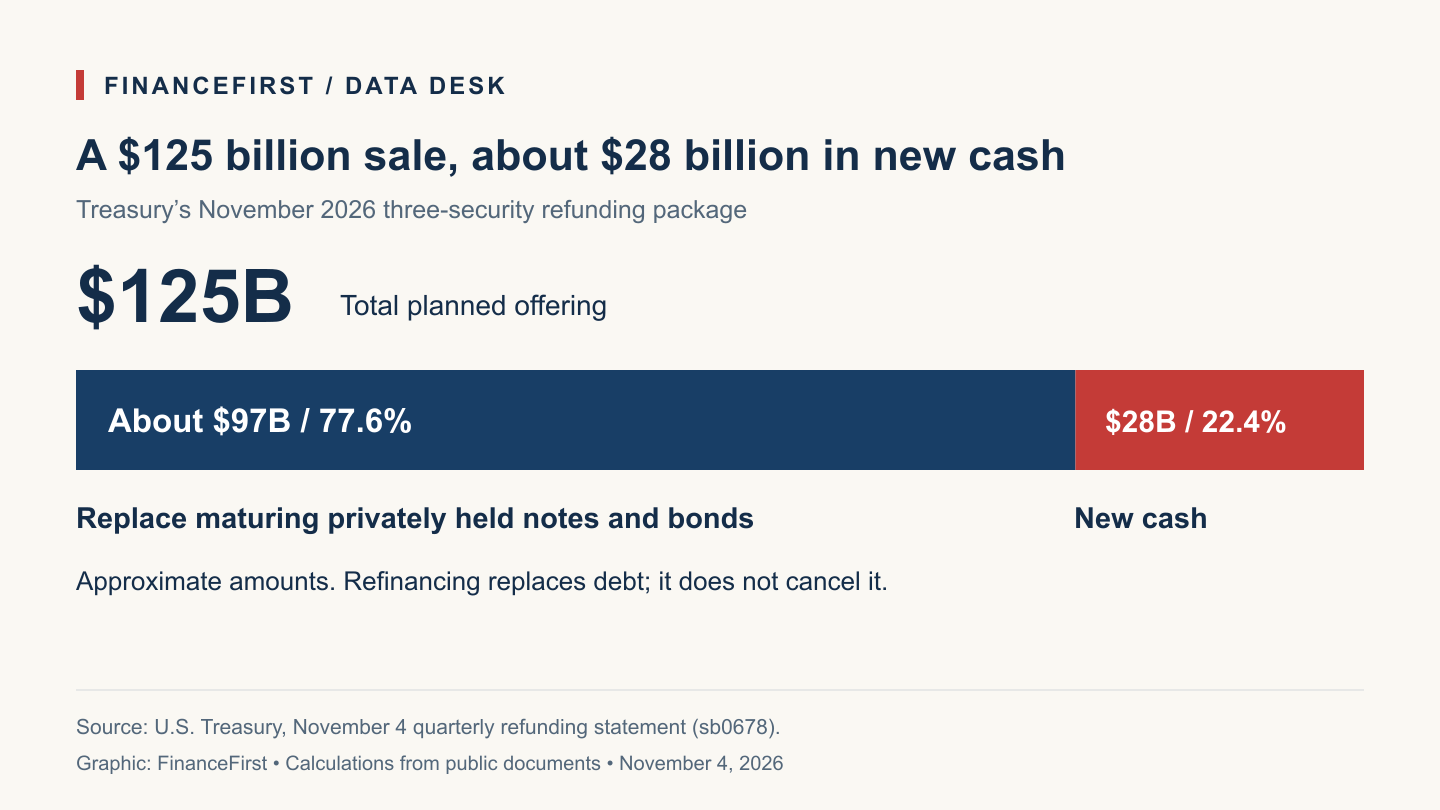
The U.S. Treasury plans to sell $125 billion of securities next week, with roughly four-fifths of the offering replacing debt that is coming due. About $28 billion will raise new cash, according to its November 4 quarterly refunding statement.
The distinction matters beyond Washington. Government borrowing helps shape the bond market in which mortgage lenders, companies and savers operate. But the amount announced for sale is neither the increase in national debt nor a decision about the interest rate a household will pay.
FinanceFirst’s calculation of Treasury’s monthly auction table shows another important distinction: the planned nominal-note, nominal-bond and floating-rate offerings total $1.04 trillion for November through January, unchanged from the corresponding August–October total. That is gross issuance for selected securities, not net borrowing.
Most of the sale rolls over existing debt
Treasury will offer a $58 billion three-year note, a $42 billion ten-year note and a $25 billion thirty-year bond. Together, they will replace approximately $97 billion of privately held Treasury notes and bonds maturing on November 15.
$125 billion offered − approximately $97 billion maturing = approximately $28 billion in new cash. Using Treasury’s rounded amounts, the refinancing share is 77.6%, or about 78%.
Scroll sideways to see every column.
Security | Offering | Auction date | Maturity |
|---|---|---|---|
Three-year note | $58 billion | November 9, 2026 | November 15, 2029 |
Ten-year note | $42 billion | November 10, 2026 | November 15, 2036 |
Thirty-year bond | $25 billion | November 12, 2026 | November 15, 2056 |
Source: Treasury refunding statement. All three auctions are scheduled for 1 p.m. Eastern, with settlement on November 16. Their auction yields have yet to be determined.
Refinancing is a routine part of managing government debt, but it still has a cost. As obligations mature, Treasury must obtain replacement funding at the prices investors will accept. This announcement alone does not establish whether the replacement debt will be cheaper or more expensive than the securities it replaces.
The broader auction schedule is unchanged
To put the headline sale in context, FinanceFirst summed each column in Treasury’s published monthly table. The result is $954 billion in nominal notes and bonds plus $86 billion in floating-rate notes in each three-month period.
Scroll sideways to see every column.
Security | Aug–Oct 2026 actual ($B) | Nov 2026–Jan 2027 planned ($B) | Change ($B) |
|---|---|---|---|
Two-year notes | 207 | 207 | 0 |
Three-year notes | 174 | 174 | 0 |
Five-year notes | 210 | 210 | 0 |
Seven-year notes | 132 | 132 | 0 |
Ten-year notes | 120 | 120 | 0 |
Twenty-year bonds | 42 | 42 | 0 |
Thirty-year bonds | 69 | 69 | 0 |
Floating-rate notes | 86 | 86 | 0 |
Total | 1,040 | 1,040 | 0 |
Source: Treasury’s November 4 monthly auction-size table; quarterly sums by FinanceFirst. This comparison excludes Treasury bills and inflation-protected securities and does not deduct maturing debt. The $125 billion refunding package is already part of the broader program; adding it to $1.04 trillion would double count that issuance.
The periods also differ from Treasury’s latest net-borrowing forecast, which covers October–December. A November–January gross-issuance total cannot be directly compared with an October–December net-borrowing estimate.
A lower borrowing estimate, driven by opening cash
On November 2, Treasury forecast $618 billion in October–December privately held net marketable borrowing, $10 billion below its August estimate. Its assumed end-of-December cash balance remains $850 billion.
The reduction needs context. Treasury entered the quarter with $984 billion in cash, versus an earlier assumption of $950 billion. That $34 billion cushion reduced borrowing needs. Other projected changes offset $24 billion of the benefit, leaving a net reduction of $10 billion.
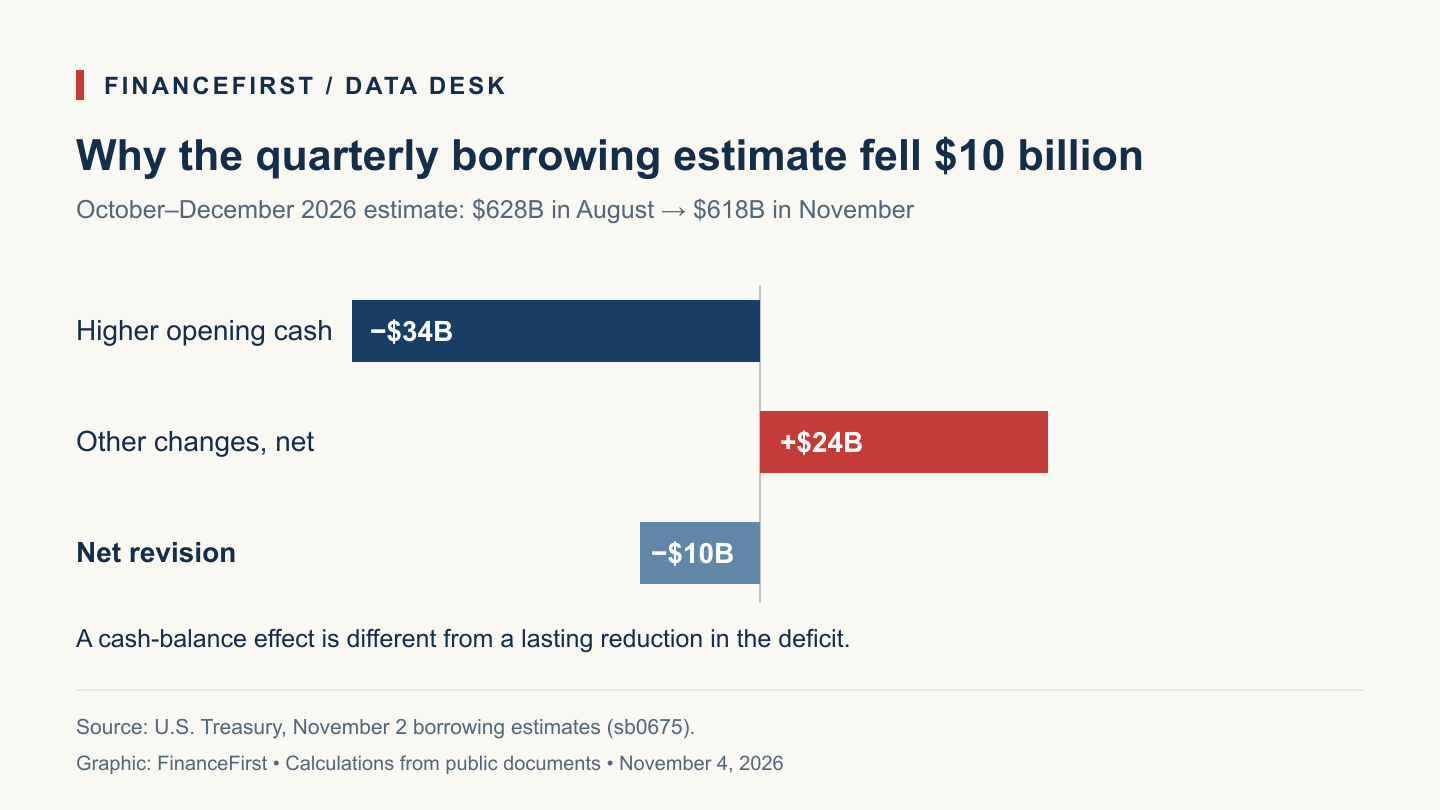
Treasury itself says that, excluding the higher opening cash balance, the quarter’s borrowing estimate would be $24 billion above the August forecast. The lower headline therefore does not, by itself, demonstrate an improvement in the underlying budget position. Available cash and an enduring change in revenue or spending are different things.
What borrowers and savers can infer
Mortgage borrowers: look at the offer, not just the announcement
Treasury yields are an important reference point for mortgage pricing. They are only part of the price. As the Federal Reserve Bank of St. Louis explains, longer-term expectations and the mortgage spread also matter. The spread incorporates compensation for mortgage risks, costs and lender margins.
Keeping auction sizes steady does not lock in yields. Inflation expectations, demand for bonds and expectations of future monetary policy can still change. Nor would a fall in Treasury yields necessarily pass through one-for-one to a mortgage quote.
To show the household sensitivity, FinanceFirst calculated three hypothetical payments on the same $300,000, thirty-year fixed-rate loan:
Scroll sideways to see every column.
Assumed annual rate | Monthly principal and interest |
|---|---|
6.00% | $1,798.65 |
6.50% | $1,896.20 |
7.00% | $1,995.91 |
At 6.00% rather than 6.50%, the payment would be approximately $97.55 lower each month. These are scenarios, not current offers or predictions about this announcement. They exclude property taxes, homeowners and mortgage insurance, association fees and closing costs.
The Consumer Financial Protection Bureau recommends comparing Loan Estimates. A lower quoted rate may involve upfront points, so fees and cash due at closing belong in the comparison. Existing fixed-rate mortgage contracts do not reset merely because market yields move.
Savers and bondholders: distinguish yield from resale value
The schedule identifies upcoming securities, but not their final auction yields. A savings account’s rate is also not set by this refunding announcement.
For an existing fixed-rate bond, promised payments and resale value are separate. Prices generally move inversely to market yields. Someone who needs to sell before maturity can face a loss even though the security’s scheduled payments have not changed. The timing of a cash need therefore matters alongside the quoted yield.
As a simple illustration, half a percentage point on $10,000 equals $50 over one year before tax, using simple interest. That is arithmetic about rate sensitivity, not a forecast of deposit returns. Our guide to short-term cash options explains the differences in access and risk.
Institutions: steady near-term supply, unresolved future needs
For banks, funds and other bond investors, the unchanged schedule offers clarity about Treasury’s near-term issuance plan. It does not remove interest-rate risk or settle the question of future supply.
The minutes of the Treasury Borrowing Advisory Committee’s November 3 meeting, released November 4, say members viewed increases in coupon auction sizes as likely appropriate in the second half of fiscal 2027. Treasury, meanwhile, says it anticipates keeping nominal coupon and floating-rate auction sizes steady for the next several quarters. The committee advises; Treasury determines the announced plan. Neither statement is a guarantee about all future auctions.
A real structural change starts in March
Treasury plans to switch seven-year notes from a new issue every month to quarterly new issues, each followed by two reopenings. New securities would be auctioned in March, June, September and December; the subsequent two months would add to the existing issue. Monthly auctions will continue.
The change begins with the March 2027 issue, followed by April and May reopenings. TreasuryDirect explains that a reopening retains the original coupon and maturity date, with a new issue date and usually a different purchase price. Buyers should check those terms rather than assume a reopened note starts a fresh seven-year life.
What to watch next
November 9, 10 and 12: the scheduled auctions will establish accepted yields and prices for this package. One auction cannot, on its own, establish a lasting market trend.
December and January: Treasury anticipates reducing shorter-dated bill auction sizes in December and increasing sizes across the bill curve in January, depending on seasonal cash flows. Steady coupon issuance does not mean all financing is unchanged.
February 3, 2027: the next scheduled quarterly refunding announcement will provide another financing update.
March 2027: the planned seven-year issuance transition begins.
Methodology and limitations
FinanceFirst checked the announced figures against Treasury’s November 4 refunding statement, its November 2 borrowing estimates and the advisory-committee minutes released November 4. The analysis uses public documents; no interviews were conducted. It does not claim an independently measured market reaction.
Quarterly auction totals sum the three monthly entries for each security in Treasury’s table. Refinancing shares divide approximately $97 billion and $28 billion by $125 billion. The cash revision is −$34 billion + $24 billion = −$10 billion.
Mortgage payments use P × r ÷ [1 − (1 + r)−n], where P is $300,000, r is the annual assumed rate divided by twelve, and n is 360 monthly payments. Payments are rounded to cents; the difference is calculated before rounding. Forecasts and schedules are attributed to Treasury rather than presented as completed outcomes. Subsequent announcements, fiscal conditions and market prices may change the picture.
Funding and interests: This report is not sponsored and contains no affiliate links. FinanceFirst reports no relevant financial interests or paid relationships connected with this report. It is independently operated. General financial information is not personalized investment advice.
Primary sources
U.S. Treasury: November 4, 2026 quarterly refunding statement: offering, auction dates, monthly sizes, seven-year transition and next announcement.
U.S. Treasury: November 2, 2026 borrowing estimates: quarterly forecast and opening cash adjustment.
Treasury Borrowing Advisory Committee minutes: November 3 meeting, released November 4, 2026; advisory discussion of future supply.
Federal Reserve Bank of St. Louis: What Determines Mortgage Rates?: October 1, 2026; pricing framework and bond price/yield relationship.
CFPB: Loan Estimate Explainer: payment components, points and comparison of offers.
TreasuryDirect: Treasury Reopenings: coupon, maturity, price and accrued-interest mechanics.
Reporting and methodology
Analysis · Editorial review: Aamir Shabbir Ahmad.
Methodology
We summed Treasury’s monthly auction-size table by security and compared August–October actuals with November–January plans. Gross issuance excludes bills and TIPS and does not subtract maturities. We separately calculated refinancing shares, the opening-cash adjustment and hypothetical mortgage payments using standard monthly amortization. Source dates and formulas are in the article; reproducible files are retained with the editorial record.
Limitations
Public-document analysis without interviews or an event-study estimate of market effects. Treasury forecasts and auction schedules may change; auction yields are not yet known. Gross November–January issuance is not comparable to October–December net borrowing. The advisory committee discussed later supply increases, while Treasury’s current schedule is unchanged. Mortgage scenarios are hypothetical, exclude other ownership costs and do not predict rates.
Conflicts disclosure
FinanceFirst reports no relevant financial interests or paid relationships connected with this report. The report is independently produced, is not sponsored and contains no affiliate links.
Forecast and uncertainty
Attributed Treasury plans, not a FinanceFirst rate forecast: November refunding, $618B October–December net borrowing, unchanged selected November–January auction sizes, seasonal bill changes and March seven-year transition. Time horizon: November 9–12 auctions; October–December2026 net-borrowing estimate; November2026–January2027 gross schedule; March2027 seven-year transition.. Assumptions and method: Treasury’s November2/4 statements and cash assumptions, including $850B end-December cash, as of November4. Scenarios for mortgage rates6/6.5/7% are hypothetical inputs, not forecasts. No causal market model or predicted direction/size of rate moves.. Alternative outcome: Treasury may revise borrowing, cash or issuance plans; receipts/outlays and investor demand may differ. Replace scheduled auction descriptions with official results once available; reassess February3 refunding statement and March implementation. Actual yields can rise or fall despite steady sizes.. Follow-up date: 2026-11-09.
Sources
- U.S. Treasury — Quarterly Refunding Statement, November 4, 2026
- U.S. Treasury — Marketable Borrowing Estimates, November 2, 2026
- Treasury Borrowing Advisory Committee — November 3, 2026 minutes
- Federal Reserve Bank of St. Louis — What Determines Mortgage Rates?
- Consumer Financial Protection Bureau — Loan Estimate Explainer
- TreasuryDirect — Treasury Reopenings