
FinanceFirst Research

Flood Risk Beyond Your Lender’s Insurance Requirement

Three checks for your lender’s rules, your property’s flood risk and the costs a policy can leave unpaid.

By 11 min readEditorial standards
Download data ↓

Flood damage can leave you paying for repairs, belongings and a place to stay even when your lender never required a flood policy. Check three things separately: what the loan requires, what could happen at the property and what your insurance would reimburse.

At a glance

  • 13,039,240 properties were outside special flood hazard areas or digitally unmapped in GAO’s published comparison. That is 81.3% of its 16,029,433 model-defined high-risk properties.
  • 86% lacked NFIP coverage in GAO’s estimate for April 30, 2026. This refers to the high-risk group overall, not just properties outside mapped hazard areas. It excludes private insurance and is not a total uninsured rate.
  • These are properties, not households. The analysis includes residential and nonresidential properties across the 50 states and Washington, D.C. The risk categories come from First Street’s commercial model, not new FEMA designations.

Source: GAO-27-108012, Table 1, Figure 1 and Appendix I. FinanceFirst contributes source synthesis, reproducible arithmetic and hypothetical household examples.

Dates: GAO source release: October 1, 2026. FinanceFirst first publication: November 11, 2026. Substantive revision and research check: November 11, 2026; version 1.1. Data reference dates are explained below.

The hero is an AI-generated explanatory illustration of a fictional home and person. It is not a flood photograph or a measure of flood depth.

What the national comparison shows

FEMA’s special flood hazard areas, or SFHAs, help determine mandatory insurance requirements. A commercial risk model answers a different question. GAO classified First Street scores 4–10 as high risk; the classifications are not interchangeable with a FEMA map designation.

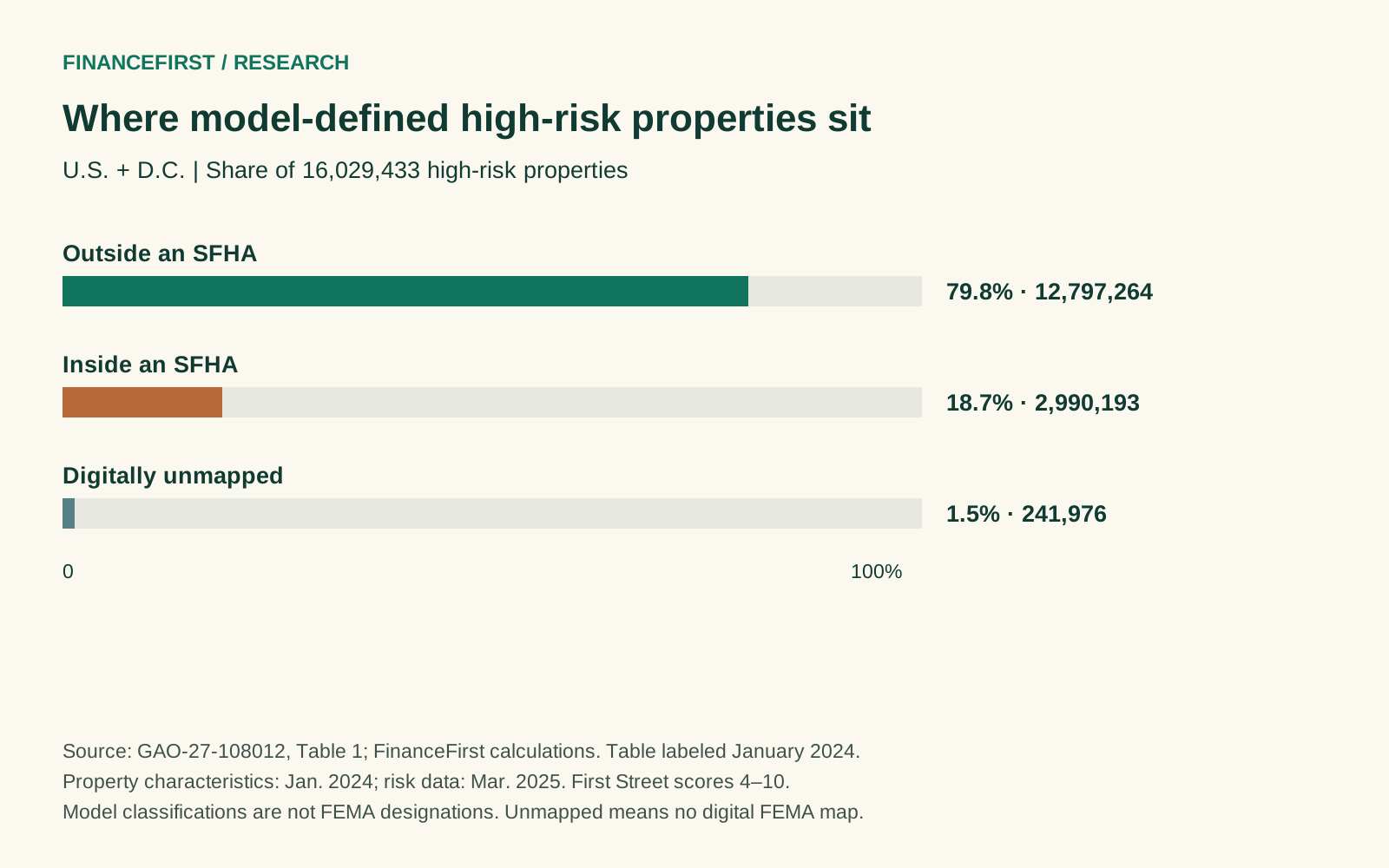
The table below preserves three separate categories. Digitally unmapped means no digital FEMA map was available, including places with paper-only maps. It does not mean no one has ever studied their flood risk. Counts include homes and nonresidential properties. [GAO Table 1 and note]

GAO labels Table 1 January 2024. Its methodology dates property characteristics to January 2024 and flood-risk data to March 2025. This is a dated comparison, not a November 2026 property census. Other models can produce different estimates.

How the 86% estimate differs: GAO matched NFIP policy records with modeled property risk and adjusted coverage rates for unmatched contracts. The estimate covers the model-defined high-risk group across map categories. Private property-level coverage was unavailable, so GAO could not measure the share with no insurance of any kind. Do not multiply 86% by Table 1’s total to invent an uninsured-property count. [GAO Figure 1 note; Appendix I, Analysis of Flood Risk and Insurance Coverage]

Model-defined high-risk properties by FEMA map category; GAO Table 1
Map categoryPropertiesShare of high-risk total
Inside an SFHA2,990,19318.7%
Outside an SFHA12,797,26479.8%
Digitally unmapped241,9761.5%
Total high-risk properties16,029,433100.0%

Where model-defined high-risk properties sit

50 states and D.C.; share of 16,029,433 properties, residential and nonresidential. Table labeled January 2024; risk data March 2025. Rounded to one decimal; model categories are not FEMA designations.

Share of high-risk propertiesPercent of the high-risk denominator
  1. Outside an SFHA
    Share of high-risk properties: 79.8%
  2. Inside an SFHA
    Share of high-risk properties: 18.7%
  3. Digitally unmapped
    Share of high-risk properties: 1.5%
View chart data
Where model-defined high-risk properties sit
Period or categoryShare of high-risk properties
Outside an SFHA79.8%
Inside an SFHA18.7%
Digitally unmapped1.5%
Source: GAO-27-108012 Table 1. 16,029,433 properties, U.S. + D.C.; table Jan. 2024, risk Mar. 2025. First Street 4-10, not FEMA designations. FinanceFirst arithmetic.

The three questions to answer for your property

1. What does the lender require?

Covered lending rules generally require flood insurance for buildings securing designated loans in SFHAs where NFIP coverage is available. A federally regulated lender’s loan can be covered even without a federal loan guarantee. Some lenders also require insurance outside an SFHA. Ask the servicer for the building’s flood determination and the written requirement. Meeting a lending minimum does not establish that every household expense is protected. [Interagency Q&A, Applicability Q1–4; Amount Q7–9]

Paying off the mortgage changes the lending relationship, not the physical hazard. Before dropping a policy, check other obligations, including requirements connected with prior federal disaster assistance. [NFIP eligibility and disaster-assistance conditions]

2. What flood risks affect the property?

Start with the FEMA Flood Map Service Center and record the map date. Ask the local floodplain or emergency-management office about drainage, past flooding and local information the map may not resolve. Development, terrain and weather can change water flow. If risk tools disagree, compare their dates and flood mechanisms rather than treating either as a promise. [NAIC, How can I find out about my flood risk?]

3. What would the insurance actually pay?

Read the declarations, policy form and endorsements together. Ask about covered water sources, insured property, valuation, separate deductibles, exclusions and the policy’s start date. Compare quotes on those terms before comparing price. The FinanceFirst homeowners-insurance guide explains how to organize the documents.

The terms that change the household’s bill

Standard homeowners and renters insurance generally excludes flood damage. NFIP residential building coverage is available up to $250,000, with contents coverage up to $100,000. These are available limits, not guaranteed payments. Building and contents coverage are generally purchased separately. NFIP eligibility normally depends on community participation, including outside SFHAs. Private coverage and state rules can differ. [NFIP buying guidance] [Eligibility]

Deductibles and valuation are separate questions

The NFIP Dwelling Form applies separate building and personal-property deductibles. Its personal-property settlement uses actual cash value, which subtracts physical depreciation. Building replacement-cost settlement has conditions, including qualifying occupancy and insurance-to-value requirements, and can depend on completed repairs. A high contents limit alone does not promise the price of brand-new belongings. [44 CFR Part 61, Appendix A(1), II.C.2, VI and VII.R]

Coverage has boundaries

The NFIP policy does not provide temporary housing or additional living expenses. Basement and below-elevated-floor coverage is restricted; check the specific items and location rather than assuming everything below ground is insured. Private products may offer different terms. Ask for the policy provision supporting the agent’s answer. [NFIP exclusions] [Florida DFS coverage FAQ]

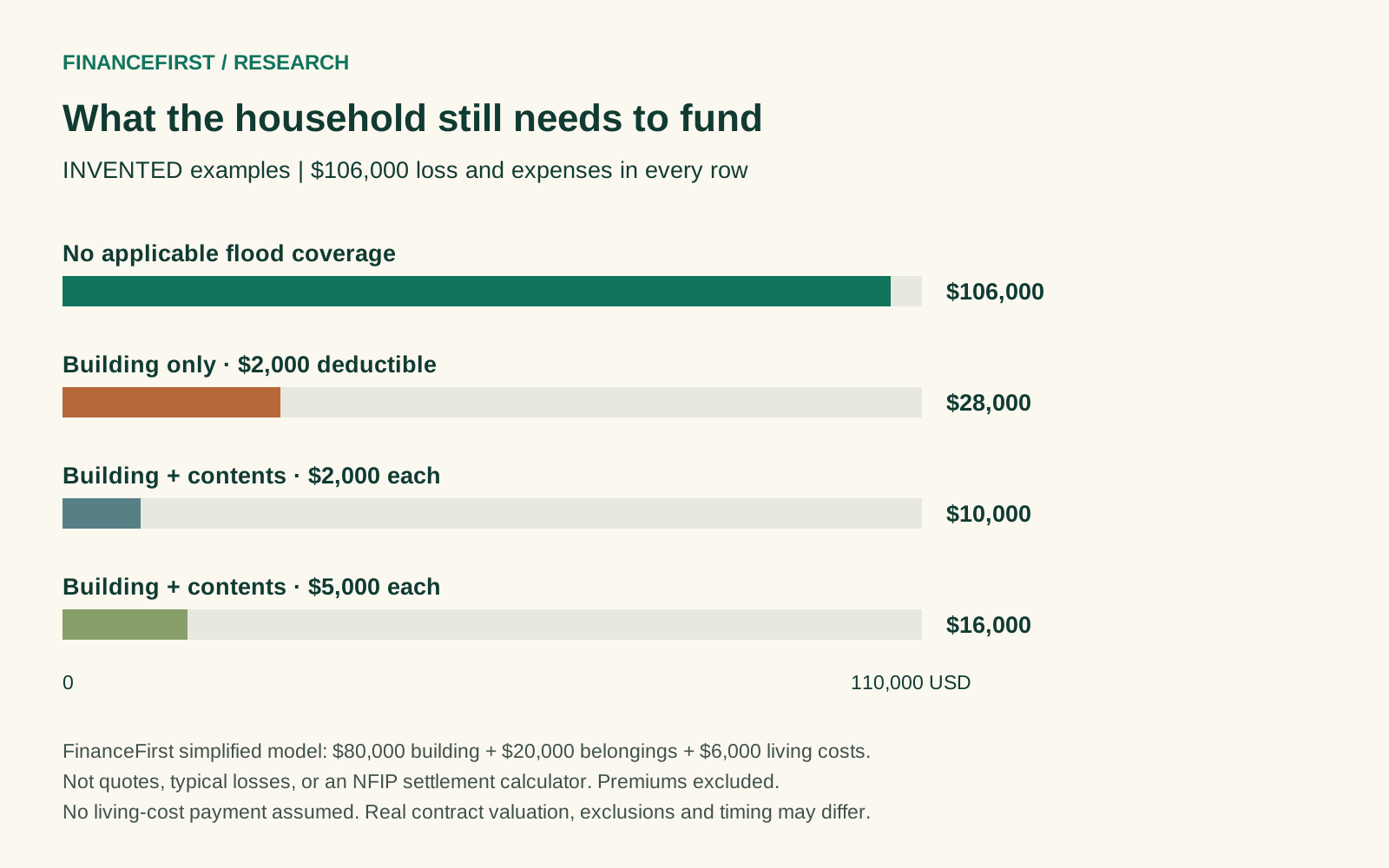
Hypothetical: one $106,000 loss, four coverage setups

All inputs are invented. Assume $80,000 of building replacement damage, $20,000 of belongings replacement damage and $6,000 of temporary living costs. Building and contents limits are assumed high enough not to bind. No living-cost reimbursement is modeled.

The third setup leaves two $2,000 deductibles plus $6,000 of living costs. Building-only coverage also leaves the belongings loss. Premiums are excluded, so this comparison does not estimate whether a policy is worth buying.

Invented examples; total replacement damage and living costs: $106,000
Coverage setupBuilding paymentContents paymentRemaining cost
No applicable flood coverage$0$0$106,000
Building only; $2,000 deductible$78,000$0$28,000
Building and contents; $2,000 each$78,000$18,000$10,000
Building and contents; $5,000 each$75,000$15,000$16,000

Hypothetical remaining household cost

INVENTED inputs: $80,000 building + $20,000 belongings + $6,000 living costs in every row. Eligible values equal replacement costs for illustration only. Premiums and payment timing excluded; not a claim calculator.

Remaining cost (USD)U.S. dollars; invented values
  1. No applicable flood coverage
    Remaining cost (USD): 106,000
  2. Building only; $2,000 deductible
    Remaining cost (USD): 28,000
  3. Building and contents; $2,000 each
    Remaining cost (USD): 10,000
  4. Building and contents; $5,000 each
    Remaining cost (USD): 16,000
View chart data
Hypothetical remaining household cost
Period or categoryRemaining cost (USD)
No applicable flood coverage106,000
Building only; $2,000 deductible28,000
Building and contents; $2,000 each10,000
Building and contents; $5,000 each16,000
Source: FinanceFirst invented model: $80,000 building + $20,000 belongings + $6,000 living. Eligible values equal replacement; premiums excluded. Not a claim calculator.

What depreciation and a coverage limit change

Depreciation can leave a replacement gap

Keep the $106,000 total, but assume the belongings cost $20,000 to replace and have an eligible depreciated value of $12,000. A $2,000 contents deductible leaves a $10,000 contents payment. Add the $78,000 building payment: $106,000 − $88,000 leaves $18,000 for the household to fund.

A large loss can exceed the limit

In a separate invented example, building damage rises to $300,000. Belongings remain $20,000 and living costs $6,000, giving a $326,000 total. With a $250,000 building cap and $2,000 deductibles, the simplified model pays $250,000 for the building and $18,000 for contents. The remaining cost is $58,000.

Separate invented sensitivities; each begins from the stated assumptions
Changed assumptionTotal costTotal modeled paymentRemaining cost
Contents eligible value falls to $12,000$106,000$88,000$18,000
Building damage $300,000; building cap $250,000$326,000$268,000$58,000

Actual policy terms may produce a different result. The model does not apply underinsurance provisions, repair-completion conditions, special sublimits, other-insurance clauses, claim disputes, assistance or payment timing. It should not be used to predict a settlement or choose a coverage amount.

Take a short coverage audit to your agent

Collect the declarations, policy, endorsements, lender determination and an inventory. Request written answers to these questions. They follow the coverage-comparison approach in Texas OPIC’s shopping guide; available products and state protections vary.

  1. Requirement and hazard: Which building and loan does the lender’s determination cover, and what local flood information should I check?
  2. Covered losses: Which water sources, belongings and basement items qualify? Which exclusions or special limits apply?
  3. Payment terms: What separate deductibles and valuation methods apply, and what conditions must be met?
  4. Cash needed: What replacement gaps and living costs remain uninsured? Can I fund the deductibles while waiting for a claim payment?
  5. Start date and price: When exactly does coverage begin, what is the full annual price including fees, and will the lender accept the proposed policy?

NFIP policies generally have a 30-day waiting period, with exceptions such as qualifying mortgage transactions. Confirm the effective date and any flood-in-progress exclusion before relying on a new policy. Renters should check contents coverage; a landlord’s building policy does not protect their belongings. [NFIP waiting-period guidance] [OPIC renter guidance]

Journalist briefing and research downloads

Citation-ready finding: FinanceFirst’s arithmetic from GAO Table 1 places 13,039,240 properties, or 81.3% of its model-defined high-risk group, outside SFHAs or in digitally unmapped areas. Keep the model classification, nonresidential scope and reference dates with the finding. It does not count uninsured homes.

Suggested attribution: “FinanceFirst calculations from GAO-27-108012, Table 1, using First Street model classifications.” Attribute the underlying evidence to GAO. Label the household examples as hypothetical.

Revision record: Version 1.1, November 11, 2026. Consolidated methodology, clarified the NFIP estimate and settlement assumptions, improved chart accessibility and repaired reproduction instructions. Headline counts, shares and all six modeled dollar results are unchanged. Report a possible error through the corrections process.

Methodology and limitations

What FinanceFirst calculated

We transcribed GAO’s aggregate Table 1 and checked every row and column total. The combined count is 12,797,264 + 241,976 = 13,039,240. Its share is 13,039,240 ÷ 16,029,433 × 100 = 81.3456%, shown as 81.3%. Keeping only the mapped-outside group in the numerator gives 79.8% of the same denominator. This sensitivity does not test a different flood model.

What the evidence cannot establish

We did not obtain First Street’s proprietary property records, reproduce its risk model, inspect homes or conduct interviews. The counts are model-derived properties, including residential and nonresidential, not current households. Model uncertainty remains even though the arithmetic uses integer counts. We have not constructed confidence intervals.

The NFIP coverage estimate is GAO’s rounded finding, not a FinanceFirst calculation. GAO’s Figure 1 note reports a 79.2% contract match rate and adjustment for unmatched contracts; Appendix I explains the matching stages and limitations. Private property-level coverage was unavailable. Different reference dates and incomplete coverage information prevent a current count of wholly uninsured households.

How the invented loss model works

For each insured category: payment = min(limit, max(eligible adjusted loss − deductible, 0)). Remaining cost = building replacement damage + belongings replacement damage + living costs − modeled payments. Replacement bills and eligible insured values are separate inputs. The formula is an educational simplification, not a complete implementation of the NFIP Dwelling Form or a private contract. See the exclusions next to the examples and the downloadable assumptions.

Review status

This report was prepared with AI assistance. No qualified human insurance or legal review has been recorded. The claims still requiring that review are the application of lending exceptions and prior-assistance obligations, and the interpretation of actual policy valuation, deductibles, exclusions and loss-settlement conditions. Code verification establishes arithmetic consistency, not how an insurer would settle a claim.

Sources and data references

  1. GAO: Flood Insurance: Congressional Action Could Help Increase Coverage for At-Risk Properties

    Table 1 and note; Figure 1 and note; Appendix I, Data Sources and Reliability / Analysis of Flood Risk and Insurance Coverage. Commercial classification; not FEMA designation. The 86% NFIP-only estimate is source-rounded and adjusted for unmatched contracts.

    Accessed 2026-11-11
  2. FEMA NFIP: Buying flood insurance

    Homeowners; Building/Contents coverage; What does not flood insurance cover?; Waiting-period FAQ. Contract terms and exceptions apply; limits are not guaranteed claim payments.

    Accessed 2026-11-11
  3. FEMA NFIP: Who is eligible for NFIP flood insurance?

    Community participation; Your mortgage lender may require flood insurance; Federal disaster assistance conditions. Not a determination for a particular loan or property.

    Accessed 2026-11-11
  4. NAIC: Flood Insurance

    How can I find out about my flood risk?; Ask these questions before you buy. Only risk-information and comparison guidance used; no premium average or outdated product reference reused.

    Accessed 2026-11-11
  5. Florida Department of Financial Services: Facts about Flood Insurance Coverage

    Separate deductible question; basement restrictions; loss settlement; additional living expenses. Federal policy form is the primary authority for settlement; private policies and state protections can differ.

    Accessed 2026-11-11
  6. Texas OPIC: Flood Insurance Shopping Guide

    Coverage questions; Customize; Other Things to Think About. State rules and available products differ; not an individual recommendation.

    Accessed 2026-11-11
  7. Federal banking regulators: Interagency Questions and Answers Regarding Flood Insurance

    I Applicability Q1-4; X Amount Q7-9. Specific loan, building, availability, exceptions and lender terms determine the obligation.

    Accessed 2026-11-11
  8. FinanceFirst: Homeowners Insurance: Compare Coverage, Rebuilding Costs and Quotes

    Coverage comparison and flood/local-risk sections. Not a primary statistical source.

    Accessed 2026-11-11
  9. eCFR / FEMA: Standard Flood Insurance Policy, Dwelling Form

    44 CFR Part 61 Appendix A(1): II.C.2; III.B.5; V; VI.A-B; VII.R.1-4. Applies to that form; does not adjudicate a claim or represent every private policy. Replacement-cost conditions and actual cash value must not be omitted.

    Accessed 2026-11-11
For journalists: copy briefing & citation

Use the dated figures with their scope and source. Charts above include vector and CSV downloads. A scenario or survey response should not be described as a measured outcome for every household.

Aisha Shabbir. “Flood Risk Beyond Your Lender’s Insurance Requirement.” FinanceFirst Research, version 1.1, November 11, 2026. https://financefirst.co/reports/flood-risk-insurance-gap