

A health plan can offer lower payroll deductions and a slightly lower ceiling on annual costs, yet leave an employee needing more money when a substantial medical bill arrives early in the benefit year. The difference is timing: savings expected over the next 12 months cannot cover a bill today.
For Aaron Snider at BlackIron, an employee-benefits and insurance consulting business, cash available now matters as much as the annual total.

“A plan may be affordable over 12 months while creating a serious cash shortage in the first month.”
Before choosing, compare two things separately: what each plan could cost over a full year and the money you could actually access for an early bill. Start with the same coverage tier, verify providers and prescriptions, and use the plan’s written benefit terms for both calculations.
Compare annual costs and early cash needs separately
Start with each plan’s Summary of Benefits and Coverage and the employee premium for the same coverage tier. The standardized summary helps compare covered services, deductibles, copayments, coinsurance and limitations. Check the network and prescription coverage, too; lower costs do not compensate for coverage that fails to meet an employee’s needs.
The first question is how annual employee premiums and covered in-network cost sharing could add up. The second is how much cash a particular early-year service could require. Neither number alone identifies the best plan.
Loretta Kilday of Debt Consolidation Care cautions against letting the payroll deduction dominate the decision.

“Do not just stare blindly at the cheap monthly premium.”
Abhinav Gupta of Profitjets frames the comparison around financial exposure.

“The question "could I afford a big bill in January" is looking for worst-case scenario cost.”
Annual premiums plus the covered in-network maximum can help describe a high-cost year. That ceiling is different from predicted spending or the amount due for one service.
Consider this hypothetical supplied by Mehdi Zare, founder of financial-education site Bina Capital. FinanceFirst recalculated the example to distinguish annual amounts from funds available when the bill arrives. Zare describes his contribution as financial education, rather than insurance brokerage advice.
Both options assume self-only coverage for a full year. Plan B and the employee are assumed otherwise eligible for HSA contributions.
Hypothetical self-only plans: annual premiums and covered in-network cost sharing
Scroll sideways to see every column.
Assumed plan terms | Plan A | Plan B |
|---|---|---|
Employee premium per month | $200 | $100 |
Annual employee premiums | $2,400 | $1,200 |
Deductible | $1,000 | $3,000 |
Coinsurance after the deductible | 20% | 20% |
In-network out-of-pocket maximum | $4,000 | $6,000 |
Annual employer HSA contribution | $0 | $1,000 |
Annual premiums plus maximum, less employer HSA funding | $6,400 | $6,200 |
Plan B has the lower ceiling in this comparison, after counting its full annual employer contribution. That is a scenario for covered in-network costs, not predicted spending or an absolute cap on every medical expense. It assumes full-year enrollment and usable employer funding; tax effects are excluded.
Test a substantial bill early in the benefit year
The stress test becomes more useful when it has a date, as Ankit Sarawagi of CFO Matrix points out.

“Calculate how much cash you need to have in month 2.”
Use the beginning of your actual benefit year; it may not be January.
Now assume a single covered, in-network service has a $10,000 allowed cost in the second month. The allowed amount is the plan-recognized cost, often called the negotiated rate; it can differ from the provider's charge. No deductible has been met. The service is subject to the stated deductible and coinsurance, with no extra copay or separate deductible. The example uses the same allowed amount for both plans to isolate their designs; actual negotiated rates can differ.
Plan A leaves the employee responsible for $1,000 plus 20% of the remaining $9,000: $2,800. Plan B produces $3,000 plus 20% of $7,000: $4,400. Neither plan’s maximum reduces these amounts.
Suppose Plan B’s employer contribution is spread over 12 equal monthly installments, with two available when the bill becomes payable. Two-twelfths of $1,000 is $166.67, rounded; actual deposits may differ by a cent or by timing. With no previous HSA balance or employee deposits, that leaves $4,233.33 to fund outside the HSA. These service amounts exclude premiums, which are paid separately.
Hypothetical $10,000 early-year covered service: patient responsibility and available HSA funds
Scroll sideways to see every column.
Early-service calculation | Plan A | Plan B |
|---|---|---|
Estimated patient responsibility | $2,800 | $4,400 |
Employer HSA funds available in the illustration | $0 | $166.67 |
Cash needed outside the HSA | $2,800 | $4,233.33 |
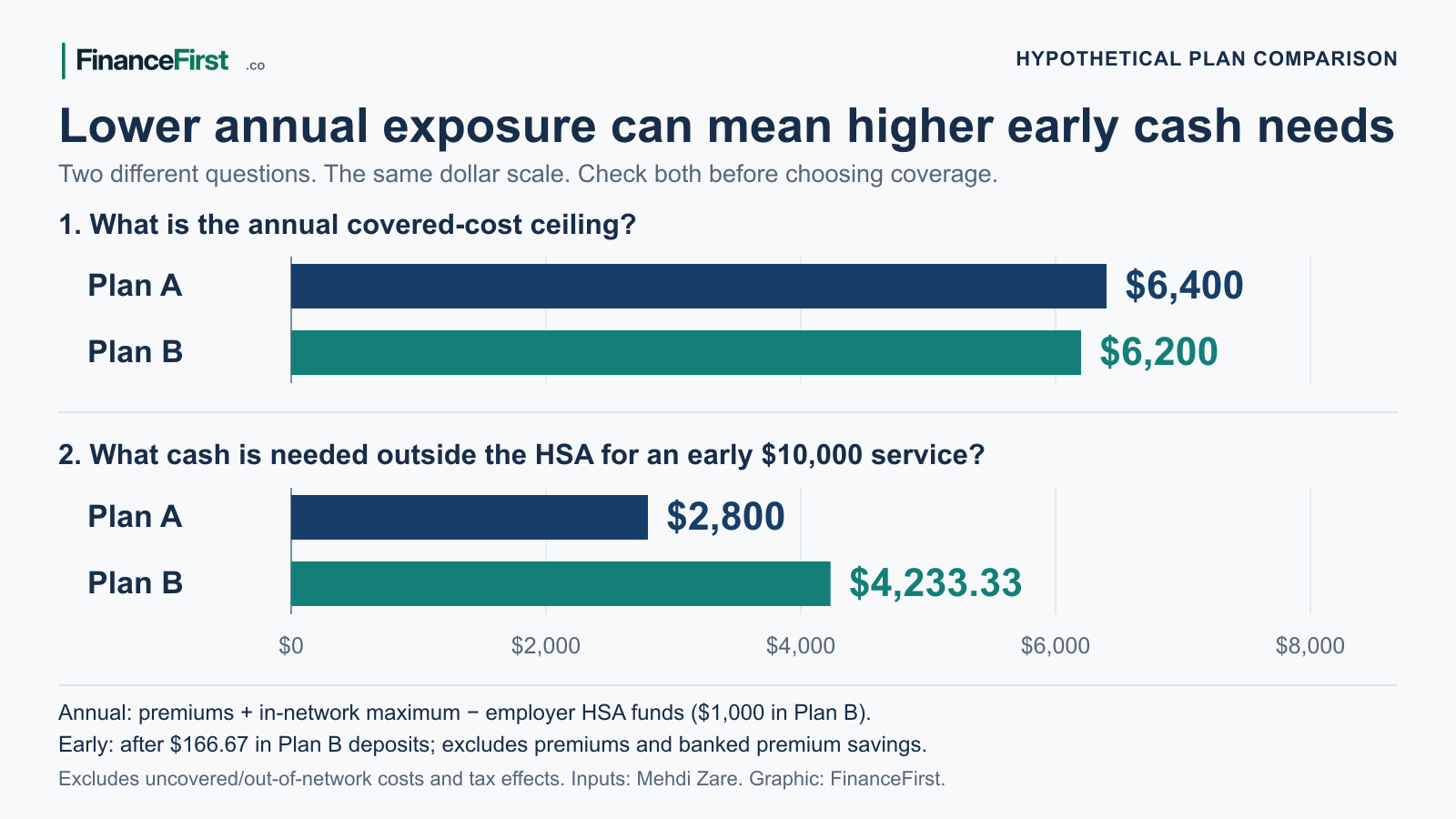
Plan B therefore needs $1,433.33 more cash outside the HSA, before counting any premium savings already set aside. If the employee has actually saved two months of the $100 premium difference, that supplies another $200 and narrows the difference to $1,233.33. Count that cash once, and do not count future savings.
Nick Avila of United Debt Relief sees the issue from the debt-relief side.

“A plan that's cheaper over twelve months can still be the riskier one if the bill lands in February.”
Avila is not a benefits broker. His point is about funding the bill, which requires a separate check from comparing annual premiums.
This is estimated patient responsibility, not a claim that the entire amount is legally due on the day of treatment. The Centers for Medicare & Medicaid Services explains that an explanation of benefits is not a provider bill. Claim processing, reimbursement and payment terms affect the actual timing.
Count available funds, not just promised benefits
Employer contributions can make a plan more attractive, but the deposit schedule matters. Mehdi Zare of financial-education site Bina Capital suggests asking a direct question.

“If you have an HSA option, does your employer deposit the whole amount in January or spread it through the year?”
At DoBetter, Chris Cordon describes two common funding schedules.

“Some employers put the full amount in on January 1. Others spread it across paychecks”
Ask HR which schedule applies and when the money becomes usable. An existing HSA balance can change the comparison substantially; future deposits cannot cover a bill that is due before they arrive.
Account labels matter. An HSA contribution requires eligibility; a large deductible by itself is not sufficient. FinanceFirst’s HSA strategy guide explains the account’s broader role. General-purpose health FSA or HRA coverage can also affect HSA contribution eligibility, subject to exceptions for compatible arrangements. IRS guidance sets out those distinctions.
A health FSA generally makes the elected annual amount available for reimbursement of eligible expenses incurred during coverage, even before all payroll contributions have been made. It does not reimburse projected treatment in advance. An HRA is employer funded; usable amounts and reimbursement terms depend on the arrangement. IRS Publication 969 explains both.
Jennifer Schaefer of JS Benefits Group suggests estimating an early service after accounting for available HRA funds, then comparing that amount with savings.

“review the premiums and out-of-pocket maximum separately.”
Check what the maximum actually covers
A deductible is not the final bill or the annual limit. Coinsurance may continue afterward, while some services receive coverage before the deductible is met.
The out-of-pocket maximum generally limits the applicable covered in-network cost sharing. Premiums, uncovered services and costs outside that protection require separate consideration. The federal health insurance glossary identifies those exclusions. Do not add a deductible on top of a maximum that already includes it.
Family coverage adds another layer. Frank Caballero of FC Insurance Solutions LLC highlights the questions to check.

“see whether the out-of-pocket max is per person or per family, and whether the employer puts money into an HSA.”
For family coverage, ask how each person’s deductible and spending contribute to the family totals. Individual cost-sharing protections and a plan’s family deductible structure are different questions. Comparing an individual limit on one plan with a family limit on another would distort the result.
The maximum should also be read alongside the rest of the coverage. Hasan Can Soygök of Remotify emphasizes the broader comparison.

“I would also compare out-of-pocket maximums, network restrictions and available emergency savings.”
Check providers, prescriptions and excluded services before treating a plan’s cost limits as protection you can rely on.
Match the early bill to your savings
Once you have an estimate for the service, compare it with money you could use without missing housing, food or other essential payments. The deductible and covered in-network maximum are useful reference points, but neither establishes the exact bill or its payment deadline.
Zachary Bradford of Bradford Informed Guidance recommends starting with a specific stress-test assumption.

“assume a big bill hits in month one, and compare each plan's deductible (and out-of-pocket max) to your emergency savings.”
Keep the question concrete: how much is already available, how much will arrive before payment is due, and what gap remains? A plan with a lower premium is not automatically better or worse; coverage and the ability to meet its costs both matter.
Lilach Bullock applies the same cash-reserve question to the out-of-pocket maximum. Her consultancy focuses on AI implementation and marketing.

“ask yourself whether you could pay it from cash in January.”
Treat that as a stress test for a calendar-year plan, not a prediction that the full maximum will be due in January.
Runbo Li of Magic Hour AI emphasizes the risk of relying on money that has not arrived.

“If your liquid cash can't cover the deductible without the employer money, you're making a bet that nothing goes wrong early.”
Some services are covered before a deductible is met, and actual patient responsibility depends on the plan and care received. The useful takeaway is to identify a funding gap before enrollment and check any provider payment arrangement before relying on it.
Make the cash gap explicit before choosing
Arvind Rongala of Invensis Learning and Edstellar connects the annual comparison with the immediate cash question.

“The key is to compare total annual exposure alongside immediate cash requirements, accounting for employer HSA contributions, covered services, and network restrictions.” “Finally, the remaining exposure should be measured against emergency savings available without relying on credit cards or loans.”
The following checks put those two calculations alongside each other.
Estimate one substantial service. For each option, use its allowed cost and the actual plan rules to calculate estimated patient responsibility.
Count funds available for that expense. Subtract account funds you could use when the bill becomes payable. Count premium savings only if already set aside, and count them once.
Compare the gap with accessible savings. Check whether you could cover the remainder without missing rent, food or other essential payments. FinanceFirst’s emergency-fund guide provides a framework for keeping that reserve separate from routine spending.
Check timing and family exposure. Ask what would happen if several family members needed care or treatment crossed the benefit reset date. Check any provider payment arrangement before relying on it.
Compare the full-year commitment. Review annual employee premiums alongside expected routine care and the larger covered in-network cost scenario. Keep uncovered and out-of-network costs separate.
The hypothetical does not establish that Plan A is better. It shows why Plan B’s lower annual ceiling does not settle the affordability question. A sound comparison identifies both the coverage an employee needs and a credible way to fund the bills when they become payable.
Sources and methodology
FinanceFirst gathered written comments through Connectively and checked plan rules against U.S. Department of Labor, IRS, CMS and federal health insurance sources. FinanceFirst independently recalculated Mehdi Zare’s hypothetical and created the comparison tables and chart to separate annual covered-cost exposure from the cash needed for an early bill. Contributor portraits were supplied through Connectively.
Limits of the example: These hypothetical plans illustrate timing, not insurance quotes, predicted spending or a recommendation. They assume self-only full-year coverage, an otherwise HSA-eligible Plan B and employee, no prior cost sharing, and the stated covered in-network service and account deposits. Annual amounts include premiums; early-service amounts exclude premiums. Uncovered care, out-of-network costs and tax effects are excluded. Family rules, actual deposit timing and payment deadlines can change the result. This is general education, not individualized insurance, tax or financial advice.
Contributor affiliations: Contributors have commercial affiliations in insurance, employee benefits, financial education, debt relief, training, technology and consulting. Roles and affiliations are those provided by the contributors; professional licenses and credentials were not independently verified. The linked businesses are identified for attribution, not endorsed by FinanceFirst.
AI assistance: AI tools assisted with source organization, research, drafting, calculation checks and preparation of the original graphic. The linked primary sources, stated assumptions and calculations are provided so readers can inspect the comparison.
Primary references checked November 25, 2026:
Reporting and methodology
Guide · Editorial review: Aamir Shabbir Ahmad.
Methodology
FinanceFirst gathered written comments through Connectively and checked plan rules against U.S. Department of Labor, IRS, CMS and federal health insurance sources. FinanceFirst independently recalculated Mehdi Zare’s hypothetical and created the comparison tables and chart to separate annual covered-cost exposure from the cash needed for an early bill. Contributor portraits were supplied through Connectively.
Limitations
The plans are hypothetical, not insurance quotes or a prediction of spending. The comparison assumes self-only coverage for a full year; Plan B and the employee are otherwise HSA-eligible. One $10,000 covered in-network allowed service is subject to the stated deductible and 20% coinsurance, with no prior cost sharing, additional copay or separate deductible. Two of 12 equal employer HSA installments are assumed available by the payment date, with no prior balance or employee deposits. Values are rounded only after calculation; actual deposit timing and cents may differ. Annual figures include employee premiums; early service figures exclude premiums and separately banked premium savings. Uncovered care, out-of-network costs and tax effects are excluded. Family rules, plan terms and payment deadlines vary. This is general education, not individualized insurance, tax or financial advice.
Conflicts disclosure
Contributors have commercial affiliations in insurance, employee benefits, financial education, debt relief, training, technology and consulting. Roles and affiliations are those provided by the contributors; professional licenses and credentials were not independently verified. The linked businesses are identified for attribution, not endorsed by FinanceFirst.
Correction or update
Updated the article’s presentation to integrate contributor comments and supplied portraits throughout the guide. The worked example, calculations and plan assumptions are unchanged.
Sources
- HealthCare.gov — Summary of Benefits and Coverage
- HealthCare.gov allowed amount
- HealthCare.gov deductible
- HealthCare.gov out-of-pocket maximum
- Joint federal ACA implementation FAQ Part XXVII (CMS PDF)
- CMS reading an explanation of benefits
- IRS Publication 969
- IRS Publication 15-B (2026)
- Aaron Snider — contributor biography and affiliation
- Mehdi Zare — contributor biography and affiliation
- Jennifer Schaefer — contributor biography and affiliation
- Frank Caballero — contributor biography and affiliation
- Zachary Bradford — Bradford Informed Guidance contributor profile
- Nick Avila — United Debt Relief contributor profile
- Loretta Kilday — Debt Consolidation Care contributor profile
- Lilach Bullock — Lilach Bullock contributor profile
- Chris Cordon — DoBetter contributor profile
- Ankit Sarawagi — CFO Matrix contributor profile
- Abhinav Gupta — Profitjets contributor profile
- Arvind Rongala — Invensis Learning contributor profile
- Arvind Rongala — Edstellar contributor profile
- Runbo Li — Magic Hour AI contributor profile
- Hasan Can Soygök — Remotify contributor profile