
The cheapest monthly health-insurance payment is easy to spot. The help you might give up by choosing it is less obvious.
HealthCare.gov's enrollment period for 2027 coverage opened November 1, 2026, according to an October 30 CMS fact sheet. As people compare plans, an existing rule deserves attention: eligible shoppers generally need a Silver plan to receive income-based help with deductibles, copayments and coinsurance. [1][2]
That does not mean everyone should buy Silver. It means a premium alone is not enough to choose a plan.
A lower-premium option might be the better fit. But first, compare it with the actual Silver plan available after the Marketplace has determined your eligibility. Otherwise, you may be comparing one visible price while overlooking a different kind of discount.
The two kinds of assistance are not interchangeable
A premium is the payment that keeps your insurance active, whether you use healthcare that month or not.
A premium tax credit can reduce that monthly payment. Separately, cost-sharing reductions can lower what an eligible person pays for care. That can include the deductible, the amount paid for a visit or prescription, and the applicable annual out-of-pocket maximum. [2]
Scroll sideways to see every column.
Assistance | What it can reduce | What to check |
|---|---|---|
Premium tax credit | Monthly insurance premium | Your Marketplace eligibility results and the premium after the credit |
Income-based cost-sharing reductions | Deductibles, copayments, coinsurance and the applicable out-of-pocket maximum | Whether you qualify and which Silver plan version is offered |
HealthCare.gov says qualifying shoppers must select Silver to get the ordinary income-based cost-sharing reductions. Choosing another metal category can still allow an eligible shopper to use a premium tax credit, but it does not preserve those additional savings. Catastrophic plans are not eligible for either benefit. [2]
This is an existing rule, not a new benefit announced for 2027.
Special rules apply to eligible members of federally recognized tribes and Alaska Native Claims Settlement Act Corporation shareholders. Their zero or limited cost-sharing plans can be available at any metal level, not just Silver. Catastrophic plans are excluded. Do not apply the general Silver-only explanation to those protections. [7][8]
The enrollment data explain why the distinction matters
CMS reported 23.1 million plan selections, including automatic re-enrollments, during the 2026 Marketplace open-enrollment period nationwide. This is historical context, not a count of people now choosing 2027 coverage. [3][4]
Its March 27 release reported the following rounded shares:
Scroll sideways to see every column.
Plan category | Share of nationwide 2026 open-enrollment plan selections |
|---|---|
Bronze | 40% |
Silver | 43% |
Gold | 17% |
Source: CMS, March 27, 2026 release. The rounded categories shown add to 100%, but this summary is not a detailed count of every plan variation. [3]
The accompanying report says 37% of nationwide plan selections included cost-sharing reductions and 87% included advance premium tax credits. Those measures overlap. They should not be added together or treated as two separate groups of people. The report also notes a limited New York state cost-sharing subsidy inclusion in its CSR measure. [4]
These figures do not show that Bronze shoppers made a mistake. They do not tell us why people chose a category, how much care they used, or whether a different plan would have cost them less.
Plan selection is also not the same as paid, active coverage throughout the year. The report's national scope combines HealthCare.gov and state-based exchanges, with different reporting windows.
A $40 monthly saving has a $480 annual limit
Here is a useful way to make the comparison smaller and clearer.
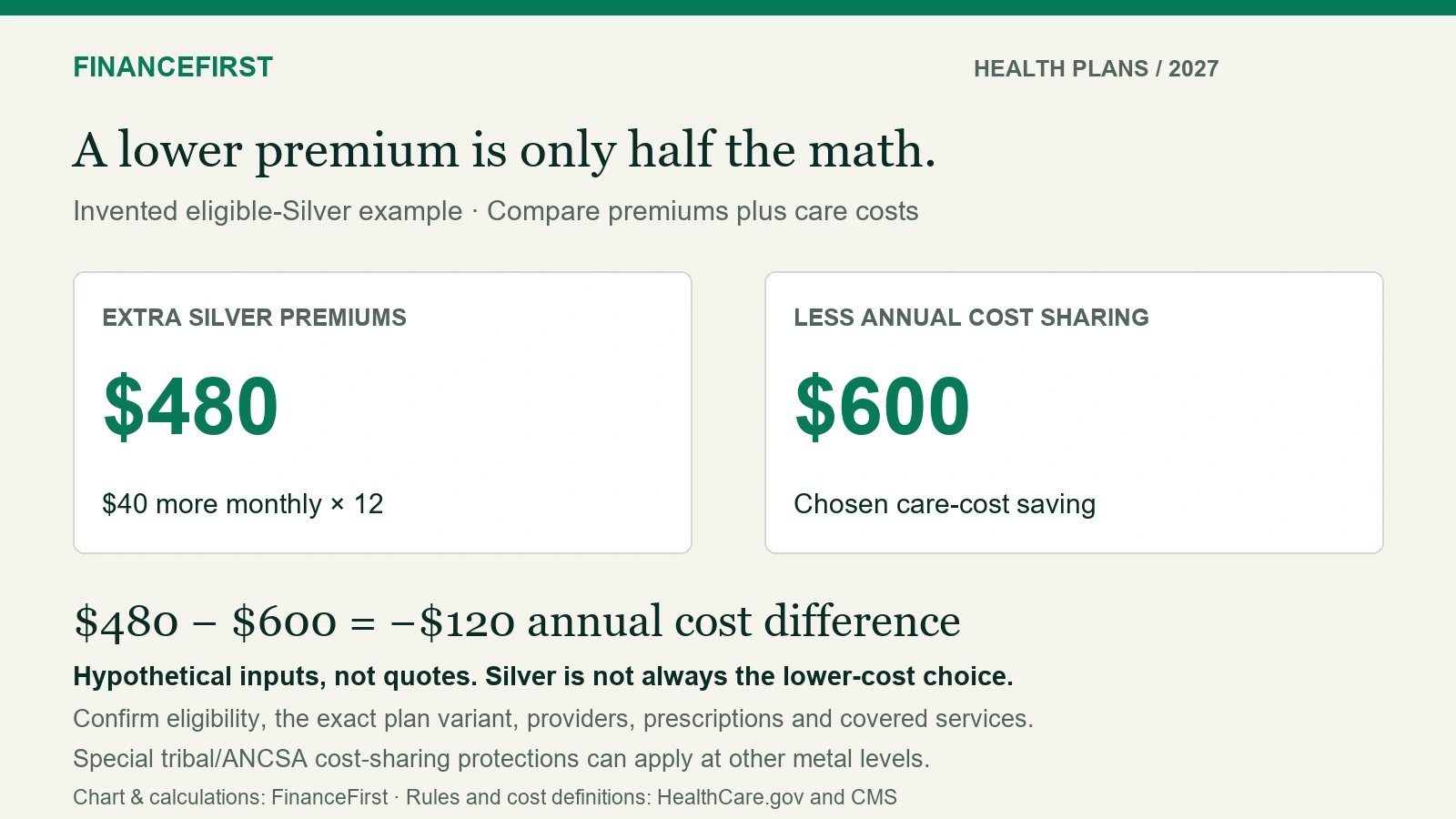
Suppose a lower-premium option costs $40 less each month than the eligible Silver option. Over a full 12 months, the premium difference is $480.
If the Silver option reduces your annual medical cost-sharing by more than $480, it more than offsets that higher premium.
If it reduces cost-sharing by less than $480, the lower-premium option remains cheaper on this simplified annual measure.
Scroll sideways to see every column.
Hypothetical annual cost-sharing saving with Silver | Extra annual Silver premium | Silver's total annual cost compared with the lower-premium option |
|---|---|---|
$0 | $480 | $480 more |
$300 | $480 | $180 more |
$480 | $480 | Equal |
$600 | $480 | $120 less |
$1,200 | $480 | $720 less |
FinanceFirst calculations using chosen inputs. These are not insurer quotes, observed savings, typical premiums or estimates of how often Silver is cheaper.
The formula is:
Silver's additional annual cost = 12 × monthly premium difference − annual cost-sharing saving.
A negative result means Silver is cheaper on that specific measure. It does not automatically make Silver the right choice. Different networks, covered drugs, services and cash-flow needs can matter more than that comparison.
The calculation is useful precisely because it does not require pretending to know an average person's medical bill. You can replace the assumptions with your own plan terms and a range of care scenarios.
Start with the eligibility notice, not a plan's marketing label
HealthCare.gov says the Marketplace's Eligibility Determination Notice can identify ordinary income-based extra savings with the wording "Can choose a health plan with lower copayments, coinsurance, and deductibles," followed by codes (04), (05) or (06). [2]
Check the actual notice rather than assuming that an income estimate, a Silver label or last year's eligibility guarantees the same benefits.
Then compare the Silver plan version shown for you. HealthCare.gov notes that the level of savings depends on your specific income estimate and that exact plan savings become clear when you apply and shop.
If you do not understand the notice, get help from the Marketplace or a qualified enrollment assister before making the selection. The comparisons in this article do not determine tax-credit eligibility, CSR eligibility or a correct income estimate.
Compare the cost of using the plan
HealthCare.gov recommends comparing estimated total annual costs, not just premiums. Its guidance includes premiums, deductibles, copayments and coinsurance. [5]
For each plan, write down:
The monthly premium you would actually pay after any applicable premium credit.
The deductible rules for the services and prescriptions you expect to use.
Copayments and coinsurance, including any separate prescription rules.
The applicable in-network out-of-pocket maximum.
Whether your doctors, hospitals and medicines are covered under the terms you need.
Do not add a full deductible as an extra bill after you have already counted the same spending in your medical cost-sharing estimate.
For a simplified high-use, covered in-network budget, annual premiums plus the applicable out-of-pocket maximum is a useful separate reference point. It is not a ceiling on every healthcare expense. Premiums, noncovered services, out-of-network care and charges above allowed amounts generally sit outside that limit. [6]
If a familiar doctor is outside one plan’s network, an apparently cheaper calculation may not answer your real question. FinanceFirst’s health-insurance comparison guide explains networks and total-cost checks; use your actual 2027 plan documents for current terms.
Check the early bill as well as the full-year total
An annual comparison can conceal a cash problem.
A plan might have an affordable monthly premium but assign you a substantial share of an early service. A lower projected yearly total does not guarantee you have the money when that bill arrives.
Ask what you would owe for a realistic first service under the actual deductible and copayment rules. Then compare that amount with money already available, rather than money you hope to save later.
FinanceFirst's existing health-insurance cost report explains this timing problem using a separate employer-plan example. Those employer-plan inputs are not Marketplace quotes and should not be transferred into a 2027 Marketplace comparison.
Do not confuse access to a cheap plan with choosing one
CMS's October 30 fact sheet says more than 75% of people purchasing through HealthCare.gov will have access to premiums at or below $50 in 2027. That is an agency statement about access to an option, not a guarantee that your preferred plan will cost $50 or less. [1]
The historical 2026 enrollment report separately says 54% of HealthCare.gov plan selections had premiums of $50 or less after advance tax credits. That describes selected plans in a prior period and a defined platform population. [4]
Those are different measures. Comparing 75% and 54% would not establish a 21-percentage-point increase in cheap coverage.
Neither measure tells us that covered care, prescription access or the annual household bill will be inexpensive. The 2027 fact sheet does not provide enough calculation detail in the retrieved page to independently reproduce its access estimate, so we do not treat it as a FinanceFirst finding.
Who should pay particular attention?
This comparison is especially relevant if your eligibility notice says you qualify for extra cost-sharing savings, if you expect regular covered care, or if a large early bill would be difficult to manage.
It is also worth checking if you are automatically re-enrolled. The 2026 data include people who did not actively choose a new plan, but the national totals do not establish that those people overlooked benefits.
Silver is not automatically cheaper, and Bronze is not automatically a bad choice. Your applicable premium, exact CSR level, services, prescriptions and network all matter.
What to do before enrolling
Check your Marketplace eligibility notice. Compare the actual Silver option with alternatives using both premiums and care costs. Look at a low-use scenario, expected-use scenario and a higher-use covered in-network budget.
Then check whether an early bill would be manageable.
The October 30 CMS fact sheet lists the HealthCare.gov enrollment window for 2027 coverage as November 1, 2026 through January 15, 2027. Check your Marketplace's current deadline and effective-date rules directly, especially if you use a state-run exchange. This is not a statement that every enrollment date produces January 1 coverage. [1]
The most important question is not, "Which plan has the lowest monthly price?"
It is, "After the help I actually qualify for, what would I pay to keep this plan and use it?"
The full hypothetical break-even comparison
All 15 rows are invented annual comparisons, not plan quotes or observed outcomes. Coverage is fixed at 12 months. The premium gap is Silver minus the lower-premium option; cost-sharing saving is the lower-premium option’s eligible annual care costs minus Silver’s. A negative result means lower annual cost for Silver on this measure alone. It is not a recommendation or eligibility finding. Download the table as CSV using its control.
Scroll sideways to see every column.
Extra monthly Silver premium | Extra annual Silver premium | Annual cost-sharing saving | Silver additional annual cost |
|---|---|---|---|
$20.00 | $240.00 | $0.00 | $240.00 |
$20.00 | $240.00 | $300.00 | $-60.00 |
$20.00 | $240.00 | $480.00 | $-240.00 |
$20.00 | $240.00 | $600.00 | $-360.00 |
$20.00 | $240.00 | $1,200.00 | $-960.00 |
$40.00 | $480.00 | $0.00 | $480.00 |
$40.00 | $480.00 | $300.00 | $180.00 |
$40.00 | $480.00 | $480.00 | $0.00 |
$40.00 | $480.00 | $600.00 | $-120.00 |
$40.00 | $480.00 | $1,200.00 | $-720.00 |
$80.00 | $960.00 | $0.00 | $960.00 |
$80.00 | $960.00 | $300.00 | $660.00 |
$80.00 | $960.00 | $480.00 | $480.00 |
$80.00 | $960.00 | $600.00 | $360.00 |
$80.00 | $960.00 | $1,200.00 | $-240.00 |
Sources and scope
[1] CMS, Plan Year 2027 Marketplace Plans and Prices Fact Sheet, October 30, 2026. Supports the federal enrollment window and the agency's access-to-low-premium statement, not observed 2027 spending. https://www.cms.gov/newsroom/fact-sheets/plan-year-2027-marketplace-plans-prices-fact-sheet-0
[2] HealthCare.gov, Cost-sharing reductions. Undated guidance retrieved November 10, 2026. Supports eligibility-notice wording, income-based Silver rule and benefit distinctions. https://www.healthcare.gov/lower-costs/save-on-out-of-pocket-costs/
[3] CMS, March 27, 2026 enrollment release. Supports 23.1 million selections and rounded Bronze/Silver/Gold shares. https://www.cms.gov/newsroom/press-releases/exchange-coverage-remains-near-record-high-23-1-million-enroll-2026-reflecting-continued-strength
[4] CMS, Health Insurance Exchanges 2026 Open Enrollment Report, released March 27, 2026. Supports financial-assistance shares, platform distinctions, after-credit premium distribution and reporting limitations. https://www.cms.gov/files/document/health-insurance-exchanges-2026-open-enrollment-report.pdf
[5] HealthCare.gov, Your total costs for health care. Undated guidance retrieved November 10, 2026. https://www.healthcare.gov/choose-a-plan/your-total-costs/
[6] HealthCare.gov, Out-of-pocket maximum/limit. Undated guidance retrieved November 10, 2026. Used for definition and exclusions, not annual statutory limits. https://www.healthcare.gov/glossary/out-of-pocket-maximum-limit/
[7] HealthCare.gov, American Indian and Alaska Native coverage guidance. Undated page retrieved November 10, 2026. https://www.healthcare.gov/american-indians-alaska-natives/coverage/
[8] CMS, Working with American Indians and Alaska Natives, updated January 2026. Supports the any-metal exception and catastrophic-plan exclusion. https://www.cms.gov/marketplace/agents-brokers/files/american-indians-alaska-native-fact-sheet.pdf
Reporting and methodology
Analysis · Editorial review: Asim Ahmad.
Methodology
Uses CMS’s October 30, 2026 fact sheet for the 2027 federal enrollment window; the March 27, 2026 release and report for historical plan-selection figures; and HealthCare.gov/CMS guidance for eligibility and cost definitions. FinanceFirst reproduced 15 hypothetical comparisons: 12 times a chosen monthly Silver premium gap minus a chosen annual cost-sharing saving. Negative results mean lower cost for Silver on that measure alone. All examples assume a full year; they are invented inputs, not insurer quotes or observed outcomes. The full comparison table is downloadable as CSV.
Limitations
Ordinary income-based CSR generally requires an eligible Silver plan; special zero or limited cost-sharing protections for qualifying tribal members and ANCSA shareholders differ and exclude catastrophic plans. This article does not determine eligibility or estimate an individual medical bill. Actual plan variants, networks, drugs, services, coverage timing and early cash needs matter; do not count a deductible twice. Premiums plus the applicable in-network maximum is not a ceiling on all spending. Historical 2026 selections include automatic re-enrollments and are not paid active coverage. Assistance shares overlap, and the CSR measure has a limited New York subsidy inclusion. CMS’s 2027 low-premium access estimate is attributed and not independently reproduced; it is not comparable to the 2026 selected-plan share. No finding that Bronze shoppers erred or Silver is always cheaper is made.
Conflicts disclosure
Uses public CMS and HealthCare.gov sources; no insurer recommendations, affiliate links, sponsored research or original interviews.
Sources
- Plan Year 2027 Marketplace Plans and Prices Fact Sheet | CMS
- Exchange Coverage Remains Near Record High as 23.1 Million Enroll in 2026, Reflecting Continued Strength and Stability | CMS
- HEALTH INSURANCE EXCHANGES 2026 OPEN ENROLLMENT REPORT
- Cost-sharing reductions | HealthCare.gov
- Your total costs for health care: Premium, deductible, and out-of-pocket costs | HealthCare.gov
- Out-of-pocket maximum/limit - Glossary | HealthCare.gov
- Health Care Coverage for American Indians and Alaska Natives | HealthCare.gov
- Health Insurance Costs: Premiums, Deductibles and Cash Risk | FinanceFirst
- Working with American Indians and Alaska Natives: Information and Tips for Agents and Brokers