
Cheaper gas next year might not leave as much money in your budget as you hoped.
The U.S. Energy Information Administration still expects regular gasoline to cost less in 2027 than in 2026. But its November 10 forecast raises next year's expected national average from $3.56 to $3.73 a gallon. [1][2]
That is a 17-cent change in the forecast, not a 17-cent increase already recorded at the pump.
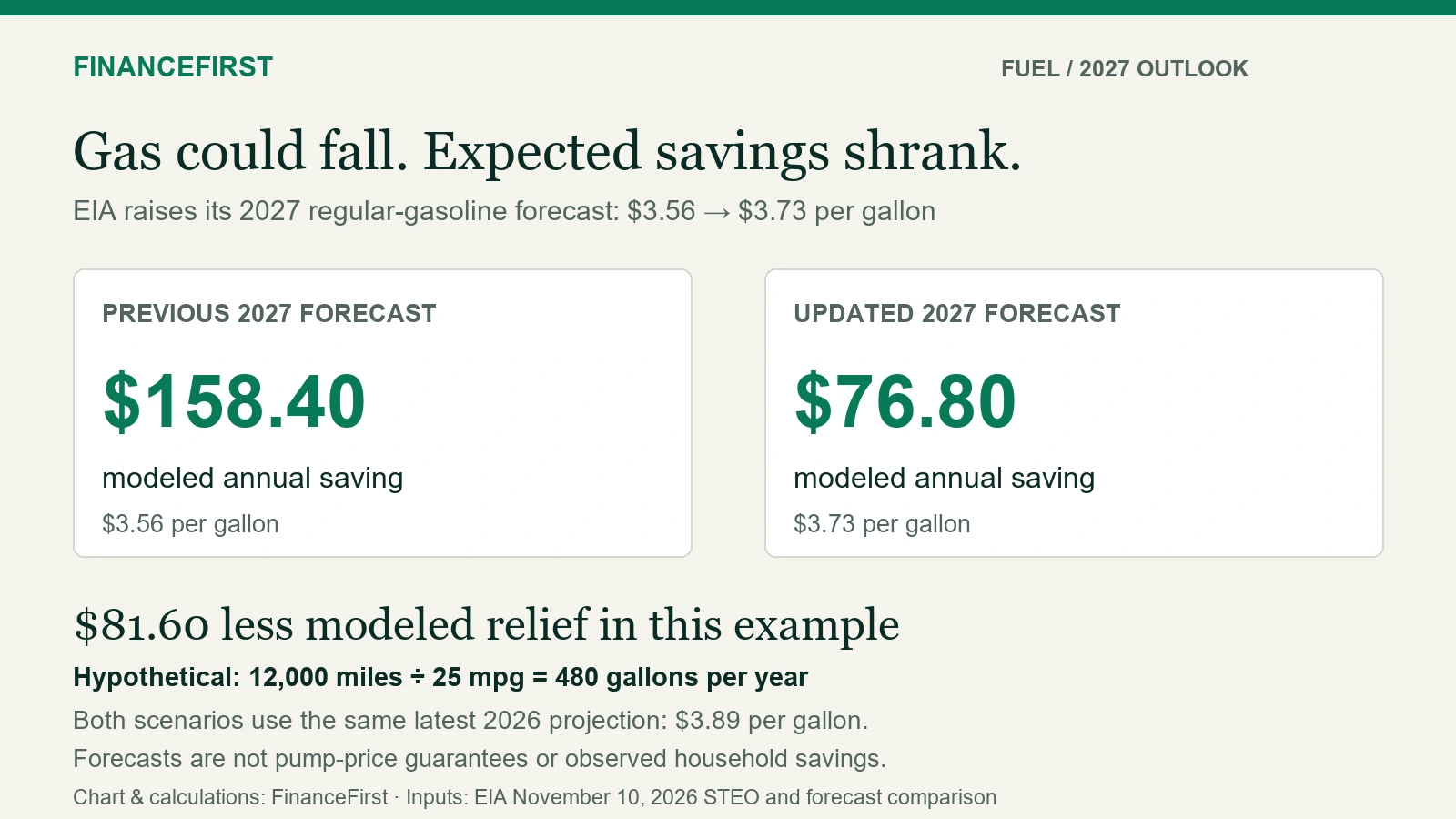
For a hypothetical driver traveling 12,000 miles a year in a vehicle getting 25 miles per gallon, the revision adds $81.60 to the modeled annual fuel bill compared with the earlier outlook.
The more revealing comparison is what happens to the expected saving. Against the latest projected 2026 price, that driver's saving falls from $158.40 under the earlier 2027 forecast to $76.80 under the updated forecast.
In this example, more than half the previously expected relief disappears.
Nobody can promise those savings. The mileage and fuel efficiency are chosen assumptions, and national annual averages do not predict the price at a particular station. But the calculation explains something that a simple "gas prices expected to fall" headline misses.
What changed in the new forecast?
EIA's November outlook raises both its gasoline and diesel forecasts for 2027. Its detailed comparison identifies gasoline as regular-grade retail fuel, including taxes, and diesel as retail fuel including taxes. [2]
Scroll sideways to see every column.
National annual average, dollars per gallon | 2026 projection in November outlook | Previous 2027 forecast, October outlook | Updated 2027 forecast, November outlook | 2027 upward revision |
|---|---|---|---|---|
Regular gasoline, including taxes | $3.89 | $3.56 | $3.73 | $0.17 |
Retail diesel, including taxes | $5.25 | $4.49 | $5.03 | $0.54 |
Source: EIA November 2026 Short-Term Energy Outlook and current-versus-previous forecast comparison. These are nominal prices, not inflation-adjusted prices. [1][2]
Both updated 2027 forecasts remain below the corresponding 2026 projections.
That is why "prices could fall next year" and "the outlook just became more expensive" are not contradictory statements. One compares two calendar years. The other compares two predictions for the same calendar year.
For anyone planning next year's commuting or business budget, both comparisons matter.
What 17 cents means in an ordinary driving example
Start with two assumptions: 12,000 miles of annual driving and 25 miles per gallon.
That works out to 480 gallons:
12,000 miles ÷ 25 miles per gallon = 480 gallons.
Applying EIA's displayed annual prices gives the following illustrative costs.
Scroll sideways to see every column.
Price used | Calculation | Hypothetical annual gasoline spending |
|---|---|---|
Latest 2026 projection | 480 gallons × $3.89 | $1,867.20 |
Previous 2027 forecast | 480 gallons × $3.56 | $1,708.80 |
Updated 2027 forecast | 480 gallons × $3.73 | $1,790.40 |
FinanceFirst calculations. These are not observed household bills or an estimate of the average driver's spending.
The updated model is $81.60 more expensive than the previous one:
480 gallons × ($3.73 − $3.56) = $81.60.
The new forecast still produces a $76.80 saving against the latest 2026 projection. The old forecast would have produced a $158.40 saving using that same baseline.
Using one common baseline is important. This is a controlled illustration of the 2027 revision, not a claim that both earlier and later EIA releases used identical 2026 forecasts.
The impact depends on how much fuel you buy
A driver with a short commute and an efficient car will not experience the same dollar effect as someone driving long distances in a less efficient vehicle.
Scroll sideways to see every column.
Chosen annual mileage | Chosen fuel economy | Annual gallons | Additional modeled 2027 cost from the gasoline forecast revision |
|---|---|---|---|
8,000 | 40 mpg | 200 | $34.00 |
12,000 | 25 mpg | 480 | $81.60 |
20,000 | 20 mpg | 1,000 | $170.00 |
All three rows are hypothetical. They apply the same 17-cent revision to different fuel-use assumptions.
The useful question is not simply, "Will gas be cheaper?" It is, "How much gasoline does my household actually buy, and what would a different price mean for us?"
If you have fuel receipts or a budgeting app, last year's gallons can be a better starting point than a generic mileage example. If you only know miles and fuel economy, dividing the former by the latter gives a rough estimate.
Use realistic fuel efficiency, not necessarily the advertised rating. Traffic, weather, loads and driving conditions can change your actual result.
Why EIA raised its expectations
EIA says it now expects global petroleum-product markets to face supply constraints through the end of 2027. It expects those conditions to support wider refining margins. [1]
Its petroleum-products analysis describes refinery damage in the Middle East and Russia that reduced refined-product exports available to the global market. It also identifies maintenance and possible unplanned outages as risks to the refining outlook. [3]
This distinction matters because crude oil is not the same product as gasoline. Refineries must turn crude into usable fuels. Constraints at that stage can affect fuel prices even when another part of the oil market is improving.
These explanations are EIA's assessment and forecast assumptions. They are not a FinanceFirst estimate assigning a precise share of any household's fuel bill to a particular disruption.
The agency finalized the forecast's model inputs on November 5. It says the forecast does not specifically account for market events after that date. [1]
Diesel has a bigger revision, but that does not give us a grocery-price forecast
The diesel forecast increased by 54 cents a gallon, from $4.49 to $5.03 for 2027. [2]
For a hypothetical diesel user purchasing 1,000 gallons during the year, that difference is $540.
That is a direct fuel-cost illustration, not a prediction about freight rates, food prices or the cost of an online order.
Delivery contracts, fuel surcharges, vehicle efficiency, other business costs and competitive conditions all affect what happens between a change in diesel costs and a customer's final price. This analysis does not estimate that pass-through.
It would be misleading to take the diesel revision and announce an equivalent percentage increase in groceries.
How to use the news without overreacting
First, separate a forecast from a price you are already paying. There is no need to treat $3.73 as today's local gasoline price or as a guaranteed price next year.
Second, build a budget around fuel use rather than a national headline. The same price change has a larger dollar effect when you buy more gallons.
Third, avoid committing every dollar of an expected saving before it arrives. A forecast can help with planning, but it is not money already in your bank account.
Finally, compare more than one scenario. The formula and downloadable scenario table below let you compare different mileage, fuel-efficiency and price assumptions. FinanceFirst’s gas-price budgeting guide explains how to work from your own fuel use. These illustrations are not a recommendation to replace a vehicle or switch fuel types.
The basic relationship is simple:
Annual fuel spending = annual miles ÷ miles per gallon × price per gallon.
Changing any of those inputs changes the answer.
What this analysis can and cannot establish
The strongest finding is narrow and verifiable: EIA raised its displayed 2027 gasoline forecast by 17 cents a gallon and its diesel forecast by 54 cents between its October and November outlooks.
The household dollar figures are calculations based on those displayed prices and explicitly chosen fuel-use assumptions.
They do not measure actual 2027 spending. They do not account for different local taxes, vehicle fuel requirements, seasonal purchase patterns or changes in driving. They exclude repairs, insurance, financing and every other ownership cost.
There are also source-quality qualifications. The retrieved EIA press release labels its summary table as based on draft overview and forecast tables and says all figures are subject to final STEO review. It separately flags annual Henry Hub natural-gas forecasts as pending reconciliation. We therefore cross-checked the fuel levels against the outlook and detailed comparison rather than relying on the press-release table alone. [1][2][4]
Published percentage changes can also differ from percentages calculated using displayed, rounded prices. This analysis uses the displayed dollar levels and cent changes. It does not claim to reproduce EIA's unrounded model outputs.
The conclusion is not that fuel costs are certain to rise next year. It is that the latest forecast leaves less room for savings than the previous one did.
For households, that is the more useful news.
Compare the hypothetical scenarios
These 18 chosen examples hold mileage and fuel economy unchanged. The latest November 2026 price projection is the common baseline for both 2027 scenarios; this isolates the 2027 revision. All amounts are nominal dollars. Download the table as CSV using its control. These are not observed bills, average household savings or fuel-price guarantees.
Scroll sideways to see every column.
Fuel | Annual miles | Miles per gallon | Annual gallons | Added cost versus previous 2027 forecast | Saving versus latest 2026 projection |
|---|---|---|---|---|---|
Gasoline | 8,000 | 20 | 400 | $68.00 | $64.00 |
Gasoline | 8,000 | 25 | 320 | $54.40 | $51.20 |
Gasoline | 8,000 | 40 | 200 | $34.00 | $32.00 |
Gasoline | 12,000 | 20 | 600 | $102.00 | $96.00 |
Gasoline | 12,000 | 25 | 480 | $81.60 | $76.80 |
Gasoline | 12,000 | 40 | 300 | $51.00 | $48.00 |
Gasoline | 20,000 | 20 | 1000 | $170.00 | $160.00 |
Gasoline | 20,000 | 25 | 800 | $136.00 | $128.00 |
Gasoline | 20,000 | 40 | 500 | $85.00 | $80.00 |
Diesel | 8,000 | 20 | 400 | $216.00 | $88.00 |
Diesel | 8,000 | 25 | 320 | $172.80 | $70.40 |
Diesel | 8,000 | 40 | 200 | $108.00 | $44.00 |
Diesel | 12,000 | 20 | 600 | $324.00 | $132.00 |
Diesel | 12,000 | 25 | 480 | $259.20 | $105.60 |
Diesel | 12,000 | 40 | 300 | $162.00 | $66.00 |
Diesel | 20,000 | 20 | 1000 | $540.00 | $220.00 |
Diesel | 20,000 | 25 | 800 | $432.00 | $176.00 |
Diesel | 20,000 | 40 | 500 | $270.00 | $110.00 |
What to watch next
EIA schedules its next Short-Term Energy Outlook for December 8, 2026. The next release can change the forecast again; compare both the 2027 price and the 2026 baseline before updating a household scenario. [1]
Sources
[1] U.S. Energy Information Administration, Short-Term Energy Outlook, released November 10, 2026; forecast inputs finalized November 5. https://www.eia.gov/outlooks/steo/
[2] EIA, Current/Previous Forecast Comparisons, current November 10, 2026; previous October 6, 2026. Energy Prices table, regular-grade gasoline retail including taxes and diesel retail including taxes. https://www.eia.gov/outlooks/steo/pdf/compare.pdf
[3] EIA, U.S. Petroleum Products, November 2026 Short-Term Energy Outlook. https://www.eia.gov/outlooks/steo/report/petro_prod.php
[4] EIA, November 10, 2026 press release. Retained with its draft/reconciliation caveat. https://www.eia.gov/pressroom/releases/press594.php
Reporting and methodology
Analysis · Editorial review: Asim Ahmad.
Methodology
Uses EIA’s November 10, 2026 Short-Term Energy Outlook, detailed current/previous comparison, petroleum-products analysis and qualified press release. FinanceFirst checked 16 annual price cells and reproduced 18 chosen mileage/efficiency scenarios using decimal arithmetic. Annual gallons equal miles divided by mpg; annual cost equals gallons times the displayed fuel price. Both 2027 scenarios use the latest 2026 projected price as a common baseline to isolate the revision. Results are nominal and rounded to cents. The public comparison table can be downloaded as CSV.
Limitations
Forecasts are not observed 2027 prices or household savings. The scenarios are chosen illustrations, not representative drivers; local taxes, grade requirements, seasonal purchases, changing driving and other vehicle costs are excluded. Both vintages are compared against a common latest2026 baseline, not their own separate2026 forecasts. Displayed rounded dollar levels do not reproduce all official unrounded percentage changes. EIA’s press-release table remains marked draft and subject to final review, with a separate Henry Hub reconciliation warning; fuel levels were cross-checked against the outlook and comparison. EIA finalized inputs November5; later events are not specifically modeled. No diesel-to-grocery pass-through is estimated.
Conflicts disclosure
Uses public EIA sources; no fuel or vehicle recommendations, affiliate links, sponsored research or original interviews.
Forecast and uncertainty
EIA projected2027 national annual retail regular gasoline3.73USD/gallon and retail diesel5.03, includingtaxes; FinanceFirst scenarios condition on those inputs, not an independent forecast. Time horizon: Calendar year2027; November10,2026 forecast vintage with inputs finalizedNovember5.. Assumptions and method: EIA expects continued global petroleum-product supply constraints and elevated refining margins. Household scenarios hold chosen mileage and efficiency unchanged, use displayed nominal national annual price levels and latest2026 projection as a common baseline.. Alternative outcome: Faster easing of constraints, different demand, outages, crude prices or local purchase patterns could produce higher or lower fuel costs. The old and new forecasts are not promises; no probability is assigned by FinanceFirst.. Follow-up date: 2026-12-08T18:00:00.000Z.