

The myth that you need a high income to build wealth has kept countless people from even trying. The reality? Plenty of teachers, nurses, and blue-collar workers retire millionaires, while high earners live paycheck to paycheck. Wealth is about what you keep and grow, not just what you earn.
Strategy 1: Pay Yourself First
Before you pay bills, buy groceries, or spend on anything else, save and invest a percentage of your income. Start with 10% if possible. Automate the transfer to happen on payday so you never see the money.
Consider a scenario: someone earning $45,000 per year automates a 10% transfer of $375 per month to a low-cost index fund. At a 7% average annual return, that single habit turns into over $190,000 in 20 years. The trick is treating savings like a non-negotiable bill, it comes out before you ever decide what to spend on.
According to the Federal Reserve's Survey of Household Economics, 37% of Americans cannot cover a $400 emergency with cash. Paying yourself first breaks that cycle by building a financial buffer automatically.
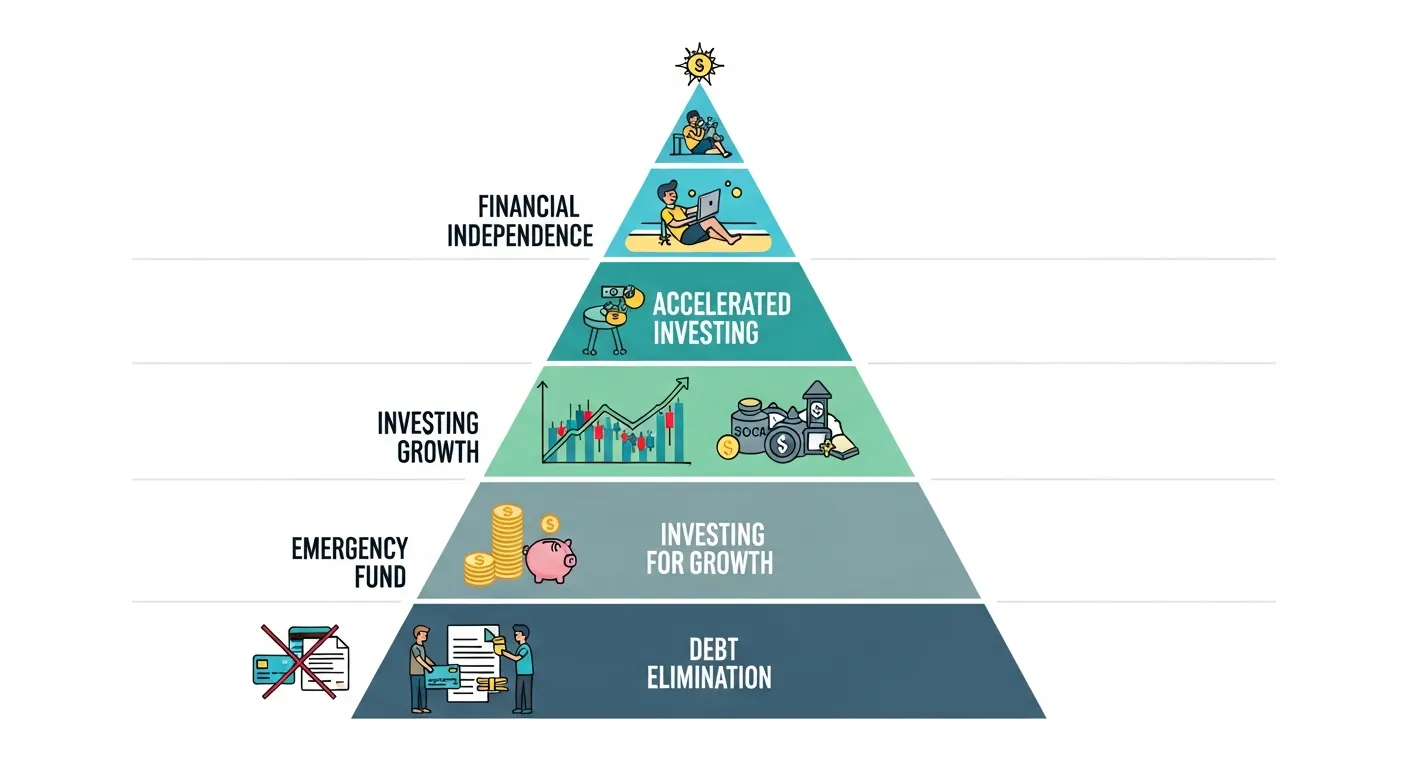
Strategy 2: Eliminate High-Interest Debt
Debt is the enemy of wealth building. Credit card interest at 20% or higher makes it mathematically impossible to get ahead. Follow our debt payoff guide to eliminate it.
Consider a scenario: someone carrying $8,000 in credit card debt at 22% APR and making only minimum payments. They will pay over $12,000 in interest alone and take more than 25 years to clear the balance. Redirecting just $300 per month to that debt eliminates it in under three years and saves over $9,000 in interest, money that can then flow straight into investments.
Strategy 3: Live Below Your Means
The gap between what you earn and what you spend is your wealth-building engine. This does not mean deprivation. It means intentional spending on what matters and cutting ruthlessly on what does not.
The Bureau of Labor Statistics Consumer Expenditure Survey shows the average American household spends 95% of its after-tax income. That leaves almost nothing for wealth building. Households that consistently save 20% or more build net worth five to ten times faster than average. Track your spending for 30 days using our budgeting guide, and you will likely find $200-500 per month in spending that does not align with your priorities.
Strategy 4: Invest Early and Consistently
Time in the market is your superpower. Low-cost index funds have outperformed most professional investors over time. Our beginner's investing guide shows you how to start.
The math is striking. According to historical data from NYU Stern, the S&P 500 has returned roughly 10% annually (about 7% after inflation) since 1928. Investing $200 per month starting at age 25 produces approximately $525,000 by age 60 at a 7% real return. Wait until 35 to start and you would need $415 per month to reach the same amount, more than double.
Strategy 5: Maximize Free Money
Never leave employer 401(k) matching on the table. If your employer matches 50% up to 6% of your salary, that is an instant 50% return on your money.
Consider a scenario: someone earning $60,000 whose employer matches 100% of the first 3% and 50% of the next 2%. Contributing 5% ($3,000 per year) earns $2,400 in employer match, an immediate 80% return before any market gains. Over a 30-year career at 7% growth, that employer match alone becomes over $240,000. According to Vanguard's How America Saves report, roughly one in five eligible workers still does not contribute enough to capture the full employer match.
Strategy 6: Build Multiple Income Streams
Relying on one income source is risky. Consider side hustles, passive income from investments, or monetizing your skills.
A study of IRS tax data reveals that the median millionaire has three or more income sources. These do not have to be complicated: dividend-paying index funds, a rental property, freelance consulting, or an online business all qualify. Even an extra $500 per month invested at 7% grows to over $260,000 in 20 years.
Strategy 7: Increase Your Earning Power
Invest in yourself. Learn skills that command higher pay. Negotiate salary at every opportunity. Switch jobs strategically.
Data from the Bureau of Labor Statistics shows that workers who switch jobs typically receive salary increases of 10-20%, compared to the 3-5% average annual raise for those who stay. Over a career, the compounding effect of higher base salaries is enormous. A single $10,000 raise at age 30, invested wisely, can translate into over $150,000 in additional retirement savings by age 65.
Strategy 8: Avoid Lifestyle Inflation
When income goes up, spending usually follows. Redirect at least half of every raise to savings before adjusting your lifestyle.
Consider a scenario: someone receives a $5,000 raise and immediately increases their lifestyle, a nicer car payment, upgraded streaming services, more dining out. Within months, they are spending every penny of the raise and their savings rate has not changed. Now consider redirecting $250 per month (half the raise) to investments instead. Over 20 years at 7%, that alone becomes over $130,000. The key is making the savings transfer automatic the moment a raise hits, before your spending habits adjust.
Strategy 9: Protect Your Wealth
Build an emergency fund of 3-6 months of expenses. See our emergency fund guide. Get proper insurance coverage.
Wealth protection is as important as wealth creation. A single uninsured medical event can cost $65,000 or more and wipe out years of savings. Make sure you have adequate health, auto, renters or homeowners, and disability insurance. Our health insurance guide explains how to choose the right coverage without overpaying.
Strategy 10: Understand Taxes
Use tax-advantaged accounts fully. Our tax filing guide helps you keep more of what you earn.
Maximizing contributions to a 401(k), IRA, and HSA can reduce your taxable income by $30,000 or more per year. At a 22% marginal tax rate, that is $6,600 in annual tax savings, money that stays invested and compounds for decades. Learn more about optimizing your retirement accounts in our IRA vs 401(k) comparison guide.
Strategy 11: Avoid Get-Rich-Quick Traps
Real wealth builds slowly. Avoid speculative investments you do not understand and high-fee products promising extraordinary returns.
The SEC warns that investment fraud costs Americans billions of dollars each year. Common traps include cryptocurrency "guaranteed return" schemes, high-fee whole life insurance marketed as investments, forex trading programs, and MLM opportunities. If an investment promises consistent double-digit returns with "no risk," it is almost certainly a scam or an unsustainable model. Stick to diversified, low-cost index funds for the core of your portfolio.
Strategy 12: Think Long-Term
Wealth building is a decades-long game. Stay patient. Stay consistent. In 20-30 years, you will look back amazed at what steady progress created.
Markets crash, recessions happen, and life throws curveballs. The investors who build real wealth are those who stay the course. According to J.P. Morgan's Guide to the Markets, missing just the 10 best trading days over a 20-year period cuts your returns by more than half. Panic-selling during downturns is one of the most destructive financial behaviors. Set your plan, automate your contributions, and let time do the heavy lifting.
Wealth Building Timeline: What Is Possible at Different Income Levels
Wealth building is not reserved for high earners. Here is what consistent saving and investing can produce at various income levels, assuming a 15% savings rate and 7% average annual investment return:
| Annual Income | Monthly Savings (15%) | After 10 Years | After 20 Years | After 30 Years |
|---|---|---|---|---|
| $35,000 | $438 | $75,800 | $228,000 | $527,000 |
| $50,000 | $625 | $108,200 | $325,700 | $753,000 |
| $75,000 | $938 | $162,400 | $488,600 | $1,129,000 |
| $100,000 | $1,250 | $216,500 | $651,400 | $1,506,000 |
| $150,000 | $1,875 | $324,700 | $977,100 | $2,259,000 |
Notice that even at $35,000 per year, saving 15% consistently can produce over half a million dollars in 30 years. The magic is not the income, it is the consistency and time.
Common Wealth-Building Mistakes to Avoid
Even motivated savers can undermine their progress with these common errors:
- Waiting for the "right time" to start: There is no perfect moment. The best time to start investing was 10 years ago. The second best time is today. Every month you delay costs you thousands in lost compound growth.
- Trying to time the market: Research from DALBAR's annual study consistently shows that the average investor earns significantly less than market returns because of poor timing decisions. Buy consistently and hold for the long term.
- Ignoring fees: A 1% difference in investment fees can cost you hundreds of thousands over a career. Choose index funds with expense ratios below 0.10% whenever possible.
- Not tracking net worth: What gets measured gets managed. Calculate your net worth (assets minus liabilities) at least quarterly. Watching it grow is motivating and reveals problems early.
- Comparing yourself to others: Social media makes it look like everyone else is richer. The reality is that many high-spending households carry enormous debt. Focus on your own trajectory.
- Neglecting insurance: One lawsuit, one medical crisis, or one disability can erase a decade of progress. Proper insurance is not optional, it is foundational.
- Saving without investing: Money in a savings account barely keeps pace with inflation. After building your emergency fund, excess cash belongs in a HYSA, CD, or money market account only if you need it within 1 to 3 years. Longer-term money should be invested in diversified, growth-oriented assets.
The Bottom Line
Building wealth is not complicated. It is simple habits repeated over time. Start today. Even small steps move you closer to financial freedom. The strategies above work regardless of whether you earn $30,000 or $300,000, because wealth is determined by the gap between earning and spending, multiplied by time and compound growth.
Related Reading
- How to Create a Budget That Actually Works
- How to Pay Off Debt Fast
- How to Start Investing with $500
- Complete Guide to Building an Emergency Fund
- IRA vs 401(k): Which Retirement Account is Best?
Frequently Asked Questions
Can You Build Wealth on Minimum Wage?
Yes, it is possible to build wealth on minimum wage, though it requires more discipline and creativity. The key strategies include keeping housing costs below 30% of income through house hacking or shared living arrangements, automating even small savings amounts like $25-50 per paycheck into a Roth IRA, taking advantage of employer benefits like 401(k) matches if available, and actively working to increase your income through skill development, certifications, or side hustles. Many millionaires started with modest incomes and built wealth through consistent saving habits and compound growth over decades.
How Much Should I Save Each Month?
A common guideline is the 50/30/20 rule: 50% of after-tax income for needs, 30% for wants, and 20% for savings and debt repayment. However, the ideal savings rate depends on your goals and timeline. To retire comfortably, aim to save at least 15% of gross income for retirement, plus additional savings for other goals like an emergency fund and down payment. If you are starting late or want to achieve financial independence sooner, saving 25-50% of income significantly accelerates your timeline. The most important step is to start saving something consistently, even if it is less than the recommended percentage.
What Investments Build Wealth the Fastest?
Historically, equities (stocks) have produced the highest long-term returns, averaging 7-10% annually after inflation. Low-cost total stock market index funds provide the broadest exposure with minimal fees. Real estate can also build wealth through rental income and appreciation, especially when leveraged with a mortgage. For the fastest wealth building, combine multiple strategies: maximize tax-advantaged retirement accounts, invest consistently in diversified index funds, develop additional income streams, and reinvest all returns. Avoid speculative investments that promise outsized returns, as they carry proportionally higher risk of loss.
How Long Does It Take to Build Wealth?
The timeline depends on your savings rate, investment returns, and starting point. Investing $500 per month at a 7% average annual return grows to approximately $122,000 in 15 years, $260,000 in 20 years, and $610,000 in 30 years. Increasing contributions to $1,000 per month roughly doubles those figures. Most people can build a solid six-figure net worth within 10-15 years of consistent saving and investing, and reach millionaire status within 20-30 years. Starting earlier dramatically reduces the monthly amount needed because compound growth does more of the work over longer periods.
What Are the Best Passive Income Ideas for Beginners?
The most accessible passive income sources for beginners include dividend-paying index funds that distribute quarterly income, high-yield savings accounts earning 4-5% APY, and real estate investment trusts (REITs) that provide real estate exposure without direct property ownership. More active options that can become passive over time include creating digital products, building a content website, or renting out a spare room. True passive income requires upfront investment of either money or time. Start with dividend investing through your existing portfolio and explore other options as your capital and experience grow. For more details, see our complete guide to dividend investing.