
Debt feels like a weight on your chest that never goes away. Consider a common scenario: someone with $47,000 in credit card debt, student loans, and a car payment consuming nearly half their income. It can feel impossible to escape, but thousands of people do it every year with the right strategy. Here is exactly how to do it.
The average American carries $104,215 in total debt according to Experian's 2025 Consumer Debt Study. That includes mortgages, student loans, auto loans, and credit cards. While some debt like a reasonable mortgage can be strategic, high-interest consumer debt is a wealth destroyer that keeps millions from building the future they deserve.
Why Most Debt Payoff Plans Fail
Before we dive into strategies, we need to address why so many people struggle. The top three reasons are:
- No clear system: Making minimum payments across multiple accounts without a focused strategy
- Burnout: Starting too aggressively and giving up when life gets hard
- Ignoring the root cause: Paying off cards only to run them back up
A successful debt payoff plan addresses all three. It gives you a clear roadmap, builds in psychological wins, and changes the habits that created the debt.
Step 1: Know Your Numbers
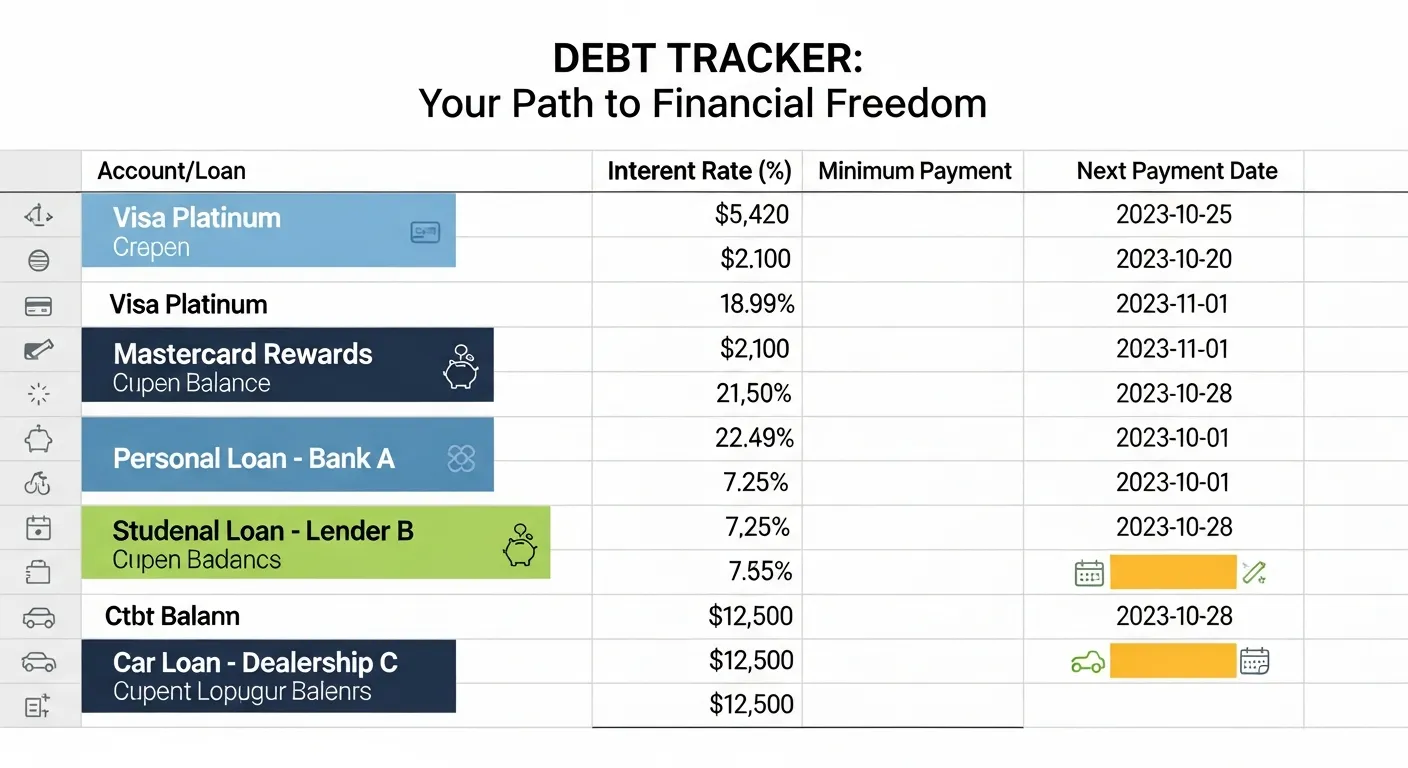
You cannot fix what you do not measure. Grab every statement and list out your creditor name, current balance, interest rate APR, minimum payment, and payment due date.
This exercise can be uncomfortable, but it is essential. Many people underestimate their total debt by 20-30% because they avoid looking at the full picture.
Step 2: Choose Your Payoff Method
There are two proven approaches, and choosing the right one depends on your personality.
The Debt Avalanche Method
With the avalanche method, you pay minimums on everything except your highest-interest debt. All extra money goes toward that highest-rate balance until it is gone. Then you move to the next highest rate.
Pros: Mathematically optimal, saves the most money, pays off debt faster overall, and is best for people motivated by numbers.
Cons: If your highest-rate debt has a large balance, your first win may take a long time and can feel discouraging early on.
The Debt Snowball Method
With the snowball method, you pay off debts from smallest balance to largest, regardless of interest rate. You attack the smallest debt first, eliminate it, then roll that payment into the next smallest.
Pros: Quick wins build momentum and motivation, fewer accounts to manage faster, and psychologically powerful.
Cons: May cost more in interest over time and takes slightly longer mathematically.
Here is the truth: research from Harvard Business Review shows that people who use the snowball method are more likely to actually pay off their debt. The psychological wins matter. If you know you will stay disciplined regardless, use the avalanche. If you need motivation, go with the snowball.
Step 3: Find Extra Money to Accelerate Payoff
Minimum payments keep you in debt for decades. To escape, you need to throw more money at the problem.
Reduce Expenses
- Cut subscriptions you forgot you had. The average American wastes $133 per month on unused subscriptions.
- Negotiate bills like car insurance, internet, and phone plans
- Cook more meals at home, which saves $200-400 per month for most families
- Pause retirement contributions temporarily if needed, since getting out of 24% APR debt beats an 8% average market return
Increase Income
- Ask for a raise. The average successful salary negotiation yields 7-10% increase.
- Start a side hustle like driving, freelancing, or tutoring
- Sell things you no longer need
- Take on overtime if available
Even an extra $300-500 per month dramatically accelerates your timeline. On $20,000 in credit card debt at 22% APR, adding $500 to your monthly payment cuts your payoff time from 11 years to just 2.5 years.
Step 4: Consider Debt Consolidation
Debt consolidation combines multiple debts into a single loan with one payment. This can be helpful if you qualify for a lower interest rate than your current debts, you want to simplify multiple payments into one, and you have good enough credit to get approved.
Balance Transfer Credit Cards
Many cards offer 0% APR for 12-21 months on balance transfers. If you can pay off the balance before the promotional period ends, this saves significant money. Watch out for transfer fees, typically 3-5% of the balance.
Personal Loans
Fixed-rate personal loans from banks, credit unions, or online lenders can consolidate credit card debt at lower rates. Look for rates under 12% if possible, and avoid loans with prepayment penalties.
Step 5: Prevent Future Debt
Paying off debt is pointless if you immediately rack it back up. Build these habits:
- Emergency fund first: Even $1,000 prevents going back into debt for unexpected expenses. Once debt is gone, build 3-6 months of expenses. Check out our complete emergency fund guide for details.
- Budget with intention: Know where your money goes before you spend it. Our budgeting guide can help.
- Use credit cards only for what you can pay in full: If you cannot pay the balance monthly, do not charge it.
Debt Payoff Method Comparison
| Method | How It Works | Pros | Cons | Best For |
|---|---|---|---|---|
| Avalanche | Pay highest-interest debt first | Saves the most money; fastest mathematically | First win may take months; requires discipline | Numbers-driven people who stay motivated by math |
| Snowball | Pay smallest balance first | Quick psychological wins; builds momentum | Costs more in total interest | People who need motivation and visible progress |
| Consolidation | Combine debts into one lower-rate loan | Simplifies payments; may lower interest rate | Requires good credit to qualify; fees may apply | Those with good credit and multiple high-rate debts |
| Balance Transfer | Move balances to a 0% APR card | 0% interest for 12-21 months; massive savings if paid in full | Transfer fee of 3-5%; high rate after promo ends | People who can pay off the balance before the promotional period expires |
How Long Will It Take to Pay Off Your Debt?
Your payoff timeline depends on your total debt, interest rates, and how much extra you can pay each month. Here are realistic examples based on common debt scenarios, assuming the debt avalanche method:
Scenario 1: $10,000 Credit Card Debt at 22% APR
- Minimum payments only (~$250/month): 5 years and 2 months. Total interest paid: $5,840.
- $500/month payments: 1 year and 11 months. Total interest paid: $2,140. You save $3,700.
- $750/month payments: 1 year and 3 months. Total interest paid: $1,380. You save $4,460.
Scenario 2: $30,000 Mixed Debt (Credit Cards + Car Loan)
Assume $18,000 in credit cards at 20% APR and $12,000 car loan at 6% APR:
- Minimum payments only (~$700/month): Over 7 years. Total interest paid: approximately $18,500.
- $1,200/month total payments: 2 years and 10 months. Total interest paid: approximately $7,200. You save $11,300.
Scenario 3: $50,000 in Student Loans at 6.5% APR
- Standard 10-year repayment ($568/month): 10 years. Total interest paid: $18,150.
- Aggressive $1,000/month: 4 years and 10 months. Total interest paid: $8,200. You save $9,950.
These examples illustrate a critical point: even modest increases in monthly payments dramatically shorten your timeline and reduce total interest. Use our debt payoff calculator to run your specific numbers. The Consumer Financial Protection Bureau also offers free tools to estimate your payoff timeline.
Your 30-Day Action Plan
Week 1: List all debts with balances, rates, and minimums. Calculate your total.
Week 2: Choose snowball or avalanche. Set up automatic minimum payments on all accounts.
Week 3: Find at least $200 per month in expenses to cut or income to add.
Week 4: Make your first extra payment toward your target debt. Set a calendar reminder for monthly progress check-ins.
The Bottom Line
Getting out of debt is not about willpower or deprivation. It is about having a system that works with your psychology, staying consistent, and celebrating progress along the way.
Every payment you make is a step toward freedom. The day you make your final payment and owe nothing to anyone is one of the best feelings you will ever experience. Start today.
Related Reading
- How to Boost Your Credit Score Fast - Improve your credit as you pay off debt
- The Complete Guide to Building an Emergency Fund - Prevent future debt emergencies
- How to Create a Budget That Actually Works - Control your spending
Frequently Asked Questions
What Is the Best Debt Payoff Method?
The best method depends on your personality. The debt avalanche (paying highest-interest debt first) saves the most money mathematically, while the debt snowball (paying smallest balances first) provides quicker psychological wins that keep you motivated. Research from Harvard Business Review found that snowball users are more likely to eliminate their debt entirely because the early wins sustain momentum. If you are highly disciplined with numbers, choose the avalanche. If you need motivation to stay on track, the snowball is more effective in practice.
How Long Does It Take to Pay Off $10,000 in Debt?
The timeline depends on your interest rate and monthly payment amount. At 22% APR with minimum payments of roughly $250 per month, it takes over 5 years and costs $5,840 in interest. Increasing your payment to $500 per month cuts the payoff time to under 2 years and reduces total interest to about $2,140. Adding $750 per month shortens it to approximately 15 months. Use our debt payoff calculator to estimate your specific timeline.
What Are the Pros and Cons of Debt Consolidation?
Debt consolidation combines multiple debts into a single loan, ideally at a lower interest rate. The pros include simplifying payments, potentially lowering your interest rate, and having a fixed payoff timeline. The cons include needing good credit to qualify for favorable rates, possible origination fees of 1-8%, and the risk of running up new balances on the cards you just paid off. Consolidation works best when you qualify for a rate significantly lower than your current average and commit to not accumulating new debt.
Should I Save Money or Pay Off Debt First?
Financial experts recommend a balanced approach. First, build a starter emergency fund of $1,000 to prevent going further into debt for unexpected expenses. Then focus aggressively on paying off high-interest debt above 7-8% APR, since no savings account earns enough to offset 20%+ credit card interest. Once high-interest debt is eliminated, build your full emergency fund of 3-6 months of expenses before turning to other financial goals like investing. If your employer offers a 401(k) match, contribute enough to capture the full match even while paying off debt, because the match is an immediate 50-100% return.
Does Paying Off Debt Improve Your Credit Score?
Yes, paying off debt typically improves your credit score in several ways. Reducing your credit card balances lowers your credit utilization ratio, which accounts for about 30% of your FICO score. Consistently making on-time payments builds your payment history, which is the single largest factor at 35% of your score. Most people see noticeable improvement within 1-2 billing cycles after significantly reducing balances. Paying off installment loans like car loans or student loans has a smaller but still positive impact. For a deeper dive, see our guide on how to boost your credit score fast.