
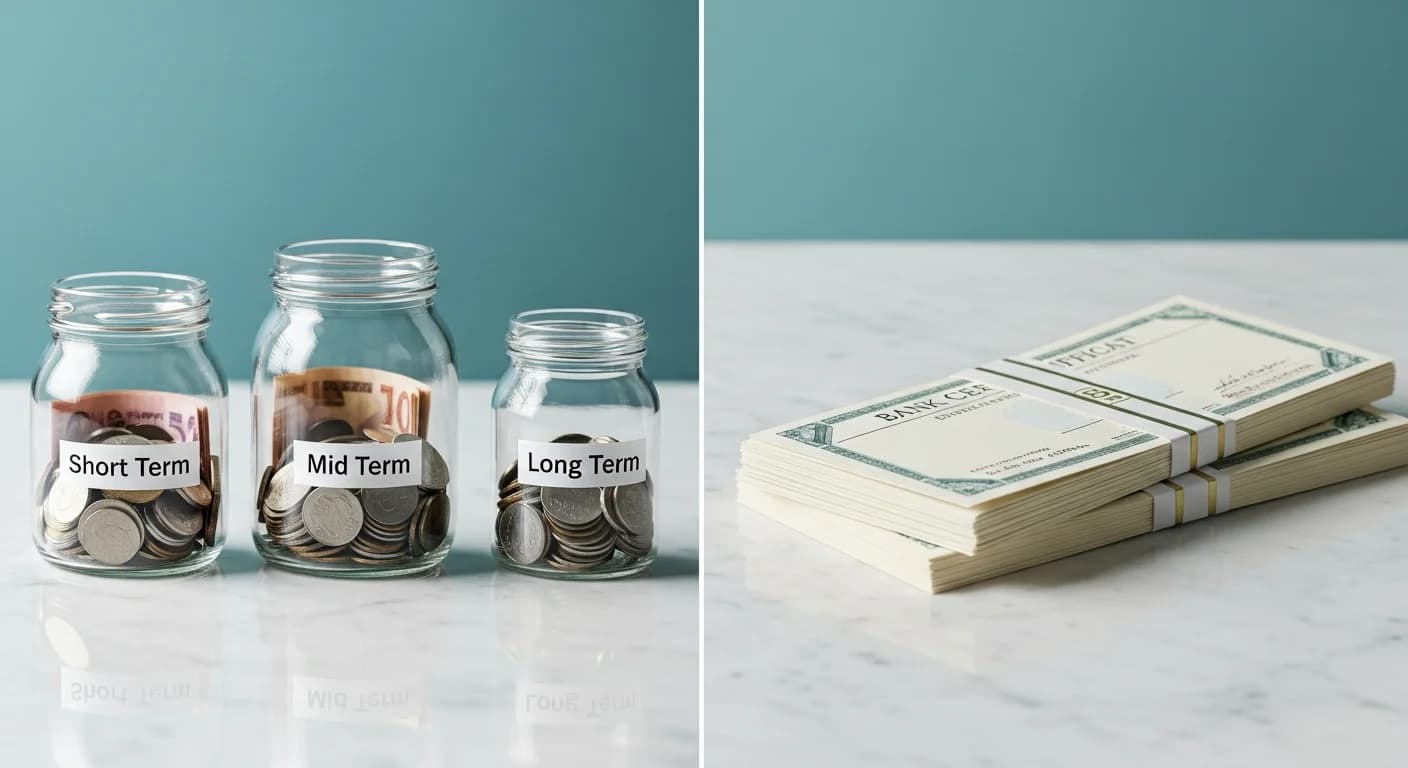
If you are deciding where to keep cash in 2026, a HYSA is usually best for flexibility, a CD is best for locking in a rate, and a money market account is best when you want savings interest with easier access to checks or debit features. The right choice depends on when you need the money, how much access you want, and whether rates are likely to fall.
In this guide, you will see how HYSAs, CDs, and money market accounts compare on APY, liquidity, penalties, minimum balances, and FDIC protection so you can choose the right account for your emergency fund, short-term savings, or larger cash reserves.
Last updated: March 2026. Rate data reflects publicly available figures from the Federal Reserve, FDIC, and major financial comparison platforms.
Quick Answer: HYSA vs CD vs Money Market
Choose a HYSA if you need full access to your money and want a strong rate for an emergency fund or short-term goal. Choose a CD if you can leave the money untouched for a fixed period and want to lock in a guaranteed rate. Choose a money market account if you want competitive interest plus features like check writing or easier access for larger balances.
- Best for emergency funds: HYSA
- Best for locking in rates: CD
- Best for large balances with check access: Money market
- Best for flexibility: HYSA
- Best if rates may fall soon: CD
- Best all-around choice for most savers: HYSA
Bottom line: For most people, a HYSA is the best default choice because it combines strong rates with full liquidity. A CD is better when you know you will not need the money before maturity and want to lock in yield. A money market account makes sense when you want interest plus easier access features for larger balances.
This guide is for you if you are building an emergency fund, saving for a down payment, holding a large cash balance, or deciding where to move money out of a low-yield checking or savings account.
Key Takeaways
- HYSA: best for emergency funds and short-term savings you may need anytime
- CD: best when you can leave money untouched and want to lock in today's rate
- Money market: best for larger balances when you want interest plus easier transaction access
- Most people should start with a HYSA unless they have a fixed timeline and want a guaranteed CD rate
- The wrong choice is usually keeping cash in a near-0% traditional savings account
Jump to What Matters Most
Which Account Is Best for Each Situation?
| Situation | Best Account | Why |
|---|---|---|
| Emergency fund | HYSA | Full access and competitive APY |
| Saving for a home in 12 to 24 months | HYSA or CD | Depends on flexibility vs certainty |
| Want to lock in rates before cuts | CD | Fixed yield during term |
| Need checks or easier spending access | Money market | More access features |
| Large cash balance sitting idle | Money market or HYSA | Better yield than traditional savings |
| Unsure and want simplicity | HYSA | Best default choice for most savers |
Keep reading for side-by-side APY comparisons, CD penalty examples, emergency fund guidance, and the exact situations where each account wins.
HYSA vs CD vs Money Market Rates in 2026
Before comparing these three account types, you need to understand why rates are where they are. The Federal Reserve's benchmark rate sits at 4.25%-4.50% as of early 2026, down from the peak of 5.25%-5.50% in mid-2024. The Fed has signaled potential further cuts, which directly affects what banks offer on deposits.
This matters because the direction of rates should influence which account you choose. When rates are stable or falling, locking into a CD can protect your earnings. When rates are rising, staying flexible with a HYSA or money market account lets you capture higher rates as they appear. If you already know you want a HYSA, see our ranked list of the best high-yield savings accounts for 2026.
Here is the fastest way to compare a HYSA, CD, and money market account if your goal is to choose the best place for your cash in 2026.
HYSA vs CD vs Money Market: Side-by-Side Comparison
| Feature | High-Yield Savings | Certificate of Deposit | Money Market |
|---|---|---|---|
| Top APY (Feb 2026) | 4.25% - 5.00% | 4.50% - 5.25% | 4.00% - 4.75% |
| FDIC Insured | Yes, $250K | Yes, $250K | Yes, $250K |
| Liquidity | Full access anytime | Locked until maturity | Full access + checks |
| Minimum Balance | $0 - $100 | $0 - $1,000 | $1,000 - $2,500 |
| Early Withdrawal Penalty | None | 3-12 months interest | None |
| Rate Type | Variable | Fixed | Variable |
| Check Writing | No | No | Yes (limited) |
| Best For | Emergency fund, short-term goals | Rate-locking, planned expenses | Large balances, flexible access |
Research Insight
When interest rates rise quickly, high-yield savings accounts often adjust rates faster than CDs because HYSA rates are variable and banks compete for deposits. However, when rates begin to fall, CDs can temporarily offer higher yields because their rates remain locked for the entire term. This lag creates a window where CDs outperform HYSAs, which is exactly the environment many savers face in 2026 as the Federal Reserve signals further rate cuts.
This pattern is observable in the Federal Reserve H.15 interest rate data, which tracks deposit rates across institution types over time.
What a HYSA Is Best For
A high-yield savings account works exactly like the savings account at your local bank, except it pays 40 to 50 times more interest. While Chase, Bank of America, and Wells Fargo offer around 0.01% to 0.05% APY on savings, the best online HYSAs currently pay between 4.25% and 5.00% APY.
How HYSAs Work
You deposit money. You earn interest daily (compounded daily or monthly depending on the bank). You withdraw whenever you want with no penalties. That is it. There is no lock-up period, no maturity date, and typically no minimum balance requirement. The interest rate is variable, meaning the bank can change it at any time based on market conditions and the Federal Reserve's decisions.
Real Dollar Comparison
Here is what $25,000 earns at different rates over one year:
- Traditional savings (0.05% APY): $12.50 in interest
- HYSA at 4.50% APY: $1,125.00 in interest
- HYSA at 5.00% APY: $1,250.00 in interest
That is over $1,200 per year you are giving up by using a traditional savings account. Over five years with compound interest, that gap grows to over $6,500. Use our Compound Interest Calculator to see exactly how much your specific balance could earn.
HYSA Pros
- Complete liquidity: Access your cash anytime via transfer (usually 1-2 business days)
- No penalties: Withdraw as much as you want with zero fees
- Low or no minimums: Many accounts have no minimum balance requirements
- FDIC insurance: Your money is protected up to $250,000 per depositor
- Simple: No terms to track, no maturity dates, no decisions to make
HYSA Cons
- Variable rates: Your rate can drop if the Fed cuts rates, and it will eventually
- Rate chasing: The highest-paying HYSA today might not be the highest next month
- Transfer delays: External transfers take 1-3 business days (not instant like checking)
- No checks or debit card: You cannot spend directly from most HYSAs
When a HYSA is the Best Choice
A HYSA is the ideal account for your emergency fund because you need instant access and cannot afford penalties. Many financial planners consider a HYSA the best savings account for an emergency fund. It is also excellent for any savings goal where the timeline is less than two years, such as saving for a vacation, wedding, or house down payment. If you are deciding where to park cash short-term, a HYSA is almost always the right call.
When a CD Makes More Sense Than a HYSA
A certificate of deposit is a time-locked savings agreement. You give the bank a lump sum for a fixed period (the "term"), and in exchange, they guarantee a fixed interest rate for the entire term. When the term ends (the CD "matures"), you get your principal plus all earned interest back.
How CDs Work
You choose a term (typically 3 months to 5 years), deposit your money, and receive a guaranteed rate. The bank can never lower your rate during the term, regardless of what the Fed does. In exchange for that guarantee, you agree not to withdraw the money before maturity. If you do withdraw early, you pay an early withdrawal penalty, usually equal to 3 to 12 months of interest depending on the CD term and the bank.
CD Term Comparison (February 2026 Top Rates)
| CD Term | Top APY | Interest on $25,000 | Early Withdrawal Penalty |
|---|---|---|---|
| 3 months | 4.50% | $281 | 1-3 months interest |
| 6 months | 4.75% | $594 | 3 months interest |
| 12 months | 5.00% | $1,250 | 6 months interest |
| 18 months | 4.85% | $1,819 | 6-9 months interest |
| 24 months | 4.60% | $2,300 | 9-12 months interest |
| 60 months | 4.25% | $5,312 | 12-18 months interest |
The CD Ladder Strategy
Instead of locking all your money into one CD, spread it across multiple CDs with different maturity dates. For example, take $20,000 and split it into four $5,000 CDs:
- $5,000 in a 3-month CD
- $5,000 in a 6-month CD
- $5,000 in a 12-month CD
- $5,000 in an 18-month CD
Every three to six months, one CD matures. You can either use the money or reinvest it into a new CD. This gives you regular access to portions of your cash while still earning higher locked-in rates. It is a particularly smart strategy when rates are uncertain or expected to decline.
CD Pros
- Guaranteed rate: Your rate is locked in no matter what happens to the economy
- Higher potential rates: CDs often offer slightly higher rates than HYSAs, especially for 12-month terms
- Discipline: The penalty discourages impulsive withdrawals
- FDIC insurance: Same $250,000 protection as savings accounts
- Predictable returns: You know exactly how much you will earn from day one
CD Cons
- Illiquidity: Your money is locked up, accessing it costs you
- Early withdrawal penalties: Pulling money before maturity means losing months of interest
- Opportunity cost: If rates rise, you are stuck at the lower locked-in rate
- No additions: Most CDs do not let you add money after the initial deposit
When CDs are the Best Choice
CDs excel when you have money you absolutely will not need for a known period. Planning to buy a car in 12 months? A 12-month CD locks in your rate. Expecting rates to fall? A longer-term CD protects your earnings. Building a down payment fund with a specific closing date? A CD maturing right before your target date is smart. In the CD vs savings account debate, the answer depends entirely on your timeline. Just make sure you have a separate emergency fund in a HYSA so you never need to break a CD early.
When a Money Market Account Is the Better Fit
While CDs focus on locking in interest rates, money market accounts prioritize flexibility and transaction access. A money market account combines elements of both savings and checking accounts. Like a HYSA, it earns competitive interest. Like a checking account, it often comes with check-writing privileges and sometimes a debit card. It sits in the middle ground between earning and spending.
How Money Market Accounts Work
You deposit money, earn interest at a variable rate, and can access your funds through transfers, checks, or sometimes a debit card. Many money market accounts require higher minimum balances ($1,000 to $2,500 is typical) and may charge fees if your balance falls below the minimum. The interest rate is variable, similar to a HYSA.
MMA Pros
- Check writing: Write checks directly from the account for large payments like rent or tuition
- Debit card access: Some accounts include ATM and debit card access
- Competitive rates: Interest rates are close to HYSAs, typically 4.00%-4.75% APY
- FDIC insurance: Same $250,000 protection
- No penalties: Withdraw anytime without penalties (unlike CDs)
MMA Cons
- Higher minimums: Often require $1,000-$2,500 or more to avoid fees
- Monthly fees: Some charge $10-$25/month if balance drops below minimums
- Slightly lower rates: Generally pay 0.25%-0.50% less than the top HYSAs
- Transaction limits: Some accounts limit the number of transactions per month
When a Money Market Account is the Best Choice
Money market accounts work best for large cash reserves where you occasionally need direct payment ability. Business owners who want to earn interest on operating cash while still being able to write checks love MMAs. They are also good for people who want a single account that combines earning and spending, though you will typically earn slightly less than a pure HYSA.
Head-to-Head: Which Account Wins in Every Scenario?
Scenario 1: Building an Emergency Fund
Winner: HYSA. Your emergency fund needs to be 100% accessible at all times. A HYSA gives you the best combination of competitive interest and zero restrictions. Use our Emergency Fund Calculator to determine how much you need, then park it in a HYSA earning 4.50%+ APY.
Scenario 2: Saving for a Down Payment (12-24 Months Away)
Winner: CD ladder or HYSA (depends on your timeline). If you know your exact closing date, a CD maturing right before that date locks in your rate. If the timeline is flexible, stick with a HYSA for maximum flexibility. Read our full down payment savings guide for detailed strategies.
Scenario 3: Parking $50,000+ in Cash While You Decide What to Do
Winner: Money Market Account. With large amounts, the slightly lower rate is offset by the convenience of checks and debit access. You can move money directly where it needs to go without transfer delays.
Scenario 4: Protecting Against Rate Drops
Winner: CD. If you believe the Fed will continue cutting rates, a 12 or 18-month CD locks in today's rate. Even if HYSA rates drop to 3%, your CD keeps earning at 5%. This is the single biggest advantage CDs have right now in February 2026.
Scenario 5: Maximizing Returns on Cash You Won't Need for 3+ Years
Winner: None of these, consider investing instead. For money with a horizon beyond three years, investing in index funds or ETFs historically returns 7-10% annually, far exceeding any savings rate. Only use cash accounts for money you cannot afford to lose or need within 1-3 years. Check our index funds vs ETFs guide to learn more.
Scenario 6: Building Wealth on a Tight Budget
Winner: HYSA. No minimums, no fees, and competitive rates make HYSAs the most accessible option. Even $500 in a HYSA earns $22.50 per year at 4.50% APY, not life-changing, but it is free money. Read our guide to building wealth on any income for a full breakdown.
A Simple Cash Strategy: When to Use All Three
The real secret? You do not have to choose just one. Here is how a well-organized cash management system uses all three:
- Emergency fund (3-6 months expenses): Keep in a HYSA for instant access. Non-negotiable. Use our Emergency Fund Calculator to find your target.
- Short-term goals (1-2 years): Split between HYSA (for flexibility) and CDs (for rate protection). The exact split depends on how certain your timeline is.
- Large operational cash: Money market account if you need check-writing or direct spending capability.
- Long-term growth (3+ years): Not in cash at all, this belongs in a diversified investment portfolio or retirement account.
This tiered approach ensures you are earning maximum interest on every dollar while maintaining appropriate access for each purpose. Our 50/30/20 Budget Calculator can help you determine how much to allocate to savings versus investing.
Expert Tip: Combine Multiple Accounts
Many savers use a combination rather than picking just one:
- HYSA for the emergency fund (full access, strong rate)
- CD ladder for medium-term savings (lock in rates at staggered maturity dates)
- Money market for large cash balances that need occasional check or debit access
This approach lets you maximize interest while keeping money available when you need it. The best place to keep cash depends on the purpose of that cash.
HYSA vs CD vs Treasury Bills
Some savers also compare HYSAs and CDs with Treasury bills (T-bills). Treasury bills are short-term U.S. Treasury securities that typically mature in 4 weeks to 1 year and often offer yields similar to high-yield savings accounts. Unlike bank accounts, Treasury bills are backed by the full faith and credit of the U.S. government rather than FDIC insurance.
| Feature | HYSA | CD | Treasury Bills |
|---|---|---|---|
| Typical yield (early 2026) | 4% to 5% | 4.5% to 5.25% | 4% to 5% |
| Liquidity | Anytime | Locked until maturity | Until maturity (or sell on secondary market) |
| Risk protection | FDIC insured | FDIC insured | U.S. government backed |
| Tax treatment | Federal + state tax | Federal + state tax | Federal tax only (exempt from state) |
| Best for | Flexible savings | Rate lock | Tax-efficient savings |
For most everyday savers, a HYSA is still the simplest option. Treasury bills may appeal more to savers in high-tax states who want to avoid state income tax on interest, or to investors comfortable using TreasuryDirect or a brokerage account to buy T-bills.
What Happens If Interest Rates Fall?
Interest rate direction can change which account is the safest place for savings. As of early 2026, the Federal Reserve has begun cutting rates from 2023-2024 peaks, which means this decision is especially relevant now.
If interest rates are expected to fall further, locking money into a CD may protect your yield. CDs offer fixed interest rates for the duration of the term, so you keep earning the same rate even if savings account rates decline. For example, a 12-month CD at 5.00% continues paying 5.00% even if HYSA rates drop to 3.50% during that period.
If rates are rising, a HYSA can be the better option because its variable rate increases as banks adjust yields upward. You capture the higher rate without being locked in.
- If rates fall: CDs may win because you locked in a higher yield
- If rates rise: HYSAs may win because the variable rate adjusts upward
- If uncertain: A HYSA provides flexibility while a CD ladder hedges both directions
What About Inflation?
Even at 4.50% APY, you need to consider whether your cash is actually growing in purchasing power. In early 2026, inflation is running around 2.5-3.0%. That means your "real" return (after inflation) on a HYSA paying 4.50% is approximately 1.5-2.0%. That is positive, which is good, your cash is actually growing in real terms, but it is far below what long-term investing can deliver.
This is why financial advisors generally recommend keeping only 3-12 months of expenses in cash (emergency fund + near-term goals) and investing everything else for long-term growth. Use our Financial Independence Blueprint to see how your savings strategy fits into your overall wealth-building plan.
Tax Implications You Need to Know
Interest earned in any of these accounts, HYSA, CD, or money market, is taxable as ordinary income. You will receive a 1099-INT form for any account earning $10 or more in interest during the year. At a 22% federal tax bracket, $1,000 in interest becomes $780 after taxes.
Here is what that means in real dollars:
| Balance | Interest at 4.50% | After Tax (22% bracket) | After Inflation (2.8%) |
|---|---|---|---|
| $10,000 | $450 | $351 | $71 |
| $25,000 | $1,125 | $877 | $177 |
| $50,000 | $2,250 | $1,755 | $355 |
| $100,000 | $4,500 | $3,510 | $710 |
For strategies to keep more of your interest income, see our guide to reducing your tax bill legally and make sure you are not overlooking key deductions.
How to Choose Between Online and Traditional Banks
The highest rates are almost exclusively at online banks. Here is why:
- No branches: Online banks save millions on real estate, staff, and utilities
- Lower overhead: Savings are passed to customers as higher interest rates
- FDIC insured: Online banks carry the exact same FDIC insurance as brick-and-mortar banks
If you are nervous about online banking, consider this: these are not startups. Many online "banks" are actually divisions of large, established banks. Marcus is Goldman Sachs. Discover Savings is backed by Discover Financial. These institutions have been around for decades.
Common Mistakes to Avoid
Mistake 1: Keeping Too Much Cash in Any Account
Even a 5% HYSA barely beats inflation after taxes. Do not keep $200,000 in a savings account thinking you are being smart. Beyond your emergency fund and short-term goals, your money should be invested for growth.
Mistake 2: Chasing the Highest Rate Every Month
Some people move their money every time a new bank offers a 0.10% higher rate. The administrative hassle of switching banks for an extra $25 per year on a $25,000 balance is almost never worth it. Pick a reputable institution paying within 0.25% of the top rate and stay put.
Mistake 3: Using a CD Without an Emergency Fund
If you lock all your savings in a CD and your car breaks down, you will pay an early withdrawal penalty. Always build your emergency fund in a HYSA first, then use CDs for additional savings.
Mistake 4: Ignoring Money Market Fees
Some money market accounts charge $10-$25 per month if your balance drops below the minimum. On a $5,000 balance, a $12 monthly fee erases nearly 3% of your interest earnings. Always read the fee schedule.
Mistake 5: Not Considering FDIC Limits
FDIC insurance covers $250,000 per depositor, per institution. If you have more than that at one bank, spread your deposits across multiple institutions. Joint accounts get $500,000 in coverage.
SEC Yield vs HYSA: Understanding the Difference
If you are comparing a money market fund's "SEC yield" to a HYSA's APY, you need to understand that these two numbers measure different things and are not directly comparable.
What is SEC yield? The SEC yield (also called the 30-day SEC yield) is a standardized calculation required by the Securities and Exchange Commission for mutual funds, including money market funds. It reflects the fund's net investment income over the past 30 days, annualized, after deducting fund expenses. It does not include capital gains or losses.
What is APY? Annual Percentage Yield is the total interest you earn on a deposit over one year, including compound interest. Banks use APY for savings accounts, CDs, and money market accounts (the bank product, not the fund).
Key differences:
- SEC yield is backward-looking: It shows what the fund earned in the past 30 days. APY on a bank account shows what you can expect going forward (though variable-rate APYs can change).
- SEC yield accounts for expenses: Fund management fees (expense ratios) are already deducted. HYSA APY is what you actually receive since there are typically no fees.
- FDIC vs SIPC: HYSA deposits are FDIC-insured up to $250,000. Money market funds are NOT FDIC-insured but may be covered by SIPC up to $500,000. The risk profiles are fundamentally different.
- Tax treatment can differ: Some money market funds invest in tax-exempt municipal securities, potentially offering a higher after-tax yield than a HYSA, depending on your tax bracket.
Bottom line: When a money market fund shows a 4.50% SEC yield and a HYSA shows 4.50% APY, the actual take-home income is similar, but the HYSA is FDIC-insured and the fund is not. For most savers prioritizing safety, the HYSA is the better choice. For investors comfortable with the (very low) risk of money market funds, the SEC yield provides a fair comparison point.
Liquidity Comparison: HYSA vs Money Market
Liquidity refers to how quickly and easily you can access your money without penalties. While HYSAs and money market accounts both offer relatively fast access, CDs typically restrict withdrawals until the term ends. Here is how HYSA and money market account liquidity compares in practice:
| Liquidity Feature | HYSA | Money Market Account |
|---|---|---|
| Transfer to external bank | 1-3 business days (some same-day) | 1-3 business days |
| Check writing | Not available | Available (limited number per month) |
| Debit card access | Rarely offered | Often included |
| ATM withdrawals | Not typically available | Available at many institutions |
| Transaction limits | 6 per month (some unlimited) | 6 per month (Reg D, though many banks lifted this) |
| Minimum balance | $0 at most online banks | $1,000 - $25,000 at many institutions |
When a HYSA wins on liquidity: If you primarily need to transfer money electronically and do not need checks or a debit card, a HYSA typically offers higher interest rates with equal access speed. Most modern HYSAs have removed the old 6-transaction limit.
When a money market wins on liquidity: If you need to write checks occasionally (such as paying a contractor or making a large purchase) or want ATM access to your savings, a money market account provides more flexible access methods. This makes it a better fit for funds you need to deploy quickly in various ways.
For most savers, the liquidity difference is minor. Choose based on rate and access method preference. If you prioritize the highest APY, go with a HYSA. If you need check-writing capability, go with a money market account. Either way, both offer full liquidity unlike CDs, where early withdrawal triggers penalties.
Are HYSAs, CDs, and Money Market Accounts Safe?
High-yield savings accounts, CDs, and most money market accounts offered by banks are FDIC-insured up to $250,000 per depositor, per institution. This means that even if the bank fails, your deposits remain protected within those limits. Credit union equivalents are insured by the NCUA with the same $250,000 limit.
Money market funds offered through brokerages are different. These are investment products, not bank deposits, and they are not FDIC-insured. They may be covered by SIPC (Securities Investor Protection Corporation) up to $500,000, but SIPC protects against broker failure, not investment losses.
- HYSA: FDIC insured up to $250,000
- CD: FDIC insured up to $250,000
- Money market account (bank): FDIC insured up to $250,000
- Money market fund (brokerage): Not FDIC insured, SIPC protection only
For anyone looking for the safest place for savings, all three bank-based options (HYSA, CD, money market account) provide identical federal deposit protection.
According to the FDIC, deposit insurance covers savings accounts, money market deposit accounts, and certificates of deposit up to $250,000 per depositor, per insured institution. This federal guarantee makes these accounts among the safest options available for holding short-term cash.
Frequently Asked Questions
Is a HYSA better than a CD right now?
For most people in 2026, yes. A HYSA gives you full access to your money while paying 4.25% to 5.00% APY. A CD pays slightly more (4.50% to 5.25%) but locks your money for a fixed term. The main reason to choose a CD over a HYSA right now is if you believe rates will fall and want to lock in today's yield. If you are not sure when you will need the money, a HYSA is the safer choice.
What is the difference between a money market account and a HYSA?
Both earn competitive interest and both are FDIC insured up to $250,000. The key difference is access features. A money market account often includes check-writing privileges and sometimes a debit card, while a HYSA is transfer-only. Money market accounts typically require higher minimum balances ($1,000 to $2,500) and their rates are usually 0.25% to 0.50% lower than the top HYSAs. Choose a money market if you need to write checks from the account. Choose a HYSA if you want the highest rate and do not need check access.
Is a money market account safer than a HYSA?
They are equally safe. Both are FDIC insured up to $250,000 per depositor, per institution. Your principal is fully protected in either account. Do not confuse a money market account (a bank deposit product) with a money market fund (a mutual fund that invests in short-term debt). A money market fund is NOT FDIC insured and carries different risks.
Should I move my emergency fund into a HYSA or CD?
Always keep your emergency fund in a HYSA. The entire point of an emergency fund is instant access when you need it. A CD charges penalties for early withdrawal, which defeats the purpose. Even if a CD offers a slightly higher rate, the penalty risk makes it wrong for emergency savings. Use CDs only for money you are certain you will not need before the term ends.
What happens if I withdraw money from a CD early?
You pay an early withdrawal penalty, which is typically 3 to 12 months of interest depending on the CD term and the bank. On a 12-month CD earning 5% APY with a $10,000 balance, a 6-month penalty would cost you roughly $250. In some cases the penalty can eat into your principal if you withdraw very early. Always check the penalty terms before opening a CD.
Can I lose money in a money market account?
No. A money market account at an FDIC-insured bank protects your deposits up to $250,000. You cannot lose principal. You can lose purchasing power if inflation exceeds your interest rate, but your actual dollar balance will never decrease. If your balance exceeds $250,000, spread it across multiple FDIC-insured institutions to stay fully protected.
Which account is best if interest rates fall?
A CD is the best choice if you expect rates to drop. When you open a CD, the rate is locked for the entire term. If the Fed cuts rates and HYSA yields drop from 4.75% to 3.50%, your CD keeps paying the original rate. A CD ladder (splitting your money across multiple CDs with staggered maturity dates) gives you rate protection plus periodic access to portions of your cash.
Is a money market account FDIC insured?
Yes. Money market accounts at FDIC-member banks are insured up to $250,000 per depositor, per institution, the same coverage as HYSAs and CDs. Credit union equivalents are insured by the NCUA with the same $250,000 limit. Always verify that the institution is FDIC or NCUA insured before depositing.
Which account earns the most interest?
In most cases, CDs offer the highest rates because you agree to lock your money for a set term. As of early 2026, top CDs pay 4.50% to 5.25% APY compared to 4.25% to 5.00% for HYSAs and 4.00% to 4.75% for money market accounts. The difference between a CD and a HYSA is often small (0.25% to 0.50%), so the rate advantage only matters if you are certain you will not need the money before the CD matures.
Can I move money between these accounts?
Yes. Many savers move funds between HYSAs, CDs, and money market accounts depending on interest rates and financial goals. You can transfer money from a HYSA to a CD when you want to lock in a rate, or from a maturing CD back to a HYSA for flexibility. Most transfers between accounts at the same bank happen instantly. Transfers between different banks typically take 1 to 3 business days.
How much money should I keep in a HYSA?
Financial planners generally recommend keeping 3 to 6 months of living expenses in a HYSA as an emergency fund. Beyond that, keep any cash you expect to need within the next 1 to 2 years. If your emergency fund is $15,000 and you are saving $10,000 for a vacation next year, a HYSA balance of $25,000 makes sense. Money you will not need for 3 or more years is usually better off invested for growth.
Are Treasury bills better than a HYSA?
It depends on your priorities. Treasury bills (T-bills) often yield similarly to top HYSAs and have one key tax advantage: T-bill interest is exempt from state and local income tax. For savers in high-tax states like California or New York, this can make T-bills the better net return. However, T-bills are less liquid than a HYSA because your money is locked until the bill matures (4 weeks to 1 year), and buying them requires a TreasuryDirect account or brokerage. For most people who value simplicity and instant access, a HYSA is the more practical choice.
Where should I keep an emergency fund?
Most financial planners recommend keeping emergency funds in a high-yield savings account because HYSAs combine full liquidity with competitive interest rates. You can withdraw at any time with no penalties, which is exactly what an emergency fund needs. Avoid CDs for emergency savings since early withdrawal penalties can cost you 3 to 12 months of interest. A money market account is an acceptable alternative if you prefer check-writing access, but most savers will earn a higher rate with a HYSA. For a step-by-step approach, see our guide on the best place to keep an emergency fund.
What Readers Often Ask
Many readers ask whether they should move all their savings into a CD when rates are high. In practice, most financial planners recommend keeping emergency funds in liquid accounts such as HYSAs while using CDs only for money you will not need for a known period. The reasoning is straightforward: emergencies do not wait for CDs to mature. Even if a CD pays 0.25% to 0.50% more than a HYSA, the early withdrawal penalty can erase months of interest if you need the money unexpectedly.
Another common question is whether money market accounts are worth the higher minimum balance requirements. For most savers with less than $10,000, a HYSA is simpler and typically pays a comparable or higher rate. Money market accounts become more practical for larger balances where the check-writing and debit features add genuine value.
Best Place to Keep Cash in 2026
If you are trying to figure out the best place to keep your cash in 2026, the answer depends on what you need from that money. A high-yield savings account is the best choice for cash you want available at all times, earning between 4.25% and 5.00% APY with zero penalties for withdrawals. A CD is the best fit if you have cash you will not touch for 6 to 24 months and you want to lock in a fixed rate before the Federal Reserve cuts further. A money market account works best for savers with larger balances who want competitive yields plus the convenience of check-writing and debit card access. And for those looking for state tax efficiency, Treasury bills offer fixed returns backed by the U.S. government with interest exempt from state and local income taxes.
In most cases, the right approach is not choosing one account type but combining them: a HYSA for your emergency fund, a CD ladder for known future expenses, and a money market or Treasury position for larger idle cash.
HYSA vs CD vs Money Market vs Treasury Bills
| Feature | HYSA | CD | Money Market | Treasury Bills |
|---|---|---|---|---|
| Liquidity | High | Low | Medium | Medium |
| Rate type | Variable | Fixed | Variable | Fixed |
| Safety | FDIC insured | FDIC insured | FDIC insured | U.S. government backed |
| Best use | Emergency fund | Rate lock | Large balances | Tax efficiency |
| Typical APY (2026) | 4.25% to 5.00% | 4.50% to 5.25% | 4.00% to 4.75% | 4.00% to 4.50% |
| Early withdrawal | No penalty | Penalty applies | No penalty | Sell on secondary market |
The Bottom Line
The best cash account is the one that matches your specific situation. Use this simple decision framework:
- Need the money anytime? HYSA.
- Won't need it for a known period? CD.
- Want to earn interest AND write checks? Money market.
- Have more than you need in the next 3 years? Start investing.
The single most important step is getting your money out of a 0.01% account and into something that actually works for you. Which specific account type you choose matters far less than making that move in the first place. Even our Compound Interest Calculator will show you: the difference between 4.50% and 5.00% is minor. The difference between 0.01% and 4.50% is life-changing.
Ready to take action? Start with our guide to the best high-yield savings accounts in 2026 to find the right HYSA, then use our Financial Independence Blueprint to see how smart cash management fits into your overall path to financial freedom.
Data Sources for Savings Rates
Savings account, CD, and money market rate ranges referenced in this guide reflect data reported by the Federal Reserve (H.15 Selected Interest Rates), the FDIC National Deposit Rate data, and major financial comparison platforms such as Bankrate. Treasury yield data is sourced from Treasury.gov. Rates change frequently and the figures cited here represent ranges observed at the time of publication.
About This Guide
Researched and written by Asim Ahmad. Finance researcher focused on savings strategies, investing fundamentals, and personal finance optimization.
All FinanceFirst guides follow our editorial policy and are based on publicly available financial data. This content is reviewed regularly and updated when rate environments or product features change materially.
Related Cash Management Guides
- Best High-Yield Savings Accounts 2026 - The top HYSAs ranked by APY, fees, and features
- Complete Guide to Building an Emergency Fund - How much you need and where to keep it
- How to Save for a House Down Payment - Strategies for reaching your homeownership goal
- How to Start Investing with $500 - When your cash savings are set, start building wealth
- How to Build Wealth on Any Income - A full wealth-building framework for any budget
- How to Create a Budget That Works - Foundation skill for directing money into savings
- Index Funds vs ETFs: Complete Comparison - Where to invest once your cash is organized
- IRA vs 401(k): Which Retirement Account to Choose - Tax-advantaged alternatives for long-term savings
- How to Reduce Your Tax Bill Legally - Keep more of your interest earnings
- FIRE Guide: Achieve Financial Independence - How cash management fits into early retirement planning
- Money Market vs Savings Account - Detailed comparison of access features and rates
- CD Ladder Strategy Guide - How to build a CD ladder for guaranteed returns
- Best Place to Keep Your Emergency Fund - Which account type is safest for emergencies
- Best Short-Term Investments for Cash - Options beyond savings accounts for idle cash
- HYSA vs Treasury Bills - When T-bills beat a savings account
- Savings Account vs Checking Account - Understanding the basics of each account type