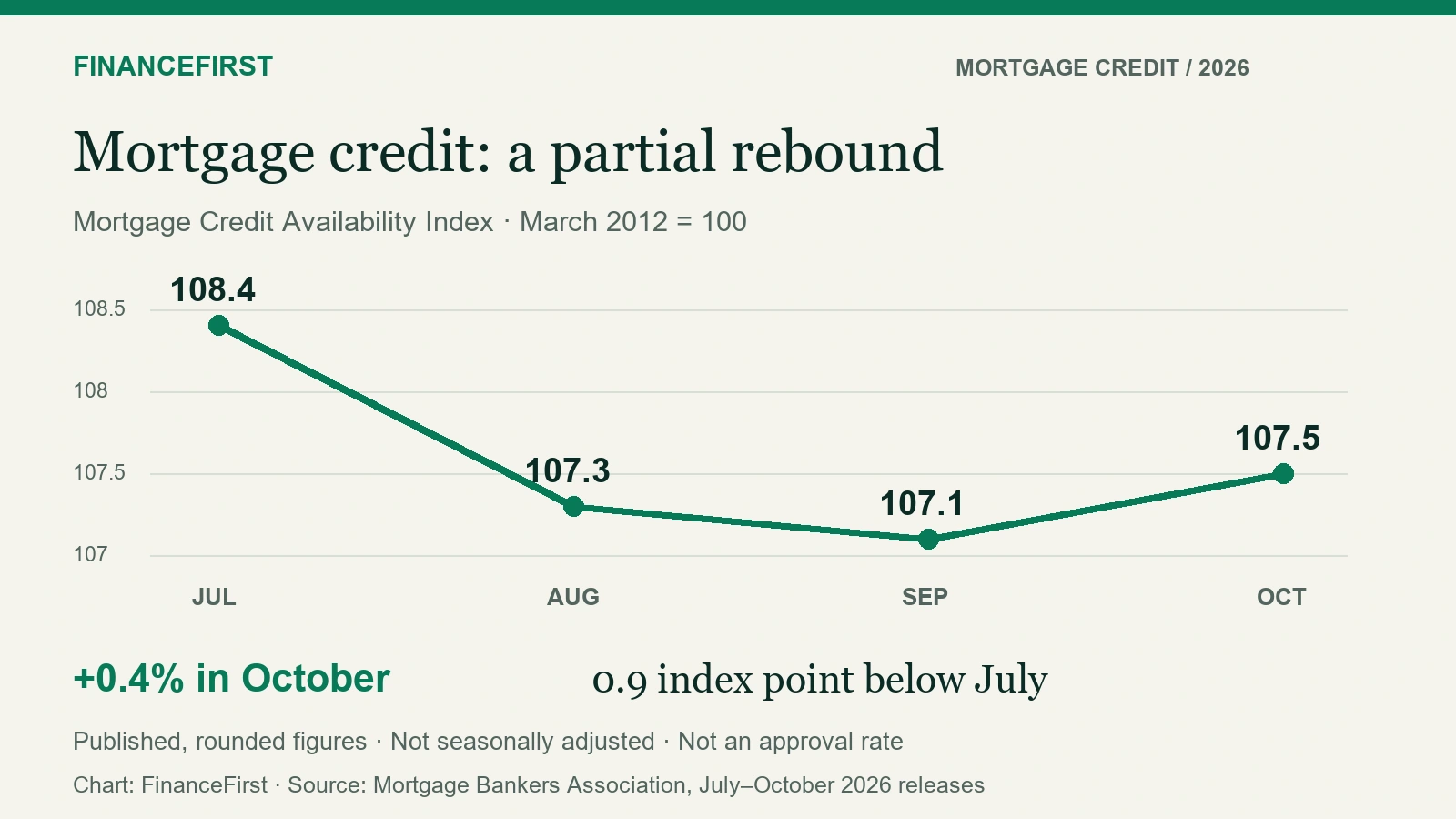
U.S. mortgage credit availability increased in October after two consecutive monthly declines, but the recovery left the market below its July level, according to Mortgage Bankers Association figures.
The association’s Mortgage Credit Availability Index rose 0.4% to 107.5, MBA reported November 10. [1] The increase followed a 1.0% decline in August and a 0.2% decline in September. [2] [3]
The latest improvement partly reflected additional adjustable-rate mortgage offerings for borrowers with lower loan-to-value ratios, including some products allowing cash-out refinancing, MBA said.
Those borrowers have more equity or larger down payments relative to their property’s value. The release did not establish that mortgage access improved equally for applicants with smaller down payments or weaker credit.
October recovered only part of the earlier decline
The overall index stood at 108.4 in July, fell to 107.3 in August, and declined again to 107.1 in September before October’s increase.
Scroll sideways to see every column.
| Month | Overall credit availability index | Monthly change reported by MBA |
|---|---|---|
| July 2026 | 108.4 | +2.5% |
| August 2026 | 107.3 | −1.0% |
| September 2026 | 107.1 | −0.2% |
| October 2026 | 107.5 | +0.4% |
Source: Mortgage Bankers Association. Index levels and monthly percentage changes are published, rounded figures. [1] [2] [3] [4]
October’s reading remained 0.9 index point below July, a comparison of MBA’s published figures shows.
The increase therefore marked a partial recovery rather than a return to the level recorded before the two-month decline.
Jumbo credit leads the monthly improvement
The expansion was uneven across mortgage categories.
Scroll sideways to see every column.
| Mortgage credit index | October monthly change |
|---|---|
| Overall | +0.4% |
| Conventional | +0.6% |
| Government | +0.1% |
| Jumbo | +0.8% |
| Conforming | Unchanged |
Source: MBA’s November 10 release. These are changes in credit availability indexes, not changes in mortgage interest rates. [1]
Jumbo credit availability reached its highest level in three months, according to MBA. The conforming index, which tracks conventional loan programs within conforming loan limits, did not increase.
The jumbo and conforming indexes are components of the conventional segment. The government segment covers FHA, VA and USDA loan programs.
“Mortgage credit availability ticked up in October after two months of declines, with greater availability of conventional credit while the government segment remained flat over the month,” said Joel Kan, MBA’s vice president and deputy chief economist.
The numerical results showed a 0.1% increase in the government index, which Kan described as essentially flat.
Lenders expand some adjustable-rate offerings
MBA linked the improvement to changes in the products lenders offered.
“With current mortgage rates still elevated, lenders increased their offerings of ARM loans for lower LTV borrowers, including some that allow for cash-out refinancing,” Kan said.
An adjustable-rate mortgage has an interest rate that can change after an initial period. Cash-out refinancing replaces an existing mortgage with a larger loan, allowing the borrower to receive part of the difference in cash.
The October development followed a different pattern in September, when MBA reported tighter documentation requirements on conventional loans and reduced offerings for cash-out refinancing and investment-property purchases.
In August, lenders had also reduced some programs with flexible documentation requirements and cash-out features.
Taken together, the releases show lenders adjusting particular product offerings rather than a uniform loosening across the mortgage market.
MBA did not quantify how much of October’s overall increase came specifically from adjustable-rate products or cash-out refinancing.
The index does not measure mortgage approvals
The Mortgage Credit Availability Index tracks the supply of mortgage credit using loan-program eligibility requirements and underwriting criteria.
MBA’s November release said the calculation incorporates criteria from more than 95 lenders and investors, using ICE Mortgage Technology data and a proprietary formula.
The methodology considers factors including credit scores, loan-to-value ratios, documentation requirements, loan purpose and mortgage type.
A higher reading indicates greater availability under MBA’s measure. It does not establish that mortgage interest rates fell, more applications were approved, or more home purchases were completed.
MBA’s methodology also states that the index does not measure lending dollar volume and is not seasonally adjusted. [5]
The October figures consequently point to a modest expansion in mortgage options, concentrated in particular segments. They do not, by themselves, demonstrate a broad improvement in housing affordability.
FinanceFirst’s mortgage-rate comparison guide explains how to compare loan offers and fees; the MCAI measures a different question: which loan programs lenders make available.
Sources
Reporting and methodology
News · Editorial review: Asim Ahmad.
Methodology
Uses MBA’s November 10, 2026 October release and the July, August and September releases. FinanceFirst compared published rounded levels: 108.4 minus 107.5 equals 0.9 index point. Monthly percentage changes are MBA’s reported figures, not recomputed from rounded levels. MBA combines loan-program criteria from more than 95 lenders and investors using ICE Mortgage Technology data and a proprietary formula.
Limitations
The MCAI is not seasonally adjusted and does not measure mortgage approval rates, interest rates, dollar volume or completed purchases. MBA did not quantify the ARM contribution to October’s increase. Product changes need not improve access equally for every borrower. All release evidence comes from MBA; FinanceFirst has not independently rebuilt its proprietary index or obtained independent-publisher corroboration. Rounded levels can differ from percentage changes calculated using underlying precision.
Conflicts disclosure
Based on public MBA releases and methodology; no lender recommendations, affiliate links, sponsored research or original interviews.