Your original mortgage payment can stay the same while borrowing against your home gets more expensive.
Balances on home equity lines of credit, known as HELOCs, rose $23 billion in the third quarter of 2026, according to the New York Fed's November 10 release. The bank describes it as the largest quarterly increase in HELOC balances observed since 2005. Outstanding balances reached $481 billion. [1]
That does not mean a repeat of the housing crisis is underway. It does mean more outstanding debt is sitting in a product that usually carries a variable interest rate and is secured by the borrower's home.
The useful question for a homeowner is not just whether today's payment fits. It is whether the borrowing still fits if the interest rate changes, income falls or the repayment terms change after the draw period.
What the new figures actually show
Scroll sideways to see every column.
Published measure | Q3 2026 finding |
|---|---|
Outstanding HELOC balances | $481 billion |
Quarterly increase in HELOC balances | $23 billion |
Quarterly increase in HELOC credit limits | $31 billion |
Outstanding credit-card balances | $1.285 trillion |
Quarterly increase in credit-card balances | $22 billion |
Source: New York Fed, November 10, 2026. Quarterly changes compare Q2 with Q3 2026. Outstanding balances are measured at the end of the third quarter. The HELOC limit change comes from the release's narrative. [1]
One comparison stands out: HELOC balances increased by slightly more dollars than credit-card balances, even though outstanding HELOC debt was much smaller.
But do not turn that comparison into a claim about what borrowers did with the money. The figures do not establish that homeowners used HELOCs to repay cards. They do not tell us whether borrowing funded repairs, renovations, other purchases or an emergency.
The $23 billion is also a net balance increase, not the total amount newly borrowed. New borrowing and repayments both affect outstanding balances. A $31 billion increase in credit limits is a different measure again: available borrowing capacity is not the same as money already owed.
The $50,000 rate stress test
The Consumer Financial Protection Bureau says HELOCs usually have variable interest rates, so payments may change from month to month. [2]
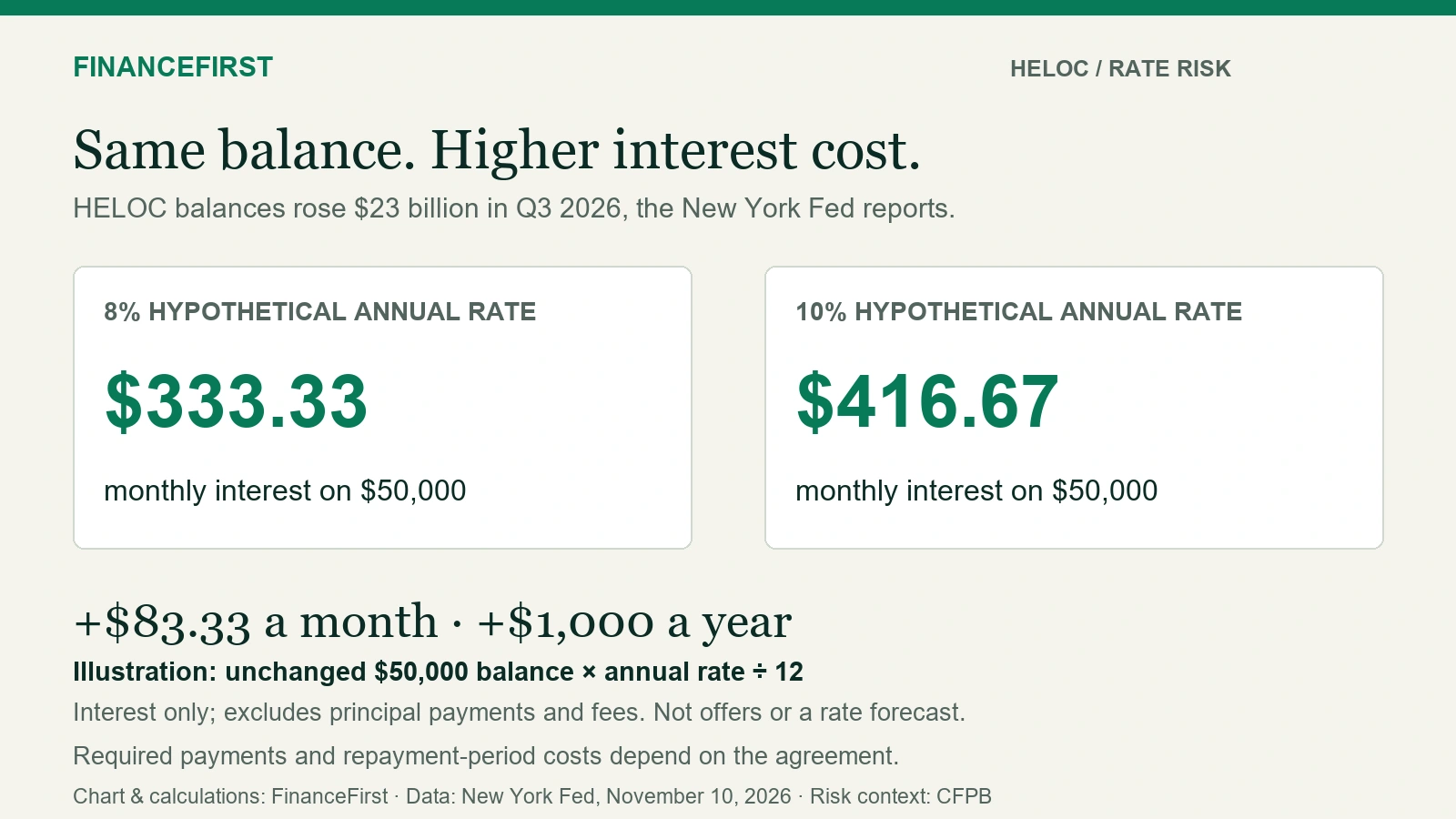
Here is a deliberately simple illustration: keep a hypothetical $50,000 balance unchanged and calculate annual interest divided by 12.
Scroll sideways to see every column.
Hypothetical annual interest rate | Monthly interest-only illustration on $50,000 |
|---|---|
6% | $250.00 |
8% | $333.33 |
10% | $416.67 |
12% | $500.00 |
These are selected scenarios, not current offers, average HELOC rates or a forecast. The calculation excludes principal repayments and fees. Actual interest charges and required payments depend on the agreement, balance changes, billing method and other terms.
Moving from 8% to 10% adds approximately $83.33 a month, or $1,000 over a full year, in interest on that unchanged balance.
The annual amount is calculated before rounding the monthly illustration. Multiplying rounded monthly figures can produce small differences.
That is money paid to finance the same outstanding debt, not an extra reduction in what the borrower owes.
How the effect changes with the balance
The same two-percentage-point rate increase produces different dollar changes depending on how much is outstanding.
Scroll sideways to see every column.
Hypothetical unchanged balance | Added monthly interest: 8% to 10% | Added annual interest |
|---|---|---|
$25,000 | $41.67 | $500.00 |
$50,000 | $83.33 | $1,000.00 |
$75,000 | $125.00 | $1,500.00 |
$100,000 | $166.67 | $2,000.00 |
Source: FinanceFirst hypothetical calculations. Formula: balance x 0.02 / 12 for the monthly illustration; balance x 0.02 for the annual amount. No principal repayment, fees, compounding, rate caps or changing balances are modeled.
This table is a sensitivity check, not a prediction that rates will increase. A lower rate would reduce interest under the same simplified assumptions. The purpose is to see whether a budget has room for an unfavorable change before taking on the debt.
The second payment risk: the draw period ends
A HELOC typically has a period in which the borrower can draw funds, followed by a repayment period.
The CFPB says monthly payments are often significantly higher after repayment begins. Some arrangements can require the outstanding amount to be repaid when that period starts. [2]
That creates a separate issue from variable interest rates. Even if the rate did not rise, a payment that begins repaying principal can be larger than one covering interest alone.
Ask for the repayment schedule before borrowing. A low initial payment does not describe the full life of the agreement.
The illustrative interest amounts above should therefore never be presented as guaranteed minimum payments or as the borrower's full future monthly cost.
Your credit limit is not an emergency fund
A HELOC provides access to credit, not money that already belongs to you.
The CFPB explains that a lender may stop additional borrowing if the home's value decreases significantly. It may also freeze access if financial circumstances change and the lender believes the borrower may not be able to make payments. [2]
That matters if a household plans to use a credit line as its only backup during a job loss or another financial setback. FinanceFirst’s guide to building an emergency fund explains how to plan a separate cash reserve. The circumstances that make borrowing more necessary can also affect access.
Do not assume every approved dollar will remain available regardless of what happens to the property or household finances.
A lower rate does not remove the collateral risk
The CFPB's basic warning is direct: if you cannot repay a HELOC on schedule, you could lose your home. [2]
That risk deserves attention when comparing borrowing options. An advertised interest rate is not the only relevant difference between products.
If you are considering using home equity to clear another balance, ask what changes besides the rate: the collateral, fees, repayment period, payment variability and total cost.
The new Fed numbers do not show how many households made that decision, whether it saved them money or whether a HELOC was suitable for them. This analysis does not recommend borrowing against a home to repay other debt.
Six questions to ask before drawing funds
How does the rate change? Request the index, lender margin, adjustment timing, any introductory period and applicable rate limits in writing.
What would the interest cost be at a higher rate? Use your intended outstanding balance, not the entire credit limit unless you expect to borrow it.
What does the required payment cover? Find out whether principal is included and how that changes later.
When does the draw period end? Ask for the repayment schedule and any balloon-payment requirement.
Which fees and minimums apply? The CFPB notes that plans can include fees, minimum draws, minimum outstanding balances or initial borrowing requirements. [2]
Could you manage without further access? Do not make a repayment plan that depends on being able to draw additional funds indefinitely.
These questions are practical preparation, not a substitute for reading the agreement or getting advice about your own situation.
What the national figures do not tell us
The Fed's report uses its Consumer Credit Panel, a nationally representative sample drawn from anonymized Equifax credit records. It measures reported debt, not every detail of a household's budget. [1]
The figures do not identify borrowers' motives, individual rates, the share with fixed-rate conversions or how many households could withstand higher payments.
The reported balance increase is nominal, not adjusted for inflation. A larger outstanding balance alone does not demonstrate worsening borrower quality.
The Fed's release says HELOC transitions into serious delinquency were flat compared with the previous quarter. That is not a guarantee of future performance, but it is a reason not to portray the balance increase itself as proof of a new default crisis. [1]
Source cautions worth keeping with the story
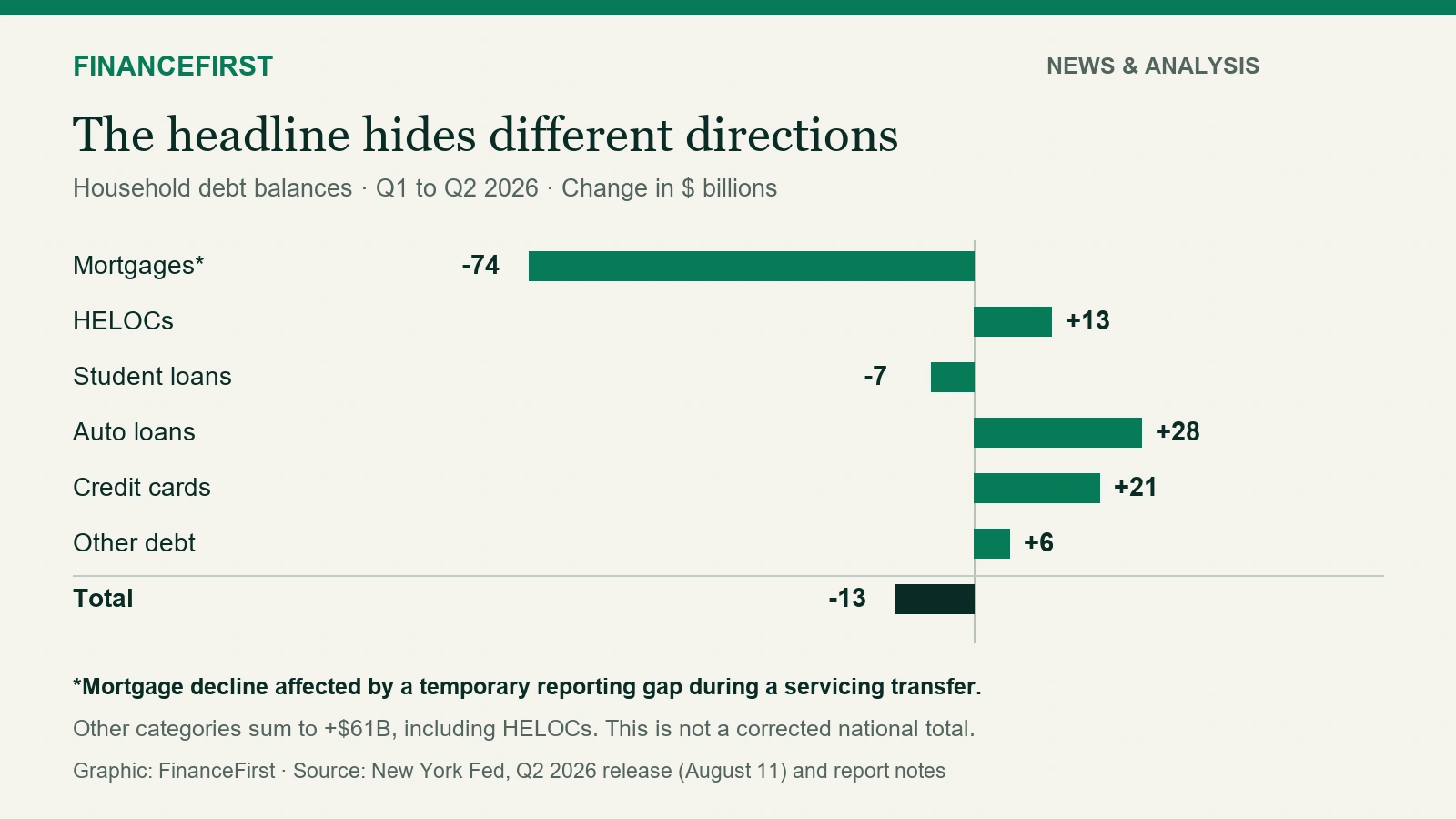
An earlier source capture showed Q2 on the Fed’s main report page. At our subsequent prepublication check, the page had updated to Q3 2026. This article uses the dated November 10 Q3 release for its balance figures. The updated report page says about half of the Q3 mortgage increase reflected re-reporting after the previous quarter’s gap; that mortgage issue is separate from the HELOC figure. [1][3] FinanceFirst’s earlier Q2 household-debt analysis explains the separate mortgage-reporting gap in that quarter. A later mortgage rebound alone cannot identify new borrowing or measure the earlier gap.
The statement that this was the largest increase since 2005 is attributed to the Fed. FinanceFirst has not independently rebuilt that historical comparison from the complete quarterly series.
The release’s quarterly category changes sum to $335 billion, while its total line reports $334 billion: a $1 billion difference. FinanceFirst preserves both published figures rather than changing a category to force a match. We have not established the reason for that difference, and the HELOC-specific analysis does not depend on reconciling the aggregate.
The takeaway
The new HELOC figures are a reason to look closely at the borrowing terms, not a reason to panic or assume every homeowner should borrow.
A payment can look manageable at the start and become harder to carry later. Before drawing against home equity, check the rate risk, the repayment schedule and what happens if further borrowing is unavailable. The value in the home does not make the debt free, fixed or riskless.
The full hypothetical rate comparison
These 16 selected balance-and-rate combinations use annual simple interest divided by 12. They are not lender offers, required payments or forecasts. Each balance remains unchanged; principal payments, fees and compounding are excluded. Download the table as CSV using its control.
Scroll sideways to see every column.
Hypothetical balance | Hypothetical annual rate | Monthly interest illustration | Annual interest illustration |
|---|---|---|---|
$25,000 | 6.00% | $125.00 | $1,500.00 |
$25,000 | 8.00% | $166.67 | $2,000.00 |
$25,000 | 10.00% | $208.33 | $2,500.00 |
$25,000 | 12.00% | $250.00 | $3,000.00 |
$50,000 | 6.00% | $250.00 | $3,000.00 |
$50,000 | 8.00% | $333.33 | $4,000.00 |
$50,000 | 10.00% | $416.67 | $5,000.00 |
$50,000 | 12.00% | $500.00 | $6,000.00 |
$75,000 | 6.00% | $375.00 | $4,500.00 |
$75,000 | 8.00% | $500.00 | $6,000.00 |
$75,000 | 10.00% | $625.00 | $7,500.00 |
$75,000 | 12.00% | $750.00 | $9,000.00 |
$100,000 | 6.00% | $500.00 | $6,000.00 |
$100,000 | 8.00% | $666.67 | $8,000.00 |
$100,000 | 10.00% | $833.33 | $10,000.00 |
$100,000 | 12.00% | $1,000.00 | $12,000.00 |
Sources and methodology
[1] Federal Reserve Bank of New York, November 10, 2026, Q3 household debt release: https://www.newyorkfed.org/newsevents/news/research/2026/20261110
[2] Consumer Financial Protection Bureau, What is a home equity line of credit (HELOC)? Page marked reviewed August 28, 2026: https://www.consumerfinance.gov/ask-cfpb/what-is-a-home-equity-line-of-credit-heloc-en-107/
[3] New York Fed report landing page, checked November 10, 2026; displaying Q2 when retrieved: https://www.newyorkfed.org/microeconomics/hhdc.html
FinanceFirst transcribed the release’s official tables and reproduced 16 balance-and-rate scenarios plus four two-percentage-point comparisons using decimal arithmetic. The scenarios are not survey observations or lender quotes. The monthly illustrations are rounded to cents after calculation; annual interest uses the unrounded annual formula.
Reporting and methodology
Analysis · Editorial review: Asim Ahmad.
Methodology
Uses the New York Fed’s November 10, 2026 Q3 release and CFPB HELOC guidance. FinanceFirst checked 35 numeric cells in the official balance and serious-delinquency tables. Sixteen scenarios hold balances unchanged and calculate simple annual interest; dividing by 12 gives the monthly illustration. Four comparisons calculate the effect of a two-percentage-point rate increase. Decimal arithmetic and boundary checks passed. Differences are computed before rounding monthly amounts to cents; annual results do not multiply rounded monthly figures. The full scenario table is downloadable as CSV.
Limitations
These are sensitivity tests, not current offers, average rates, forecasts or required minimum payments. They exclude principal repayments, fees, compounding, rate caps and changing balances. The agreement controls payments; the repayment period can raise payments even if rates stay unchanged. The home is collateral and further access can be frozen. National data do not identify borrower motives, individual risk or causal effects. The historical ranking is attributed to the Fed, not independently reconstructed. Published quarterly category changes sum to $335 billion versus the reported $334 billion total; the reason is unresolved and both figures are preserved. An earlier source capture showed Q2 on the landing page; the prepublication check now shows Q3 and the article reflects that update. Mortgage re-reporting is separate from HELOC balance changes.
Conflicts disclosure
This analysis uses public Fed and CFPB sources and contains no lender recommendations, affiliate links, sponsored research or original interviews.