
A $1,000 increase in your tax deduction sounds like $1,000 back in your pocket. It isn't.
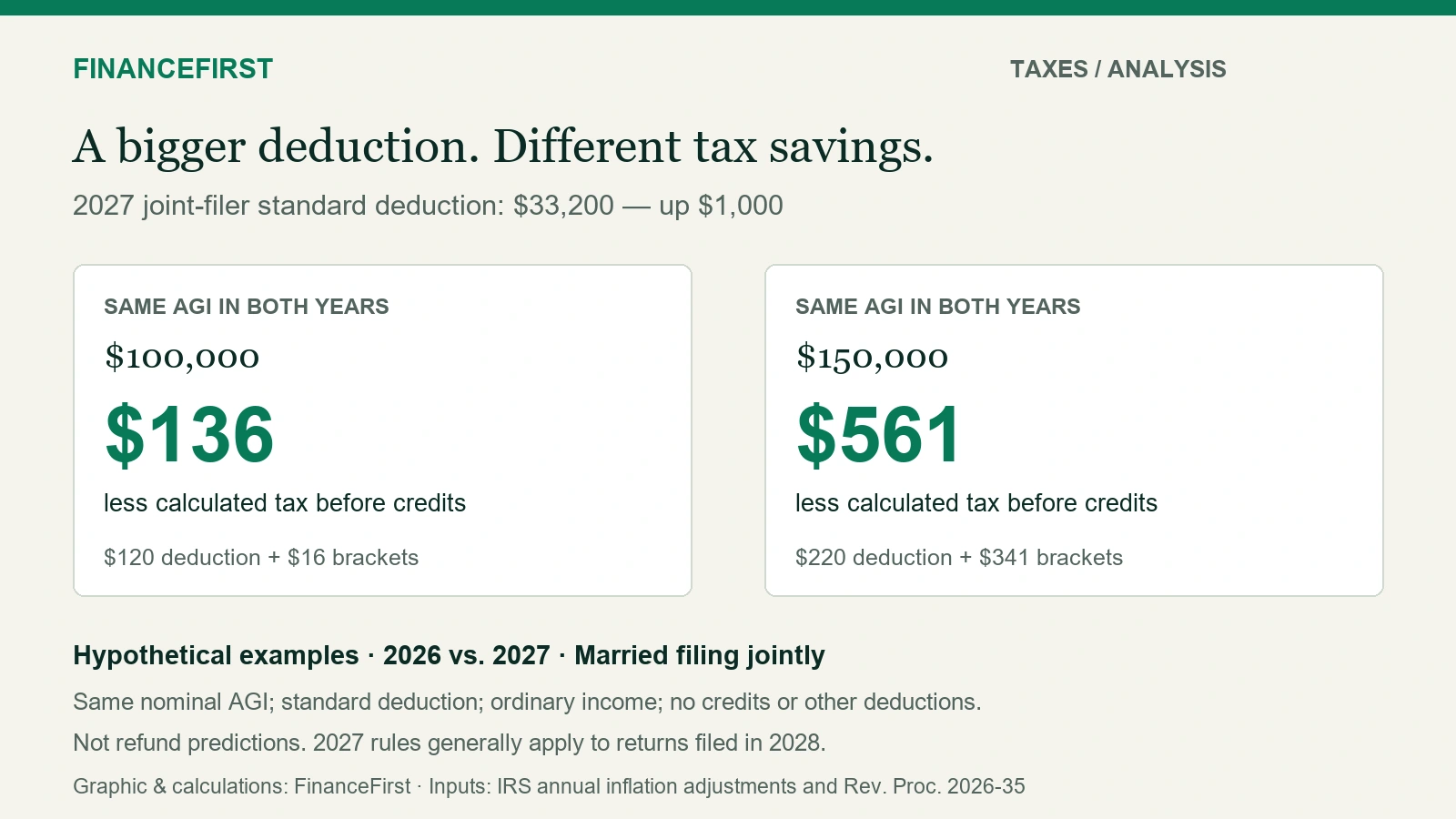
The IRS has raised the basic standard deduction for married couples filing jointly to $33,200 for tax year 2027. That is $1,000 more than in 2026. But a hypothetical couple with $100,000 in unchanged adjusted gross income would see their calculated regular federal income tax fall by $136 under the new deduction and brackets, before credits. [1][2]
For a couple with $150,000 in unchanged adjusted gross income, the reduction in the same model is $561.
Neither figure is an estimate of what the average family will save. The difference is the point: a deduction is not a tax credit, and neither tells you the size of your refund.
The IRS announced the changes on November 5, 2026. They generally apply to 2027 income, with returns filed in 2028. They are not the deduction amounts for the 2026 income-tax return most calendar-year filers will prepare in 2027. [1]
What the IRS actually changed
The basic standard deduction is increasing across filing statuses:
Scroll sideways to see every column.
Filing status | 2026 basic standard deduction | 2027 basic standard deduction | Increase |
|---|---|---|---|
Single or married filing separately | $16,100 | $16,600 | $500 |
Married filing jointly | $32,200 | $33,200 | $1,000 |
Head of household | $24,150 | $24,925 | $775 |
Sources: IRS annual inflation announcements for tax years 2026 and 2027. These are basic amounts, not additional deductions for age or blindness. Eligibility rules apply. [1][2]
Income-tax rates remain progressive. For example, the 12% bracket for joint filers begins above $25,600 of taxable income in 2027, compared with $24,800 in 2026. The 22% bracket begins above $104,050, compared with $100,800. [1][2][3]
Those thresholds refer to taxable income, not salary or adjusted gross income. A couple with $100,000 of adjusted gross income and only the $33,200 standard deduction has $66,800 of taxable income in our 2027 model.
Why a deduction is not money back dollar for dollar
The IRS describes a deduction as an amount subtracted from income. A credit is subtracted from the tax owed. [4]
That distinction changes the arithmetic.
If an extra $1,000 deduction removes income that would otherwise be taxed at 12%, its direct effect in a simple calculation is $120 less tax. At 22%, the same extra deduction would reduce tax by $220, assuming the whole $1,000 falls within that bracket and nothing else changes.
It is not a $1,000 payment. It does not establish a $1,000 refund. And the effect can be smaller if there is little or no taxable income to reduce.
The brackets are also moving. To understand the full change between the two years, we need to account for both the deduction and the income taxed in each band.
What the changes look like at different incomes
FinanceFirst calculated 12 hypothetical scenarios using the IRS's published basic standard deductions and ordinary-income bracket thresholds.
Important assumptions: The same nominal adjusted gross income in both years; eligible nondependent filers under 65 and not blind; standard deduction; all taxable income subject to ordinary rates; no other deductions, credits, alternative minimum tax or special taxes. For joint returns, these assumptions apply to both spouses.
These are simplified regular-income-tax calculations before credits, not refund predictions or complete tax-return estimates. They use bracket formulas, not IRS tax-table lookups, which can produce different amounts.
Scroll sideways to see every column.
Filing status | Same AGI in each year | 2026 calculated tax | 2027 calculated tax | Reduction |
|---|---|---|---|---|
Single | $25,000 | $890.00 | $840.00 | $50.00 |
Single | $50,000 | $3,820.00 | $3,752.00 | $68.00 |
Single | $75,000 | $7,670.00 | $7,389.50 | $280.50 |
Single | $100,000 | $13,170.00 | $12,889.50 | $280.50 |
Single | $150,000 | $24,734.00 | $24,375.00 | $359.00 |
Single | $200,000 | $36,734.00 | $36,375.00 | $359.00 |
Married filing jointly | $25,000 | $0.00 | $0.00 | $0.00 |
Married filing jointly | $50,000 | $1,780.00 | $1,680.00 | $100.00 |
Married filing jointly | $75,000 | $4,640.00 | $4,504.00 | $136.00 |
Married filing jointly | $100,000 | $7,640.00 | $7,504.00 | $136.00 |
Married filing jointly | $150,000 | $15,340.00 | $14,779.00 | $561.00 |
Married filing jointly | $200,000 | $26,340.00 | $25,779.00 | $561.00 |
Source: FinanceFirst calculations from IRS inputs. Every row represents a chosen example, not a surveyed household. Dollar amounts are nominal. A reduction means the 2026 modeled amount minus the 2027 modeled amount.
The lower-income joint-filing example has no taxable income after the basic deduction in either year. Its zero does not mean the household cannot qualify for refundable credits. Those credits are outside this model.
Likewise, results at higher incomes do not include every tax that could apply to a real household. The table is a controlled comparison of two provisions, not a substitute for tax software or individual advice.
The $100,000 example, step by step
Take a hypothetical married couple filing jointly with $100,000 of adjusted gross income in each year.
Under the 2026 rules
Subtract the $32,200 basic standard deduction:
$100,000 - $32,200 = $67,800 taxable income.
The first $24,800 is taxed at 10%, producing $2,480.
The remaining $43,000 is taxed at 12%, producing $5,160.
Calculated tax before credits: $7,640.
Under the 2027 rules
Subtract the $33,200 basic standard deduction:
$100,000 - $33,200 = $66,800 taxable income.
The first $25,600 is taxed at 10%, producing $2,560.
The remaining $41,200 is taxed at 12%, producing $4,944.
Calculated tax before credits: $7,504.
That is a $136 reduction. It includes the higher deduction and the wider lower-rate bracket.
How much comes from the deduction, and how much from brackets?
We can separate the two changes by applying them one at a time.
First, hold the 2026 brackets fixed and substitute the larger 2027 deduction. Then apply the 2027 brackets to the remaining taxable income.
For the $100,000 joint-filing example:
The deduction change alone, measured against the old brackets, reduces the calculation by $120.
Updating the brackets then reduces it by another $16.
Together: $136.
For the $150,000 joint-filing example:
The deduction-first component is $220.
The bracket-second component is $341.
Together: $561.
This is a deduction-first accounting breakdown, not two independent universal benefits. Near a threshold, changing the order can change how much is assigned to each component. The combined result is the relevant comparison.
The following table supplies the deduction-first breakdown for all 12 hypothetical scenarios. The combined result is unchanged; the allocation depends on the order of calculation.
Scroll sideways to see every column.
Filing status | Same AGI each year | Deduction first | Brackets second | Combined reduction |
|---|---|---|---|---|
single | $25,000 | $50 | $0 | $50 |
single | $50,000 | $60 | $8 | $68 |
single | $75,000 | $110 | $170.50 | $280.50 |
single | $100,000 | $110 | $170.50 | $280.50 |
single | $150,000 | $120 | $239 | $359 |
single | $200,000 | $120 | $239 | $359 |
Married filing jointly | $25,000 | $0 | $0 | $0 |
Married filing jointly | $50,000 | $100 | $0 | $100 |
Married filing jointly | $75,000 | $120 | $16 | $136 |
Married filing jointly | $100,000 | $120 | $16 | $136 |
Married filing jointly | $150,000 | $220 | $341 | $561 |
Married filing jointly | $200,000 | $220 | $341 | $561 |
Why your result could be different
Your income changes
The table holds nominal income constant to isolate the rule changes. A raise, job change, bonus or loss of income can change the result. It is not reasonable to assume that every household will have the same income in both years.
Nor does a lower nominal tax calculation tell us whether purchasing power improved. We have not adjusted income or tax amounts for inflation.
You claim tax credits
Credits can change the final bill substantially. The IRS's 2027 announcement includes separate adjustments to the child tax credit and earned income tax credit, among other provisions. We have deliberately not added those to the scenarios because eligibility and credit amounts depend on household details. [1]
A joint filing status does not tell us whether a couple has children. These examples make no claim about family size.
You itemize
The standard deduction comparison is not a calculation for someone who itemizes. The IRS explains that taxpayers compare eligible itemized expenses with the standard deduction, subject to the rules that apply to them. [4]
Do not add the basic standard deduction to the same expenses claimed as itemized deductions.
You qualify for different deduction rules
Older taxpayers, blind taxpayers, dependents and some other filers can face different standard-deduction rules or amounts. Married filing separately also has restrictions, including when a spouse itemizes. [3][4]
Our comparison does not model those situations. The head-of-household basic deduction appears in the source table, but head-of-household tax calculations are not included in the 12 scenarios.
A lower tax calculation does not guarantee a larger refund
A refund depends on payments and refundable credits as well as the final liability.
For a simple illustration, suppose a hypothetical household owes $7,640 and has paid $8,000 through withholding, with no other payments or credits. The difference is $360.
If its liability later falls to $7,504 and it still pays $8,000, the difference becomes $496. But if withholding also falls, the refund need not rise by $136. These are invented payment amounts used only to explain the relationship, not forecasts of withholding or refunds.
That is why "your deduction is increasing" should not be translated into "your refund will increase by the same amount."
Three useful checks before planning around the announcement
Check the tax year. The newly announced amounts concern 2027, generally filed in 2028. Do not put them on a 2026 return.
Start with adjusted gross income, not a paycheck headline. Salary and AGI are not always identical. The model starts at AGI and assumes no additional deductions beyond the standard deduction.
Compare the full return before changing withholding. Credits, household changes and other income can matter more than the basic deduction increase. Use the appropriate year's official guidance and a qualified tax professional when needed.
The useful takeaway is not a promise of a windfall. It is a better question: How do the new deduction and brackets change the calculation for my filing status and income?
Methodology and limitations
FinanceFirst used the dated IRS news announcements for 2026 and 2027 as its numeric input sources. The 2027 deduction amounts and modeled bracket thresholds were also checked against Revenue Procedure 2026-35.
The extraction of that procedure contains unfilled release-date placeholders in its introductory purpose section. We do not use those placeholders to establish dates. The announcement date comes from the dated IRS release. The older announcement is marked historical by the IRS; future publication should check for amendments or corrections.
The scenario calculations use decimal arithmetic, the same nominal AGI across years and a taxable-income floor of zero. They are deterministic illustrations, not a population average, a distributional study, a measurement of actual household savings or a complete tax calculator. Exclusions include payroll and state taxes, capital-gains rates, credits, AMT, other deductions and special taxes.
FinanceFirst checked 12 hypothetical scenarios against saved IRS inputs and an independent bracket-formula calculation. The comparison tables show the model outputs; the IRS links below supply the official inputs. This analysis does not include interviews or personalized tax advice.
For broader context, see FinanceFirst’s tax filing guide. Its 2026 rules must not be substituted for the 2027 figures above.
Primary sources
IRS, November 5, 2026, annual inflation adjustments for tax year 2027. https://www.irs.gov/newsroom/irs-releases-tax-inflation-adjustments-for-tax-year-2027-taxpayers-continue-to-benefit-from-the-working-families-tax-cuts
IRS, October 9, 2025, annual inflation adjustments for tax year 2026. Historical release. https://www.irs.gov/newsroom/irs-releases-tax-inflation-adjustments-for-tax-year-2026-including-amendments-from-the-one-big-beautiful-bill
IRS, Revenue Procedure 2026-35, sections 3.01 and 3.15. https://www.irs.gov/pub/irs-drop/rp-26-35.pdf
IRS, Credits and deductions for individuals. Used for general definitions and eligibility context, not its older-year dollar amounts. https://www.irs.gov/credits-and-deductions-for-individuals
Reporting and methodology
Analysis · Editorial review: Asim Ahmad.
Methodology
FinanceFirst applies IRS 2026 and 2027 basic standard deductions and ordinary progressive brackets to six unchanged nominal AGIs for each of single and married-joint filers. Taxable income is floored at zero. Decimal arithmetic and independent base-plus-marginal 2027 formula checks reproduce all12 scenarios. Tables show calculated regular federal income tax before credits, using formulas rather than the Form1040 tax-table lookup. A deduction-first decomposition holds 2026 brackets fixed before applying the 2027 thresholds; component allocation depends on order. Inputs come from dated IRS announcements, cross-checked against Revenue Procedure2026-35.
Limitations
Hypothetical illustrations, not average household savings, complete returns, inflation-adjusted gains, forecasts or refund predictions. Assumes eligible nondependent filers under65 and not blind, only ordinary income and the standard deduction. Credits, other deductions, AMT, special taxes, state and payroll taxes are excluded. The 2027 rules generally apply to returns filed in2028. The procedure purpose contains unfilled release-date placeholders; dates come from the dated IRS news release. The 2026 announcement is historical. Eligibility and later law can change actual liability.
Conflicts disclosure
This analysis uses public IRS sources and contains no product recommendations, affiliate links, sponsored research or original interviews.