
Social Security's 3.6% increase has attracted the headlines. But for people collecting retirement benefits while still working, another adjustment could also change their budget: how much they can earn before benefits are withheld.
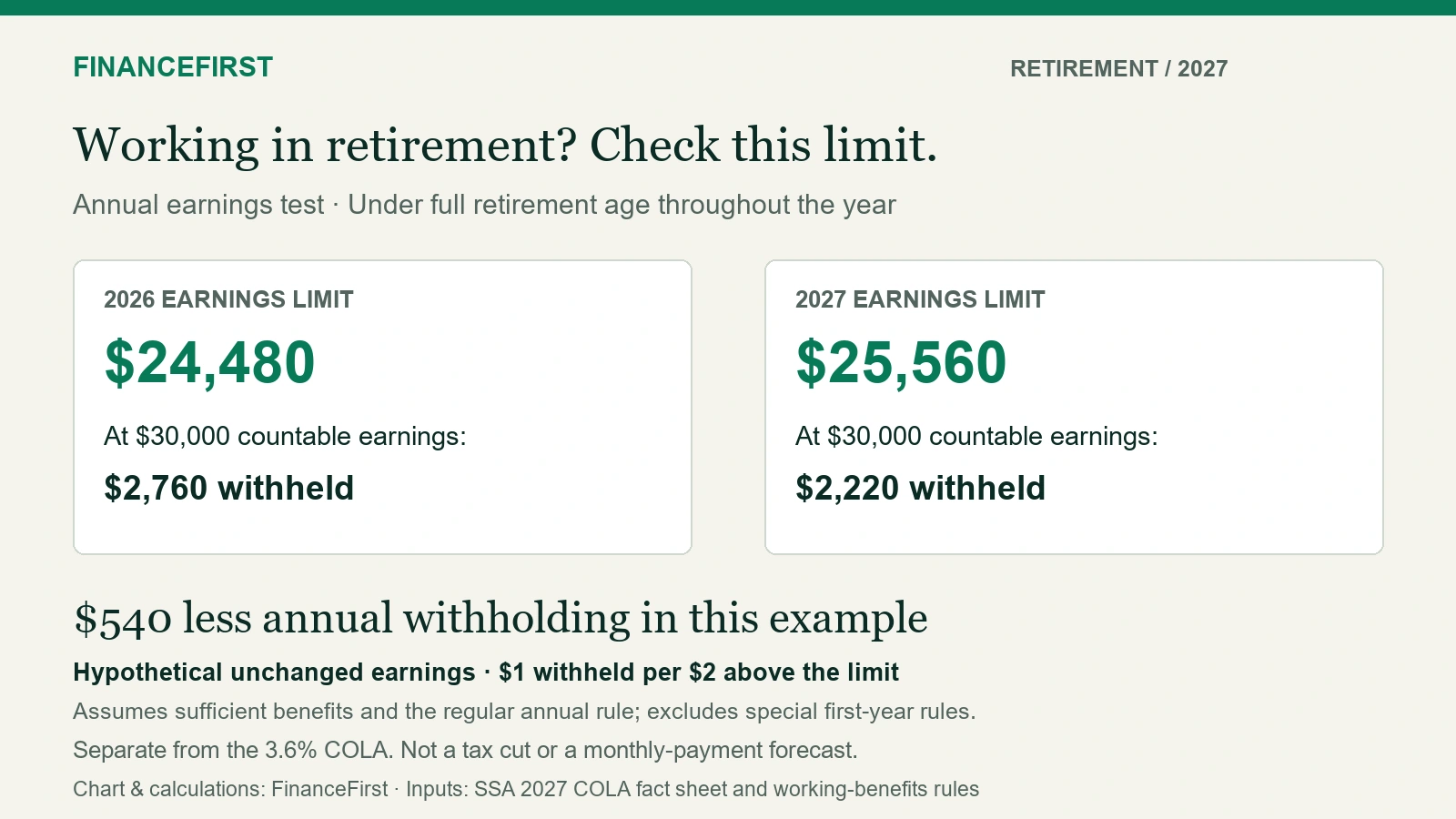
In 2027, the annual earnings limit for someone under full retirement age throughout the year rises to $25,560, from $24,480 in 2026. That is $1,080 more earnings before the regular annual test starts reducing benefit payments. [1]
For a hypothetical retiree earning $30,000 in either year, the change means $540 less withheld under that test. It is separate from the benefit increase. It is not a tax cut, an automatic bonus or a promise about the size of a particular monthly deposit.
There is also a timely administrative step. SSA says people who create a personal my Social Security account and sign up for digital notices by November 18, 2026, can access their COLA notice online up to three weeks earlier than by mail. That is an early-access deadline, not a deadline to qualify for the benefit increase. [2]
The 2027 changes at a glance
Scroll sideways to see every column.
Official measure | 2026 | 2027 |
|---|---|---|
Annual earnings limit: under full retirement age throughout the year | $24,480 | $25,560 |
Earnings limit in the year full retirement age is reached, counting only earnings before that month | $65,160 | $67,920 |
Maximum annual earnings subject to Social Security payroll tax | $184,500 | $192,300 |
Source: SSA's 2027 fact sheet. These are different rules, not three limits on the same thing. [1]
The fact sheet also estimates that the average retired-worker monthly benefit will move from $2,095 before the COLA to $2,170 afterward. That is an estimated average increase of $75, not the amount every retiree receives. A gross benefit is not necessarily the amount deposited after deductions. [1][3]
How the $540 example works
For beneficiaries under full retirement age throughout the year, SSA generally withholds $1 in benefits for every $2 of earnings above the annual limit. [1][4]
Holding annual earnings at $30,000:
In 2026: ($30,000 - $24,480) / 2 = $2,760.
In 2027: ($30,000 - $25,560) / 2 = $2,220.
Difference: $2,760 - $2,220 = $540 less withheld.
These are hypothetical annual calculations. They assume the person remains under full retirement age throughout each year, the regular annual rule applies, and enough benefits are payable for the calculated withholding to apply fully. They do not model SSA's month-by-month collection process or special first-year retirement rules.
What different earnings levels would mean
Scroll sideways to see every column.
Hypothetical annual countable earnings, unchanged between years | Calculated 2026 withholding | Calculated 2027 withholding | Less withheld in 2027 |
|---|---|---|---|
$25,000 | $260 | $0 | $260 |
$30,000 | $2,760 | $2,220 | $540 |
$35,000 | $5,260 | $4,720 | $540 |
$40,000 | $7,760 | $7,220 | $540 |
Source: FinanceFirst calculations using SSA's published limits and $1-for-$2 rule. All rows are hypothetical, not observed household outcomes. The same assumptions as the $30,000 example apply. [1][4]
Why does the difference stop at $540 in these examples? Once earnings exceed both annual limits, increasing the limit by $1,080 reduces the calculated withholding by half that amount.
For earnings between the two limits, the difference is smaller. A worker earning $25,000 is $520 over the 2026 limit but below the 2027 limit. The modeled reduction is therefore $260, not $540.
Actual changes will depend on earnings in each year. A pay increase could partly or fully offset the effect of the higher limit.
Withheld benefits are not the same as a tax
This distinction matters when deciding whether to keep working.
The earnings test affects when benefits are paid. SSA says that at full retirement age it recalculates the benefit amount to give credit for months in which benefits were reduced or withheld because of excess earnings. [4]
That does not mean an immediate dollar-for-dollar refund of everything withheld. Nor does it mean claiming early has no lasting consequences. The earnings-test adjustment and the benefit reduction associated with claiming before full retirement age are separate issues. FinanceFirst’s guide to when to claim Social Security explains the broader claiming tradeoffs; its year-specific amounts should not replace the 2027 limits here.
Do not treat the $540 example as a complete calculation of whether working more is financially worthwhile. Wages, payroll taxes, income taxes and other household circumstances still matter.
Which earnings count?
SSA says it counts wages from a job and net profit from self-employment. Bonuses, commissions and vacation pay are included. [4]
For this earnings test, SSA says it does not count pensions, annuities, investment income, interest, veterans benefits or other government or military retirement benefits.
That exclusion is specific to the earnings test. It is not a statement that those forms of income are tax-free or irrelevant to every other benefit rule.
Someone with $30,000 in wages is therefore not necessarily in the same position as someone with $30,000 in pension and investment income.
Reaching full retirement age changes the calculation
The $1-for-$2 examples above do not apply unchanged to someone reaching full retirement age during 2027.
For that year, SSA lists a $67,920 earnings limit and a $1-for-$3 withholding rule. Only earnings before the month full retirement age is reached count toward that limit. Beginning with the month full retirement age is reached, earnings no longer reduce benefits under this test. [1][4]
The year someone starts retirement benefits can also involve a special monthly rule. An annual spreadsheet cannot decide whether that exception applies. Different rules can apply to work outside the United States. Check the relevant SSA instructions before making a personal decision. [4]
Another change affects higher earners' paychecks
The earnings test is not the same as the payroll-tax earnings cap.
In 2027, the maximum earnings subject to Social Security payroll tax rises from $184,500 to $192,300. The employee Social Security tax rate remains 6.2%. [1]
For an employee earning at least $192,300 in both years, holding earnings constant:
($192,300 - $184,500) x 6.2% = $483.60.
That is $483.60 more in annual employee Social Security tax. It excludes Medicare tax, income tax and the employer's separate contribution.
Workers below the old cap do not pay more Social Security tax merely because the cap rises, assuming their earnings stay unchanged. Workers between the two caps experience a smaller increase than $483.60.
Scroll sideways to see every column.
Hypothetical covered wages, unchanged | 2026 employee Social Security tax | 2027 employee Social Security tax | Additional tax |
|---|---|---|---|
$100,000.00 | $6,200.00 | $6,200.00 | $0.00 |
$184,500.00 | $11,439.00 | $11,439.00 | $0.00 |
$190,000.00 | $11,439.00 | $11,780.00 | $341.00 |
$192,300.00 | $11,439.00 | $11,922.60 | $483.60 |
$250,000.00 | $11,439.00 | $11,922.60 | $483.60 |
Source: FinanceFirst calculations: 6.2% multiplied by the smaller of covered wages and the annual taxable maximum. Hypothetical employee-only examples; excludes Medicare, income tax, employer contributions and self-employment tax. [1]
The COLA and the taxable maximum also do not use the same adjustment mechanism. SSA ties the COLA to the CPI-W, while its announcement explains that the taxable maximum adjustment is based on average wages. [1][3]
What to check before building your 2027 budget
Find your full retirement age. The applicable earnings rule changes when you reach it.
Estimate countable earnings, not every dollar of household income. Separate wages and self-employment profit from pensions and investment income.
Use your personal benefit notice. The published $75 increase is an estimated average, not a personal entitlement.
Check the timing of retirement. Special first-year rules can change the result.
Distinguish your gross benefit from your deposit. Do not assume a 3.6% gross increase means the same percentage increase in spendable cash.
Use the November 18 reminder correctly. It concerns early digital notice access, not whether the COLA will be paid.
SSA says Social Security beneficiaries receive the COLA beginning in January 2027, while increased SSI payments begin December 31, 2026. Those payment timings should not be conflated. [3]
What this analysis can and cannot establish
The original contribution here is a transparent comparison of two years' rules at fixed hypothetical earnings. It is not a survey of retirees, a forecast of average household gains or an estimate of how many people will keep an extra $540.
The calculations do not estimate income-tax liability, Medicare premiums, benefit rounding, individual claiming histories or the number and timing of monthly checks withheld. They do not combine the COLA with earnings-test changes to promise a total household gain.
The official announcement was issued October 14, 2026. This is a November planning analysis, not a claim that SSA announced the figures today. The November 18 reminder concerns early digital-notice access, not eligibility for the COLA.
The practical takeaway is simple: before treating the COLA as your whole 2027 Social Security story, check the earnings rule that applies to you. For working retirees, that second calculation can matter.
Sources and reproducibility
[1] Social Security Administration, 2027 COLA Fact Sheet, including 2026 comparison figures: https://www.ssa.gov/news/en/cola/factsheets/2027.html
[2] Social Security Administration, dated advocate announcement, October 14, 2026, including digital-notice instructions: https://www.ssa.gov/news/en/advocates/2026-10-14.html
[3] Social Security Administration, COLA announcement and notice/payment timing: https://www.ssa.gov/blog/en/posts/2026-10-14.html
[4] Social Security Administration, Receiving Benefits While Working, including withholding rules, countable earnings, first-year exceptions and recalculation: https://www.ssa.gov/benefits/retirement/planner/whileworking.html
Sources checked November 10, 2026. FinanceFirst reproduced four hypothetical earnings-test comparisons and five employee payroll-tax examples against saved SSA inputs. These illustrations do not measure actual household outcomes.
Reporting and methodology
Analysis · Editorial review: Asim Ahmad.
Methodology
Uses SSA October14,2026 announcements, 2027 fact sheet and current working-benefits planner. Four earnings-test scenarios apply max(0,earnings-limit)/2 at unchanged hypothetical nominal earnings. Five payroll examples apply6.2% to the smaller of employee covered wages and the annual OASDI maximum. Decimal arithmetic, source-row matching, boundary checks and source-package checksums passed. The working-benefits page supplies rules and exceptions; its2026 dollar values are not used as2027 inputs.
Limitations
Hypothetical calculations, not surveyed retirees, average household gains, tax-cut estimates or monthly-payment forecasts. Earnings-test examples assume under full retirement age throughout each year, regular annual rule and sufficient benefits payable. Excludes first-year monthly exceptions, foreign-work rules, individual claiming histories, benefit rounding, Medicare deductions, income tax and monthly collection timing. Full-retirement-age-year rules differ. COLA and earnings-test effects are not combined into a promised gain. The November18 date concerns early digital-notice access, not eligibility for COLA. Announcement was October14, not today.
Conflicts disclosure
Uses public SSA sources; no product recommendations, affiliate links, sponsored research or original interviews.