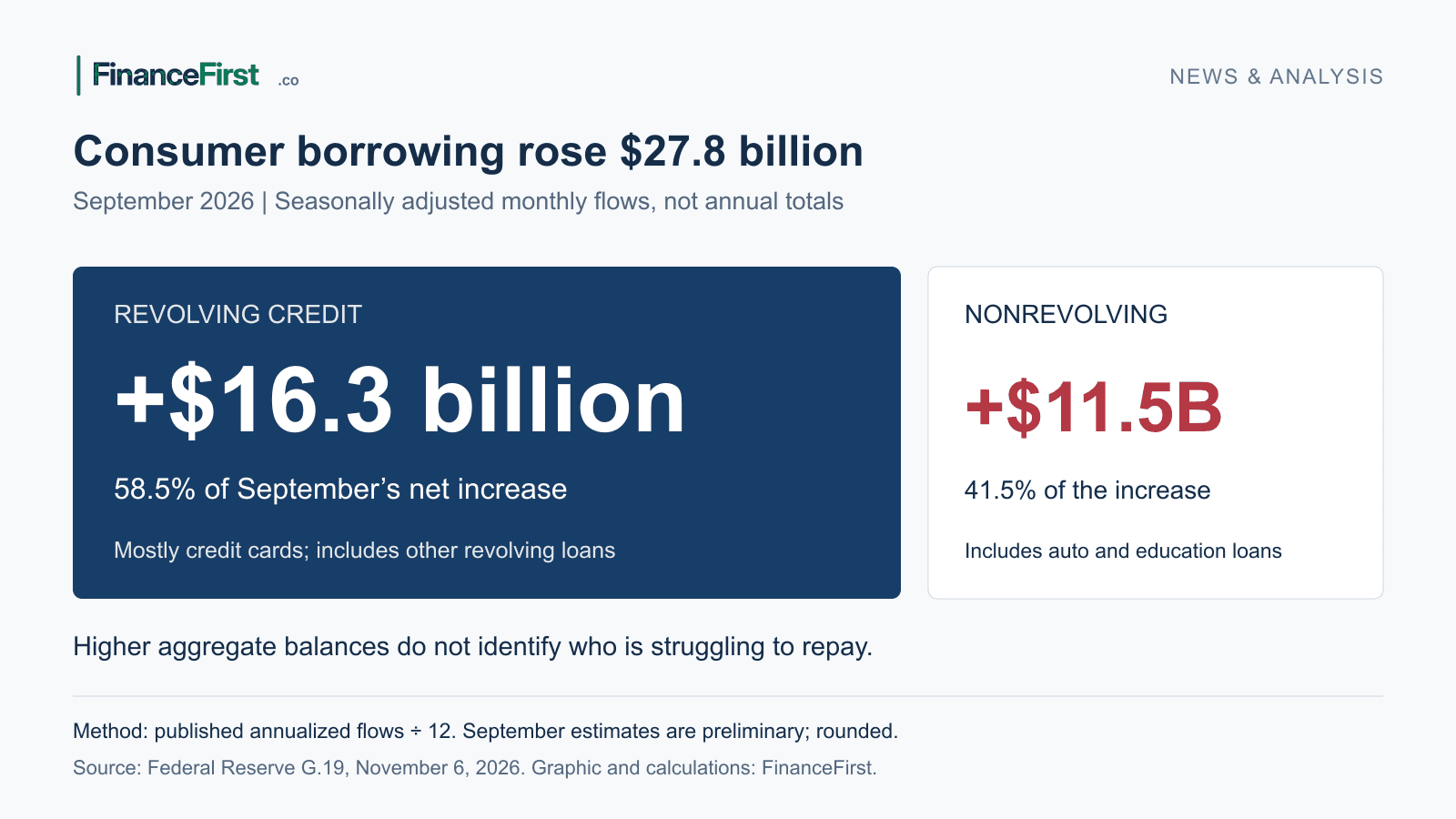

Outstanding U.S. consumer credit rose about $27.8 billion in September, led by a rebound in revolving balances, according to the Federal Reserve’s November 6 release. Revolving credit, mostly credit cards, supplied $16.3 billion of the increase after falling about $5.0 billion in August.
The immediate household issue is the cost of carrying those balances. The Fed’s third-quarter rate for commercial-bank card accounts assessed interest was 22.36%. At that rate, a $150 payment on an illustrative $5,000 balance would reduce principal by only about $57 in the first modeled month—even before new spending.
FinanceFirst’s calculations connect the national figures with that repayment arithmetic. The release shows how outstanding credit changed; a household’s own statements show whether its payments are getting ahead of interest and new charges. Source: Federal Reserve G.19.
Revolving balances supplied most of September’s increase
Scroll sideways to see every column.
| September 2026 | Total | Revolving | Nonrevolving |
|---|---|---|---|
| Outstanding credit | $5,224.4B | $1,368.5B | $3,856.0B |
| Calculated net monthly increase | $27.84B | $16.30B | $11.54B |
| Share of the increase | 100% | 58.5% | 41.5% |
Source: Federal Reserve G.19, November 6, 2026. Seasonally adjusted; September preliminary. B means billion dollars. FinanceFirst converts the published annualized monthly flows to monthly dollars by dividing by 12. Totals may differ from component sums because of rounding.
Revolving credit made up 26.2% of the outstanding stock but 58.5% of the month’s net increase. It was the smaller category contributing the larger share of September’s growth. Nonrevolving credit includes auto, education and other scheduled-payment loans. This release excludes mortgages and other real-estate-secured loans. Fed definitions.
The $27.8 billion is a net change in outstanding credit, not the value of all new loans or purchases during September. New borrowing and repayments can both be substantial even when the net change is small.
September reversed an uneven two months
The monthly revolving-credit sequence was +$2.7 billion in July, −$5.0 billion in August and +$16.3 billion in September. July and August together had reduced balances by about $2.3 billion; September more than reversed that decline.
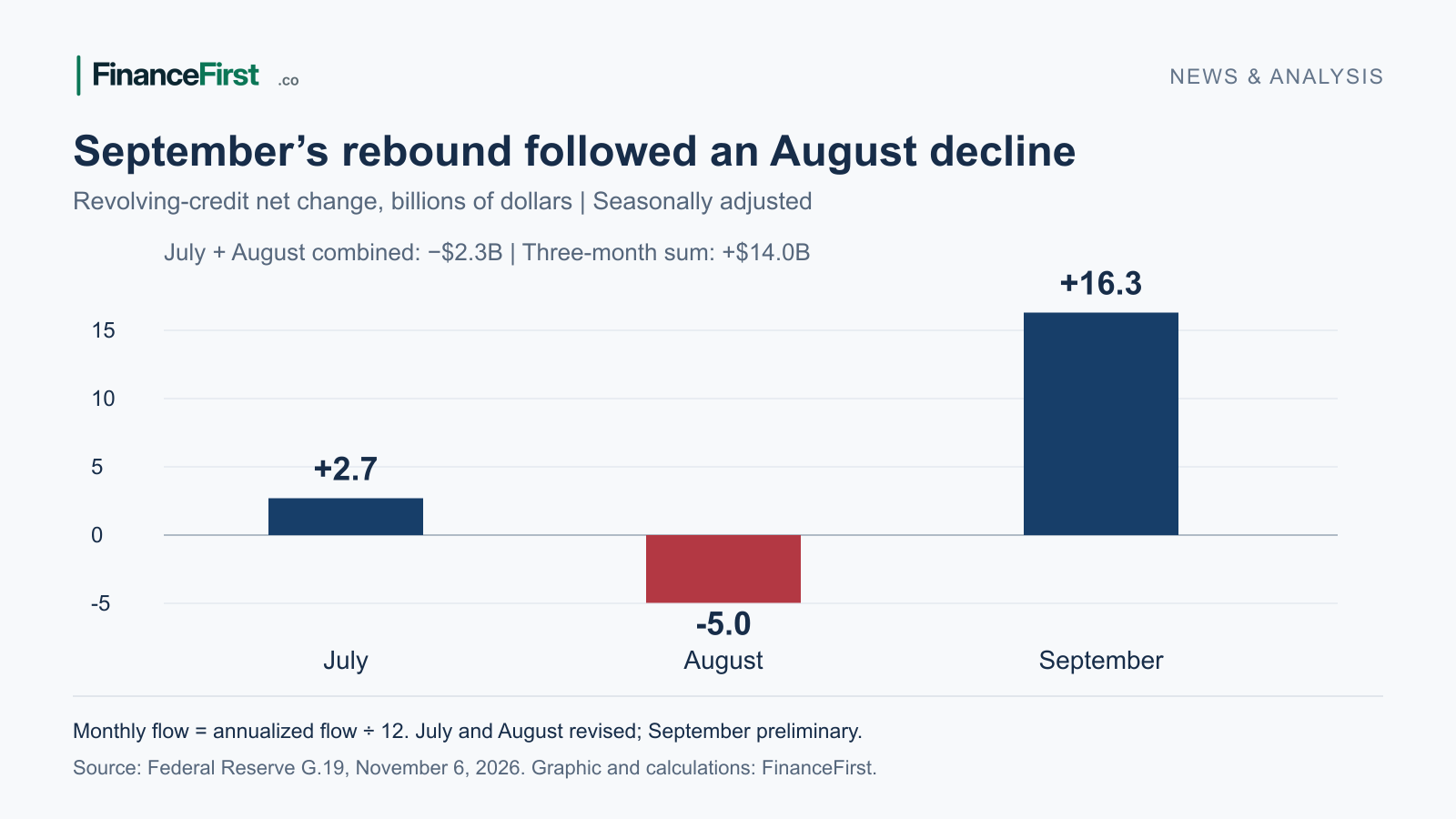
Across all three months, the calculated increase was about $14.0 billion. The Fed reported third-quarter revolving growth at a 4.1% annualized rate, compared with September’s 14.5% annualized pace. September’s figure translates to roughly 1.21% for that month under the Fed’s simple annual-rate convention.
The distinction changes the interpretation: September was a sharp rebound within an uneven quarter. It is too soon to call it a sustained acceleration, and this release does not identify which borrowers increased balances or why.
Borrowing costs remain substantial despite a lower year-earlier comparison
The assessed-interest card rate rose from 22.15% in the second quarter to 22.36% in the third, an increase of 0.21 percentage points. It was still 0.47 points below the third quarter of 2025. Costs therefore rose on the quarterly comparison while remaining lower on the annual one.
The Fed’s separate all-account rate was 21.19%. That series averages stated purchase APRs across accounts; the assessed-interest series relates finance charges to balances that incurred them. Neither is a current offer for an individual borrower. For the examples below, 22.36% is a transparent model input drawn from the latter series.
Why a $150 payment can leave a higher balance
Consider a $5,000 balance with $93.17 in monthly interest, the simplified result of $5,000 × 22.36% ÷ 12. A $150 payment would remove $56.83 of principal if there were no other charges. Add $100 of new purchases, and the same payment leaves the balance $43.17 higher.
Scroll sideways to see every column.
| Illustrative statement reconciliation | Amount |
|---|---|
| Opening balance | $5,000.00 |
| Interest | +$93.17 |
| New purchases | +$100.00 |
| Payment | −$150.00 |
| Closing balance | $5,043.17 |
Illustration: FinanceFirst. The arithmetic holds the interest charge fixed to isolate the effect of new purchases; it is not an issuer billing calculation. Actual charges depend on daily balances, transaction and payment timing, fees and applicable APRs.
That is the practical test to apply to a statement: payment minus interest, fees and new borrowing determines whether the balance is shrinking. The payment amount alone cannot answer it. A cash-flow budget helps identify how much spending would otherwise need to go back on the card.
With no new borrowing, payment size changes the cost sharply
FinanceFirst also modeled the same $5,000 balance at a fixed 22.36% APR with no new purchases or fees. At $150 a month, repayment takes 53 months and costs $2,885.61 in interest. At $250 a month, it takes 26 months and costs $1,314.50—27 fewer months and about $1,571 less interest.
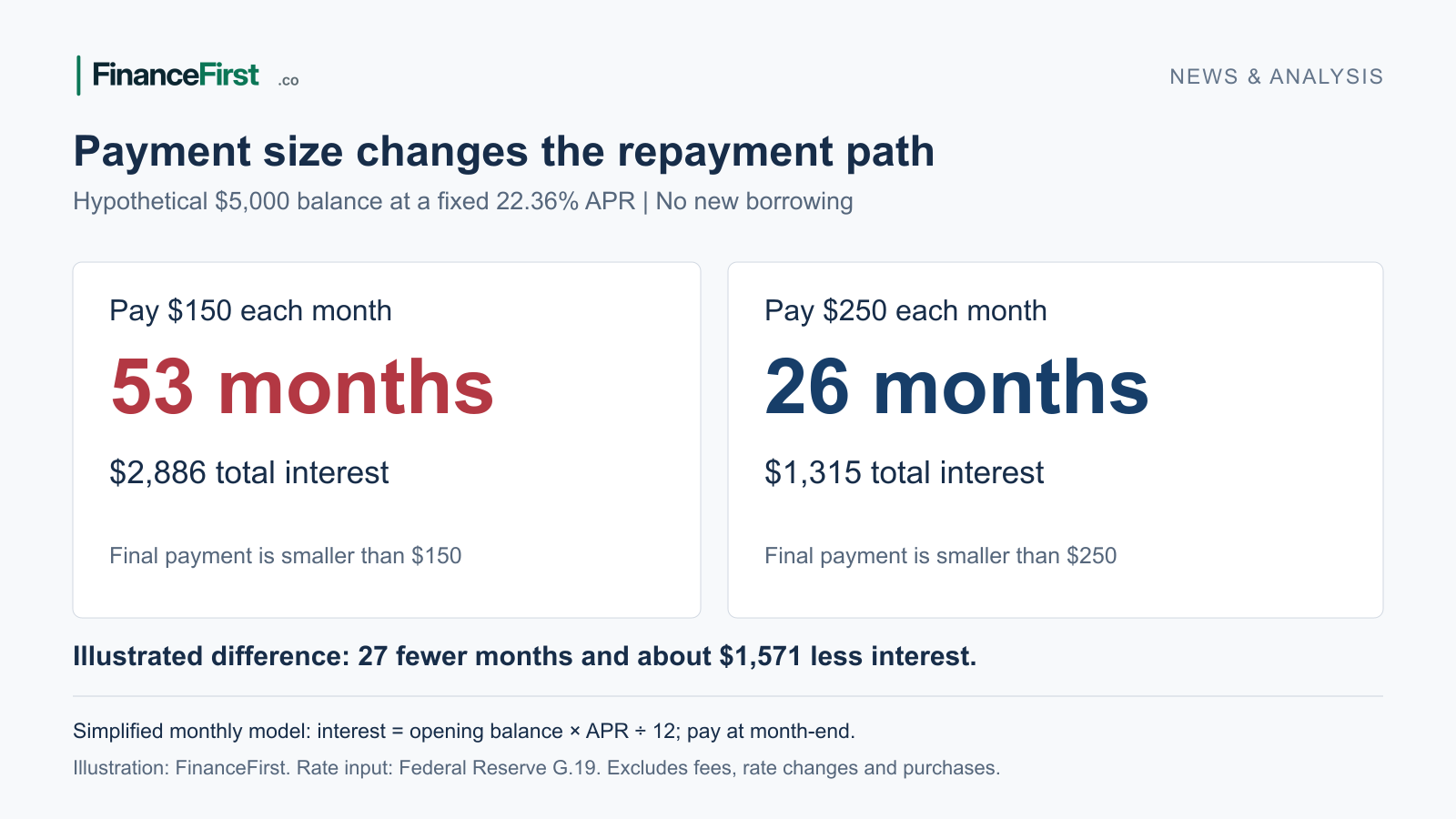
The larger payment removes more principal immediately, leaving a smaller balance to generate the following month’s interest. Choosing a sustainable payment still requires allowing for essential expenses and other required payments; borrowing again to fill the resulting cash gap can undermine the plan. Our debt payoff comparison explains how to organize balances and rates.
What matters for borrowers, lenders and the economy
Borrowers: compare at least several recent statements using the same five items—opening balance, new charges, interest and fees, payments, and closing balance. Check each balance’s applicable APR. Many issuers calculate interest daily; purchase grace periods have conditions, so a household paying in full may face different costs from a balance-carrying household. CFPB interest guidance.
Lenders: greater revolving balances create more credit exposure and may increase interest-bearing assets, but earnings depend on funding costs, account mix and credit losses as well as balance growth. G.19 cannot establish whether a particular institution’s profit or risk improved.
The economy: the next issue is whether the revolving increase persists and whether repayment performance weakens. More credit can accompany spending growth or financial strain. Delinquency and income evidence is needed to distinguish them; aggregate balances alone do not establish a household debt crisis.
If the next payment is unaffordable
The CFPB advises contacting the issuer promptly. Before calling, work out what payment is affordable, why assistance is needed and for how long; ask how a proposed arrangement affects interest, fees, account use and credit reporting. Credit counseling may help assess the options—check its services and charges first. CFPB payment-help guidance.
September’s borrowing rebound is a reason to examine the repayment arithmetic, not a substitute for it. For a household already carrying debt, the decisive measure is the balance remaining after interest and new charges—not simply whether a payment was made.
Reporting and methodology
Analysis · Editorial review: Asim Ahmad.
Methodology
FinanceFirst divided the Fed’s annualized monthly flows by 12 and used the same November 6 release vintage for July–September. The repayment examples start at $5,000 and hold APR at 22.36%, with monthly interest and month-end payments; the final payment is smaller. Full-precision schedules independently matched a closed-form calculation. The statement reconciliation holds the illustrative interest charge fixed to isolate the effect of $100 in new purchases.
Limitations
September and third-quarter credit estimates are preliminary; July and August are revised. Credit volumes are seasonally adjusted, while rates are not. The release excludes real-estate-secured loans and does not identify borrowing motives or repayment distress. Model examples exclude fees and rate changes; actual card interest depends on daily balances and transaction timing. Selected payments are examples, not issuer minimums or an affordability assessment.
Conflicts disclosure
No relevant financial interests or paid relationships were reported for this analysis.
Correction or update
Expanded November 6 analysis adds an illustrative statement reconciliation showing how new purchases can outweigh principal reduction, clarifies net credit flows and condenses repeated cautions into a single methods panel. Source data and previously published payoff-model results are unchanged.