
FinanceFirst Research
Travel Chargebacks 2026: What Credit Card Disputes and Refund Complaints Reveal
Official card-dispute and air-travel refund data, current airline refund rules, a traveler evidence checklist and transparent limitations
Data through CFPB card-market data through 2024; DOT air-travel complaint cases through June 30, 2026Latest official release: August 12, 2026Version 1.1
Executive summary
What this report finds
Public data show substantial card-dispute activity and travel refund friction, but not that chargebacks are becoming a first resort. This version adds current federal airline-refund rules, a source-reconciled comparison of refund complaint shares by organization type, and an evidence path that keeps merchant refunds, billing errors, unauthorized use and network disputes distinct.
At a glance
Key findings
- $9.8B↔
All-card charges disputed in 2024
CFPB; not travel-only
- $5.9B↔
All-card chargebacks in 2024
CFPB; not travel-only
- 43,184↔
Air-travel complaint cases
DOT, January-June 2026; not chargebacks
- 29.1%↔
All air-travel cases about refunds
12,557 of 43,184 DOT cases
- 61.3%↔
Travel-agent cases about refunds
1,314 of 2,142 DOT cases
- 7 days↔
Covered credit-card airline refund standard
Business days; eligibility depends on the facts
Definitions readers asked us to clarify
Questions readers asked
Complaint or chargeback?
A DOT complaint records a consumer submission about air travel. A chargeback is a payment-system reversal process. One does not prove the other happened.
Refund or billing error?
A merchant refund request and a federal written billing-error notice can overlap but have different actors, rules and deadlines. Keep both records distinct.
Who charged the card?
The statement descriptor identifies the merchant of record. For airfare refunds, that detail can determine whether the airline or ticket agent must issue the refund when due.
Ungated research data
Download the Travel Chargebacks 2026 publication dataset
Includes 1,107 normalized published and derived records, DOT organization-type comparisons, CFPB figure data, current federal airline-refund thresholds, formulas, source URLs and limitations.
Table of contents
- What the Public Evidence Can and Cannot Establish
- Should You Request a Refund or Dispute a Travel Charge?
- All-Card Dispute Activity Is Material but Not Travel-Specific
- What Cardholders Disputed in 2024
- Refund Was the Largest DOT Complaint Category
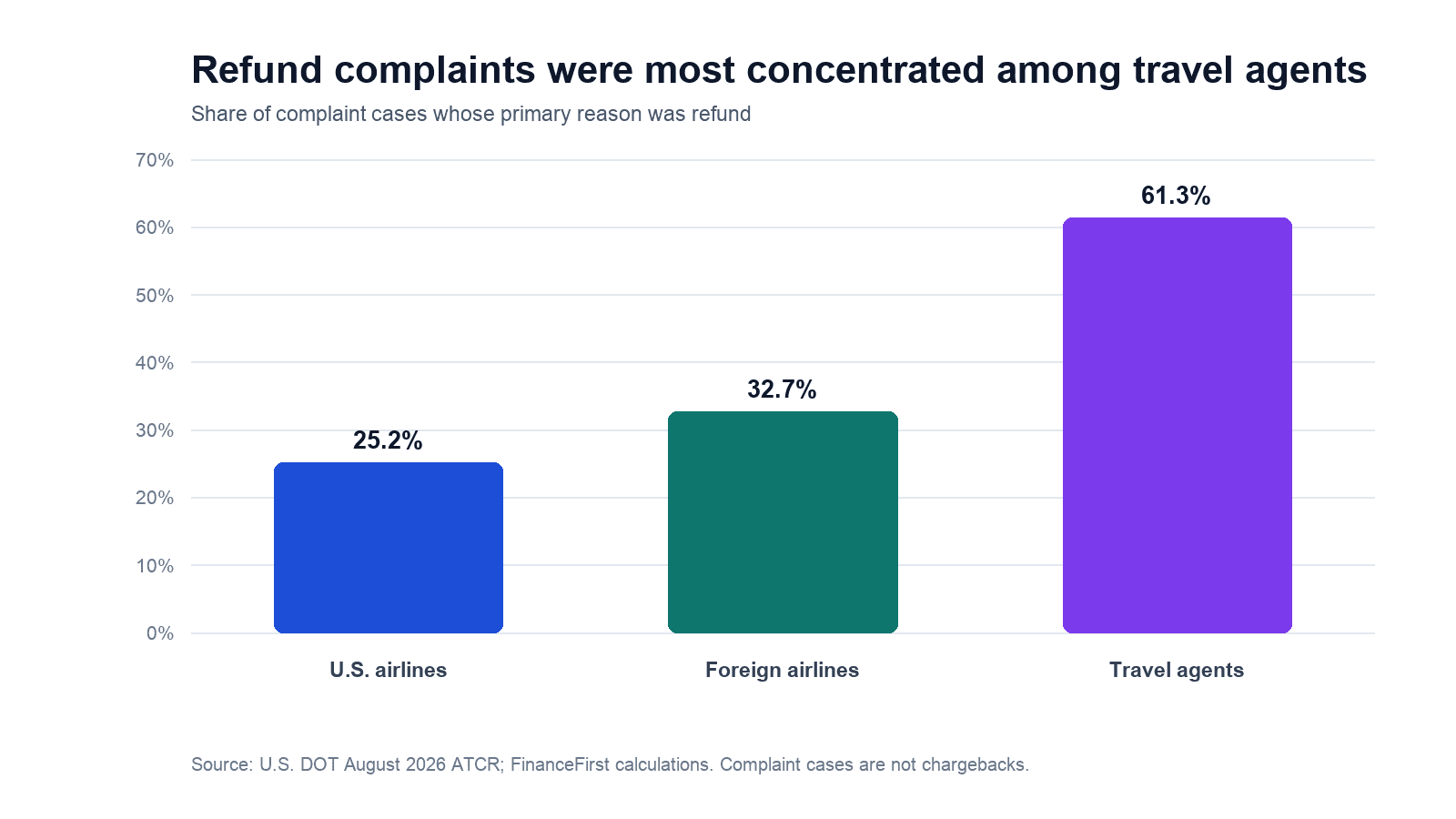
- Refund Complaints Were Most Concentrated Among Travel Agents
- Refunds Dominated Complaints About Travel Agents
- Airline Refund Rights Can Apply Before a Chargeback
- Build One Evidence File Before Contacting the Issuer
- The Federal Billing-Error Process Has Specific Timing Rules
- Merchant Evidence Packages Are Procedural, Not Universal Proof
- Questions That Still Require Verified Cases or Internal Records
- Download the Data and Journalist Materials
- Review Status, Updates and Corrections
- Sources
What the Public Evidence Can and Cannot Establish
The strongest public evidence shows substantial credit-card dispute activity and air-travel refund friction. It does not establish that travelers increasingly file chargebacks before contacting an airline, hotel, cruise line, tour operator or booking platform.
The Consumer Financial Protection Bureau reported $9.8 billion in disputed credit-card charges during 2024, resulting in $5.9 billion in chargebacks. Those are all-card market totals, not travel-only figures. The U.S. Department of Transportation recorded 43,184 air-travel complaint cases in January through June 2026, including 12,557 whose primary reason was refund. DOT complaint cases are not chargebacks.
Should You Request a Refund or Dispute a Travel Charge?
Short answer: start with the path that matches what actually happened. A merchant refund, a federal billing-error notice, an unauthorized-use report and a payment-network dispute are related but not interchangeable. Describing a voluntary cancellation as fraud or a delivered service as “not received” can make the record internally inconsistent.
| What happened | Best first record to create | What to preserve |
|---|---|---|
| You do not recognize or did not authorize the charge | Notify the card issuer promptly and review the card agreement's unauthorized-use procedure. | Statement descriptor, card possession, authorized-user details and the first notice to the issuer. |
| An airline cancelled or significantly changed the flight and you did not accept the alternative | Identify the merchant of record and document the refund path under current DOT rules. | Original itinerary, change notice, rejection or non-acceptance of the alternative, statement descriptor and refund timeline. |
| A promised service was not delivered or a promised credit did not post | Ask the seller to correct or refund the charge, then protect any applicable written billing-error rights before the deadline. | Terms at purchase, confirmation, merchant correspondence, promised credit and statement date. |
| You voluntarily cancelled a nonrefundable booking or were dissatisfied with a service you used | Check the contract, cancellation terms and any specific legal right before filing a dispute. | Terms accepted at purchase, actual use and any written exception the merchant offered. |
All-Card Dispute Activity Is Material but Not Travel-Specific
The CFPB's 2025 credit-card market report provides the most useful current public baseline for card disputes. In 2024, cardholders disputed $9.8 billion in charges and $5.9 billion became chargebacks. Dividing the two rounded published totals gives about 60.2%, but that arithmetic ratio is contextual only because both dollar figures are rounded.
Quarterly disputed purchase volume peaked in 2020 Q2 at 0.66% of purchase volume. By 2024 Q4, disputed volume was 0.30% and chargeback volume was 0.16%. The public figure does not identify travel purchases or whether the cardholder contacted the merchant first.
All-Card Dispute and Chargeback Volume, 2019 Q1-2024 Q4
Quarterly disputed and chargeback purchase volume as a percentage of purchase volume. This is an all-card series, not travel-only data.
View chart data
| Period or category | Disputed volume | Chargeback volume |
|---|---|---|
| 2019 Q1 | 0.32 | 0.15 |
| 2019 Q2 | 0.3 | 0.14 |
| 2019 Q3 | 0.31 | 0.15 |
| 2019 Q4 | 0.29 | 0.15 |
| 2020 Q1 | 0.41 | 0.22 |
| 2020 Q2 | 0.66 | 0.45 |
| 2020 Q3 | 0.43 | 0.28 |
| 2020 Q4 | 0.33 | 0.2 |
| 2021 Q1 | 0.35 | 0.2 |
| 2021 Q2 | 0.3 | 0.18 |
| 2021 Q3 | 0.33 | 0.2 |
| 2021 Q4 | 0.32 | 0.19 |
| 2022 Q1 | 0.37 | 0.22 |
| 2022 Q2 | 0.33 | 0.2 |
| 2022 Q3 | 0.34 | 0.2 |
| 2022 Q4 | 0.32 | 0.19 |
| 2023 Q1 | 0.4 | 0.21 |
| 2023 Q2 | 0.36 | 0.19 |
| 2023 Q3 | 0.39 | 0.21 |
| 2023 Q4 | 0.35 | 0.19 |
| 2024 Q1 | 0.36 | 0.2 |
| 2024 Q2 | 0.33 | 0.18 |
| 2024 Q3 | 0.34 | 0.19 |
| 2024 Q4 | 0.3 | 0.16 |
What Cardholders Disputed in 2024
For general-purpose cards, cancelled recurring transactions accounted for 40.1% of disputes, followed by service not received at 20.6%, cancelled or credit not issued at 18.5%, incorrect billing at 10.6%, and other or not recognized at 10.3%. Private-label portfolios had a different distribution.
These categories are useful context for travel disputes involving services, cancellations and missing credits. They do not identify airlines, hotels or other travel merchants, and they are not a public list of issuer denial reason codes.
| Dispute category | General purpose | Private label |
|---|---|---|
| Cancelled recurring | 40.1% | 13.9% |
| Service not received | 20.6% | 26.7% |
| Cancelled or credit not issued | 18.5% | 27.9% |
| Incorrect billing | 10.6% | 19.5% |
| Other or not recognized | 10.3% | 12.0% |
Refund Was the Largest DOT Complaint Category
DOT recorded 43,184 air-travel complaint cases in January through June 2026. Refund was the largest primary category at 12,557 cases, or a FinanceFirst-calculated 29.1% of the total. Flight schedule followed at 9,477 cases and baggage at 6,459.
DOT cautions that complaints reflect consumer perceptions and do not establish a legal violation. Each case is counted once under one primary reason. The complaint tables do not reveal card issuer involvement, chargeback filing, provisional credit, merchant response or final dispute outcome.
Leading Air-Travel Complaint Categories, January-June 2026
DOT complaint cases by primary reason. Complaint cases are not chargebacks.
View chart data
| Period or category | DOT cases |
|---|---|
| Refund | 12,557 |
| Flight schedule | 9,477 |
| Baggage | 6,459 |
| Reservation/ticketing/boarding | 3,800 |
| Customer service | 2,536 |
| Other | 2,369 |
| Fees and fares | 1,839 |
| Bumping | 1,687 |
Refunds Dominated Complaints About Travel Agents
DOT recorded 2,142 complaint cases involving travel agents and booking platforms in the first half of 2026. Refund was the primary reason in 1,314 cases, or 61.3%. The downloadable entity table preserves the published count for every named travel agent and category.
The high refund share documents friction at the complaint stage. It does not show how many consumers filed card disputes, when they did so, what an issuer asked for, or how the case ended.
Primary Reason for Travel-Agent Complaint Cases
View chart data
| Period or category | DOT cases |
|---|---|
| Refund | 1,314 |
| All other reasons | 828 |
Airline Refund Rights Can Apply Before a Chargeback
For covered air transportation to, from or within the United States, 14 CFR Part 260 requires a full and prompt refund when a flight is cancelled or significantly delayed or changed and the consumer does not accept the changed flight, rebooking, voucher, credit or other compensation. “Significant” includes arrival at least three hours late for a domestic itinerary or six hours late for an international itinerary, as well as several other listed changes.
A prompt refund is generally seven business days for a credit-card purchase and 20 calendar days for other payment methods. The refund is due in the original form of payment unless the consumer agrees to a permitted alternative.
The merchant of record shown on the card statement is responsible for an airfare refund when due. If a ticket agent or online travel agency is the merchant of record, DOT directs the traveler to that seller. The airline remains responsible for certain ancillary-service and baggage-fee refunds even when a ticket agent handled the airfare sale.
Build One Evidence File Before Contacting the Issuer
No document guarantees a result, but a consistent, dated file makes the facts easier for a merchant, regulator or issuer to evaluate. The useful record is usually narrower than a long narrative.
- Identify the seller: save the card-statement descriptor and confirm the merchant of record.
- Save the contract: keep the itinerary, invoice, cancellation terms and refund terms as shown when you purchased.
- Record the service failure: preserve cancellation or schedule-change notices, proof a promised service was unavailable, or proof a credit was promised but did not post.
- Show what you accepted: retain whether you accepted or rejected rebooking, a voucher, a credit or another alternative.
- Create a contact timeline: list dates, channels, case numbers, names and the specific remedy requested. Keep copies rather than original documents.
- Anchor the deadline: save the statement on which the charge or missing credit first appeared and any written billing-error notice.
- Keep the description consistent: distinguish unauthorized use, service not received, credit not processed and dissatisfaction with a service that was delivered.
CFPB consumer guidance says to contact the seller first for a product or service refund, while also protecting any applicable written billing-error deadline. DOT similarly encourages travelers to give the airline or ticket agent a chance to resolve an air-travel service problem before filing a DOT complaint.
The Federal Billing-Error Process Has Specific Timing Rules
Regulation Z's billing-error process can include unauthorized extensions of credit, charges for services not accepted or not delivered as agreed, and failure to credit a payment or other credit. A written notice generally must reach the creditor within 60 days after the statement containing the alleged error. The creditor generally must acknowledge it within 30 days and resolve it within two complete billing cycles, no later than 90 days.
The disputed amount may generally remain unpaid during the investigation while the consumer continues to pay undisputed amounts. Claims and defenses against an issuer under 12 CFR 1026.12(c) have separate conditions, including a good-faith attempt to obtain satisfaction from the merchant in many cases. Unauthorized-use rules are another separate pathway.
Merchant Evidence Packages Are Procedural, Not Universal Proof
Visa's merchant guide describes evidence such as transaction history, device or account details, proof of credit or reversal, acknowledgement of cancellation terms, and evidence that a service was used after a claimed cancellation. Mastercard's current guide similarly emphasizes timely, legible, case-matched documents and valid procedural handling.
Public network guides support a narrow conclusion: missing, late, unreadable, mismatched or nonresponsive documents can undermine a case. They do not support a universal list of denial reason codes, and they do not guarantee that a particular document will win.
A Mastercard-sponsored Datos Insights merchant survey reported a $120 average chargeback value among travel and hospitality respondents, the highest of five shown industries. That commercial survey is context only, not a government census or a measure of travel chargeback incidence.
Questions That Still Require Verified Cases or Internal Records
- Whether travelers increasingly use chargebacks before a good-faith attempt to resolve a problem with the merchant.
- How long individual disputes take and what documents each issuer requests.
- Which issuer or network reason categories are denied, accepted or reversed, and why.
- Whether a travel company closes a loyalty account, refuses future bookings or takes other action after a dispute.
- The prevalence of merchant error, first-party misuse, so-called friendly fraud or intentional fraud in travel.
Answering those questions responsibly requires verified traveler case files, issuer dispute records, merchant representment files or attributable professional interviews. This report does not substitute assumptions for those missing records.
Download the Data and Journalist Materials
Every research asset is ungated. Version 1.1 contains 1,107 normalized published and derived records, two new focused CSVs, a formula-driven workbook, current source URLs, formulas and limitations.
- CSV: normalized publication data
- JSON: normalized publication data
- CSV: refund complaint share by organization type
- CSV: current airline refund thresholds and timing
- XLSX: formula-driven research workbook
- PDF: full report
- PDF: journalist fact sheet
- DOCX: editable journalist fact sheet
- DOCX: methodology and data dictionary
- CSV: source manifest
- CSV: file checksums
- ZIP: chart and social-image package
- ZIP: complete journalist pack
Review Status, Updates and Corrections
Version 1.1 is published without a claimed legal-review or payments-industry-review approval. No badge, endorsement or reviewer credential is implied. The analysis relies on official public records and separately labelled commercial context.
- August 24, 2026, version 1.1: Added the organization-type refund-share comparison, current 14 CFR Part 260 airline-refund thresholds, merchant-of-record guidance, traveler decision map, evidence checklist, focused CSVs, updated workbook, documents and social image.
- August 23, 2026, version 1.0: Initial publication using the CFPB 2025 card-market report and figure workbook, DOT's August 2026 Air Travel Consumer Report, current eCFR provisions and published network guidance.
Readers can review the FinanceFirst editorial policy, consult the corrections policy, submit a data question, or continue with the related guide to common credit-card mistakes. More source-backed work appears in the FinanceFirst research library.
Methodology
Design: Descriptive public-record analysis. No survey, experiment, interview series, causal model, traveler case collection, issuer case file or merchant case file was used.
Source separation: CFPB figures describe the credit-card market generally and are not travel-only. DOT cases are complaints assigned one primary reason and are not chargebacks. Federal airline-refund rules, federal credit-card billing-error law and payment-network procedures are separate layers. Commercial survey data are labelled as such.
Dataset: FinanceFirst normalized DOT U.S.-airline and travel-agent entity-category counts, CFPB Figures 132 and 135, current federal airline-refund thresholds, and separately marked calculations. Each publication row retains the source, period, unit, location, URL and limitation.
Organization-type calculation: U.S.-airline and travel-agent counts are summed from the published entity tables. Foreign-airline counts are the exact residual after subtracting those organization types from DOT's published industry counts: 3,935 refund cases and 12,042 total cases. Organization-type refund counts sum to 12,557; organization totals sum to 43,184.
Validation: Every transcribed DOT entity row reconciles to its published total. The travel-agent table reconciles by category to DOT's total row. The twelve DOT industry categories sum to 43,184. The downloadable workbook contains formula-driven headline and organization-type shares and a formula-error scan.
Review status: FinanceFirst does not claim legal-review, payments-industry-review or external reviewer approval for version 1.1. The report is educational and not legal advice.
Sources and data references
Sources are listed for transparency. Data periods may differ, so each chart and claim should be read with its cited date and methodology.
- CFPB - The Consumer Credit Card Market (2025)
Primary federal source for all-card dispute and chargeback totals and market context. The figures are not travel-only.
Accessed August 23, 2026
- CFPB - Consumer Credit Card Market figure data (2025)
Machine-readable agency workbook for Figures 132 through 135, including quarterly volume and category series.
Accessed August 23, 2026
- U.S. DOT - August 2026 Air Travel Consumer Report
Primary federal source for January-June 2026 air-travel complaint cases by primary reason and organization type. Complaint cases are not chargebacks.
Accessed August 23, 2026
- CFPB - How to fix mistakes in your credit card bill
Consumer-facing federal guidance on written notice, investigation timing and payment treatment.
Accessed August 23, 2026
- 12 CFR 1026.13 - Billing error resolution
Current federal billing-error definitions and resolution requirements. Application depends on the facts.
Accessed August 23, 2026
- 12 CFR 1026.12 - Special credit card provisions
Current unauthorized-use and claims-and-defenses provisions, which are separate from the Section 1026.13 billing-error process.
Accessed August 23, 2026
- Mastercard-sponsored Datos Insights - 2025 State of Chargebacks
Commercial merchant-survey context on average chargeback value by industry; not a government census or incidence measure.
Accessed August 23, 2026
- Visa - Dispute Management Guidelines for Visa Merchants
Payment-network procedural examples of transaction evidence merchants may submit. Network guidance is not federal law.
Accessed August 23, 2026
- U.S. DOT - Refunds
Current federal consumer guidance on airline and ticket-agent refund eligibility, merchant-of-record responsibility and timing. It is not a general refund rule for every travel purchase.
Accessed August 24, 2026
- 14 CFR Part 260 - Refunds for Airline Fare and Ancillary Service Fees
Current federal definitions and requirements for covered airline refunds, significant changes, original payment form and prompt timing. Application depends on the facts.
Accessed August 24, 2026
Frequently asked questions about this report
Should I contact the travel company before disputing a charge?
CFPB guidance says to first ask the seller to refund or correct a product or service charge. That does not extend the separate written billing-error deadline, so preserve the statement date and any applicable issuer notice requirements.
When does an airline owe an automatic refund?
For covered U.S. air transportation, a refund can be due when the airline cancels or significantly delays or changes the flight and the consumer does not accept the changed flight, rebooking, voucher, credit or other compensation. Eligibility depends on the itinerary and facts.
How quickly is a covered airline refund due on a credit card?
Current 14 CFR Part 260 defines a prompt refund as generally within seven business days for a credit-card purchase. Other payment methods generally use a 20-calendar-day standard.
Who issues the airfare refund when I booked through an online travel agency?
DOT says the merchant of record shown on the financial statement is responsible for issuing the airfare refund when due. Responsibility for certain ancillary-service and baggage-fee refunds can differ.
What evidence should I save for a travel charge dispute?
Keep the statement descriptor, itinerary or invoice, terms accepted at purchase, cancellation or schedule-change notice, merchant correspondence, promised credit, voucher or rebooking decision, and a dated contact timeline. No document guarantees approval.
How long does the federal billing-error process take?
A written billing-error notice generally must reach the creditor within 60 days after the statement containing the alleged error. The creditor generally must acknowledge it within 30 days and resolve it within two complete billing cycles, no later than 90 days. Application depends on the facts.
Do the public data show travelers are using chargebacks as a first resort?
No. The CFPB and DOT datasets do not show whether a traveler contacted the merchant before filing a card dispute, and DOT complaint cases do not identify chargebacks.
Can a travel company close a loyalty account after a chargeback?
The public datasets used here do not track loyalty-account closures or future-booking refusals. Contract terms and applicable law matter, so a verified case or legal analysis is needed rather than a general assumption.
How to cite this report
Asim Ahmad. “Travel Chargebacks 2026: What Credit Card Disputes and Refund Complaints Reveal.” FinanceFirst Research, version 1.1, August 23, 2026. https://financefirst.co/reports/travel-chargebacks-2026
About the author
Asim Ahmad
Founder and Editor
Asim Ahmad is the founder and editor of FinanceFirst, where he leads editorial standards, consumer-finance research, and data-driven financial education.
Continue with practical guidance